

| Le Petit Écho de la mode 06 avril 1924 |
|
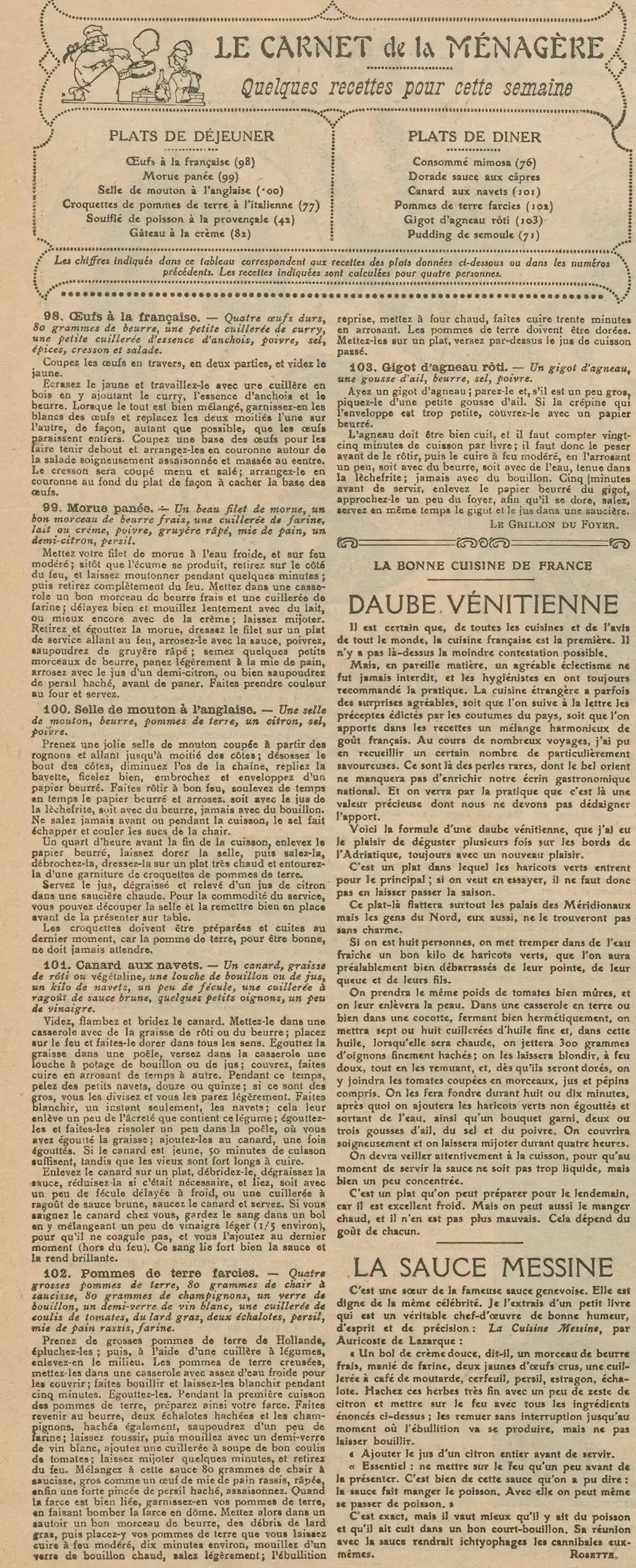
GOOD FRENCH CUISINE VENETIAN DAUBE It is certain that, of all cuisines and in everyone's opinion, French cuisine is first. There is not the slightest possible dispute about this. But, in such matters, a pleasant eclecticism was never prohibited, and hygienists have always recommended the practice. Foreign cuisine sometimes has pleasant surprises, whether we follow to the letter the precepts decreed by the customs of the country, or we bring a harmonious blend of French taste into the recipes. During numerous trips, I was able to collect a number of particularly tasty ones. These are rare pearls, whose beautiful Orient will not fail to enrich our national gastronomic setting. And we will see through practice that this is a precious value whose contribution we must not disdain. Here is the formula for a Venetian stew, which I have had the pleasure of tasting several times on the banks of the Adriatic, always with new pleasure. It is a dish in which green beans are the main ingredient; If you want to try it, you shouldn't let the season pass. This dish will especially flatter the palates of the Southerners, but people from the North, too, will not find it without charm. If there are eight people, we soak a good kilo of green beans in fresh water, having previously removed their tips, tails and strings. We will take the same weight of ripe tomatoes, and we will remove the skin from them. In an earthenware pan or in a casserole dish, closing tightly, put seven or eight spoonfuls of fine oil and, in this oil, when it is hot, throw 300 grams of finely chopped onions; We will let them brown over low heat, while stirring them, and, as soon as they are golden, we will add the tomatoes cut into pieces, juice and seeds included. We will melt them for eight or ten minutes, after which we will add the undrained green beans coming out of the water, as well as a bouquet garni, two or three cloves of garlic, salt and pepper. Cover carefully and let simmer for four hours. You will have to pay careful attention to cooking, so that when serving the sauce is not too liquid, but a little concentrated. This is a dish that can be prepared the next day, as it is excellent cold. But you can also eat it hot, and it doesn't taste any worse. It depends on everyone's taste. MESSINA SAUCE It is a sister of the famous Geneva sauce. She is worthy of the same fame. I extract it from a little book which is a true masterpiece of good humor, wit and precision: La Cuisine Messine, by Auricoste de Lazarque: “A bowl of sweet cream,” he said, “a piece of fresh butter, mixed with flour, two raw egg yolks, a teaspoon of mustard, chervil, parsley, tarragon, shallot. Chop these herbs very fine with a little lemon zest and put on the fire with all the ingredients stated above; stir them continuously until boiling, but do not let them boil. Add the juice of a whole lemon before serving. Essential: only put it on the fire a little before presenting it. It's really about this sauce that we could say: the sauce makes the fish eat. With it you can even do without fish.” That's correct, but it's better that there is fish and that it is cooked in a good court-bouillon. Its combination with the sauce would make the cannibals themselves ichthyophagous. ROSETTE. |
 |