

|
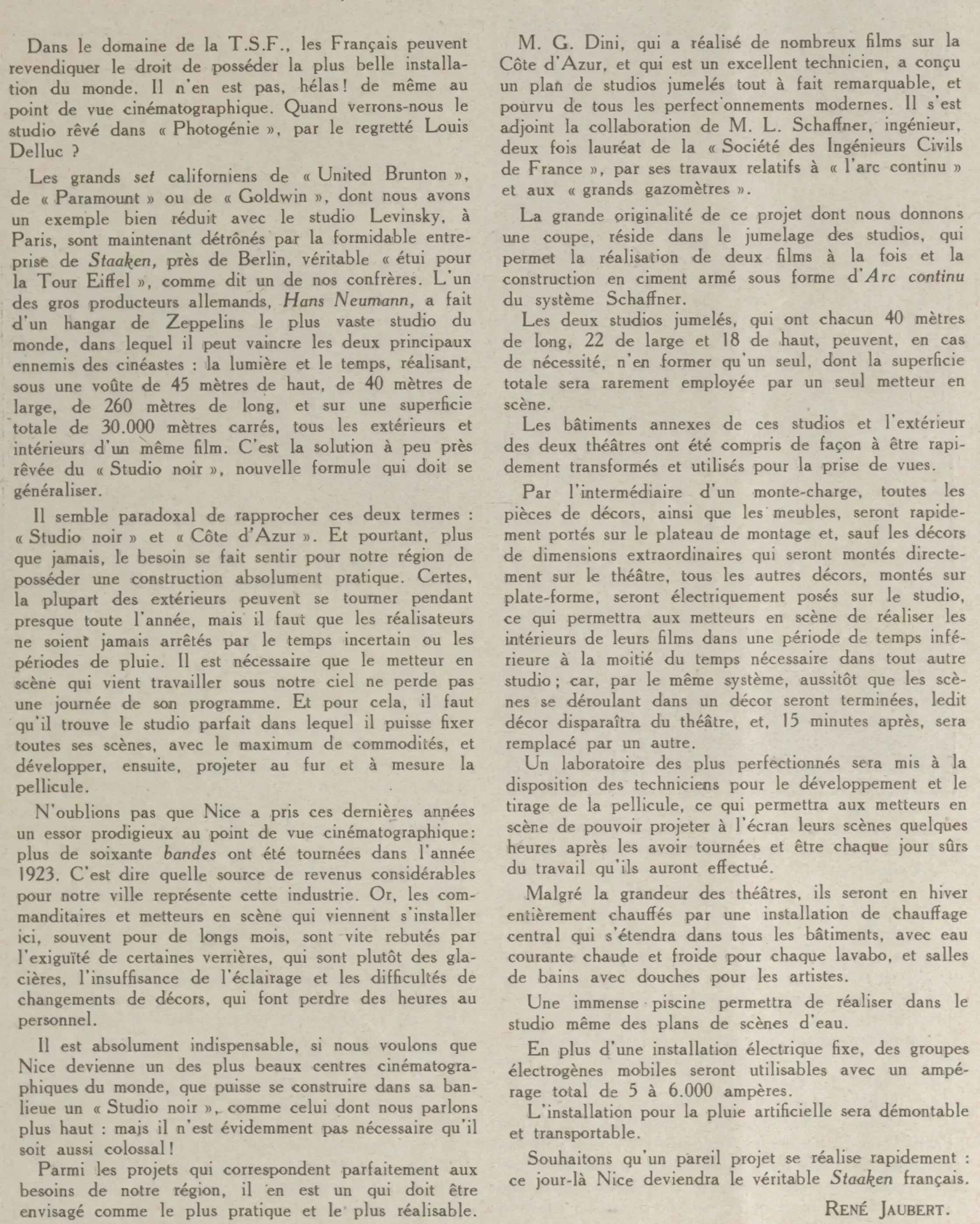
In the field of T.S.F., the French can claim the right to own the most beautiful installation in the world. It is not, alas! the same from a cinematographic point of view. When will we see the studio dreamed of in “Photogénie”, by the late Louis Delluc? The great Californian sets of “United Brunton”, “Paramount” or Goldwin, of which we have a very small example with the Levinsky studio, in Paris, are now dethroned by the formidable company of Staaken, near Berlin, a real “case for the Eiffel Tower”, as one of our colleagues says. One of the big German producers, Hans Neumann, made a Zeppelins hangar into the largest studio in the world, in which he could defeat the two main enemies of filmmakers: light and time, directing, under a vault of 45 meters high, 40 meters wide, 260 meters long, and over a total area of 30,000 square meters, all exteriors and interiors of the same film. This is almost the dream solution of “Studio noir”, a new formula which must become widespread. It seems paradoxical to bring these two terms together: “Studio noir” and “Côte d’Azur”. And yet, more than ever, the need is felt for our region to have an absolutely practical construction. Certainly, most locations can be filmed almost all year round, but directors must never be stopped by uncertain weather or periods of rain. It is necessary that the director who comes to work under our sky does not lose a day of his program. And for this, he must find the perfect studio in which he can record all his scenes, with maximum convenience, and develop, then project the film as he goes along. Let us not forget that Nice has grown prodigiously in recent years from a cinematographic point of view: more than sixty films were filmed in 1923. This shows what a considerable source of income for our city this industry represents. However, the sponsors and directors who come to settle here, often for long months, are quickly put off by the smallness of certain glass roofs, which are more like coolers, the insufficient lighting and the difficulties of changing decorations, which waste staff hours. It is absolutely essential, if we want Nice to become one of the most beautiful cinematographic centers in the world, that a “Black Studio” like the one we are talking about above can be built in its suburbs: but it is obviously not necessary that it's also colossal! Among the projects which perfectly correspond to the needs of our region, there is one which must be considered as the most practical and the most feasible. The great originality of this project, of which we give a section, lies in the twinning of the studios, which allows the production of two films at the same time and the construction in reinforced cement in the form of a continuous Arc of the Schaffner system. The two twin studios, which are each 40 meters long, 22 wide and 18 high, can, if necessary, form only one, the total surface area of which will rarely be used by a single director . The annex buildings of these studios and the exterior of the two theaters were included in such a way that they could be quickly transformed and used for filming. Via a freight elevator, all the scenery pieces, as well as the furniture, will be quickly transported to the assembly platform and, except for the sets of extraordinary dimensions which will be mounted directly on the theater, all the other sets , mounted on a platform, will be electrically placed on the studio, which will allow directors to create the interiors of their films in a period of time less than half the time necessary in any other studio; because, by the same system, as soon as the scenes taking place in a setting are finished, the said setting will disappear from the theater, and, 15 minutes later, will be replaced by another. A highly sophisticated laboratory will be made available to technicians for developing and printing the film, which will allow directors to be able to project their scenes on the screen a few hours after having shot them and to be sure every day of the work they will have carried out. Despite the grandeur of the theaters, in winter they will be fully heated by a central heating installation which will extend throughout the buildings, with hot and cold running water for each sink, and bathrooms with showers for the artists. A huge swimming pool will allow water scenes to be created in the studio itself. In addition to a fixed electrical installation, mobile generators can be used with a total amperage of 5 to 6,000 amps. The artificial rain installation will be dismantled and transportable. Let us hope that such a project comes to fruition quickly: that day Nice will become the true French Staaken. RENÉ JAUBERT. |
 |