

| La Presse 04 avril 1924 |
|
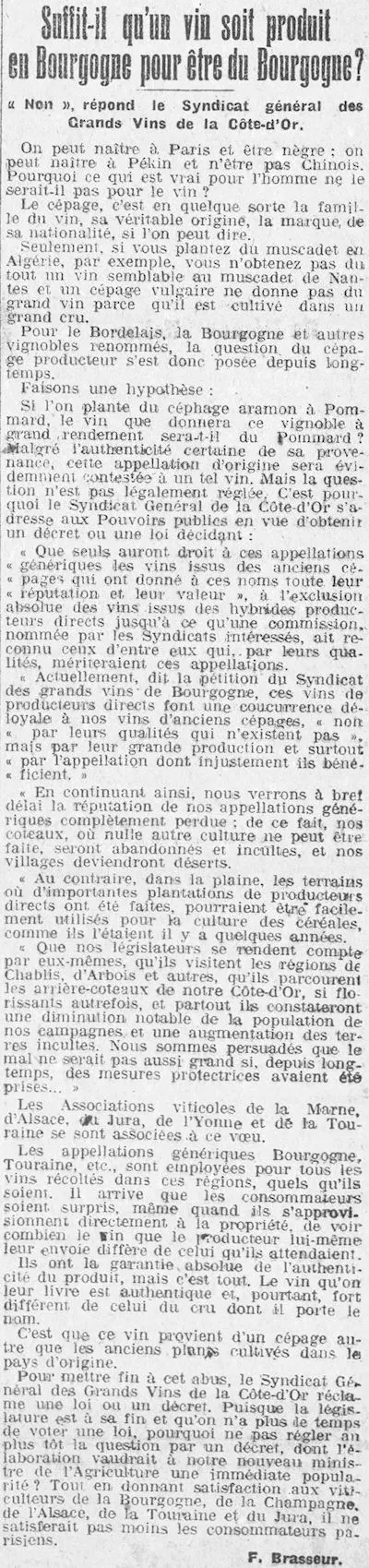
Is it enough for a wine to be produced in Burgundy to be Burgundy? “No,” replies the Syndicat général des Grands Vins de la Côte-d’Or. You can be born in Paris and be Negro; you can be born in Beijing and not be Chinese. Why should what is true for man not be true for wine? The grape variety is, in a way, the family of the wine, its true origin, the brand, of its nationality, so to speak. However, if you plant Muscadet in Algeria, for example, you do not obtain a wine at all similar to Muscadet de Nantes and a common grape variety does not produce great wine because it is grown in a grand cru. For Bordeaux, Burgundy and other renowned vineyards, the question of the producing grape variety has therefore arisen for a long time. Let's make a hypothesis: If we plant cephage aramon in Pommard, will the wine produced by this high-yielding vineyard be Pommard? Despite the certain authenticity of its provenance, this designation of origin will obviously be contested for such a wine. But the question is not legally settled. This is why the Syndicat Général de la Côte-d'Or is addressing the public authorities with a view to obtaining a decree or law deciding: “That only wines made from ancient grape varieties which have given these names all their reputation and value will be entitled to these generic designations”, with the absolute exclusion of wines made from direct producing hybrids until a commission, nominated by the Unions concerned, recognized those of them who, by their qualities, deserve these designations. “Currently,” says the petition from the Syndicat des grands vins de Bourgogne, “these wines from direct producers provide unfair competition to our wines from old grape varieties, “not by their qualities which do not exist”, but by their large production and above all “by the name from which they unjustly benefit,” “By continuing in this way, we will soon see the reputation of our generic names completely lost; as a result, our hillsides, where no other cultivation can be done, will be abandoned and uncultivated, and our villages will become deserted. “On the contrary, in the plain, the lands where significant plantations of direct producers have been made, could be easily used for the cultivation of cereals, as they were a few years ago. "Let our legislators realize for themselves, that they visit the regions of Chablis, Arbois and others, that they travel the back hillsides of our Côte-d'Or, so flourishing in the past, and everywhere they will notice a notable decrease in the population of our countryside and an increase in uncultivated land. We are convinced that the harm would not be so great if, a long time ago, protective measures had been taken... The wine associations of Marne, Alsace, Jura, Yonne and Touraine have joined together. associated with this wish. The generic appellations Burgundy, Touraine, etc., are used for all wines harvested in these regions, whatever they may be. Consumers are sometimes surprised, even when they buy directly from the property, to see how much the wine that the producer himself sends them differs from the one they expected. They have the absolute guarantee of the authenticity of the product, but that's all. The wine delivered to them is authentic and, yet, very different from that of the vintage whose name it bears. This is because this wine comes from a grape variety other than the old ones grown in the country of origin. To put an end to this abuse, the Syndicat Général des Grands Vins de la Côte-d'Or is calling for a law or decree. Since the legislature is coming to an end and we no longer have time to pass a law, why not resolve the issue a year earlier with a decree, the elaboration of which would earn our new Minister of Agriculture an immediate popularity? While satisfying the winegrowers of Burgundy, Champagne, Alsace, Touraine and Jura, it would no less satisfy Parisian consumers. F. Brewer. |
 |