

| L'Oeuvre 24 avril 1924 |
 |
|
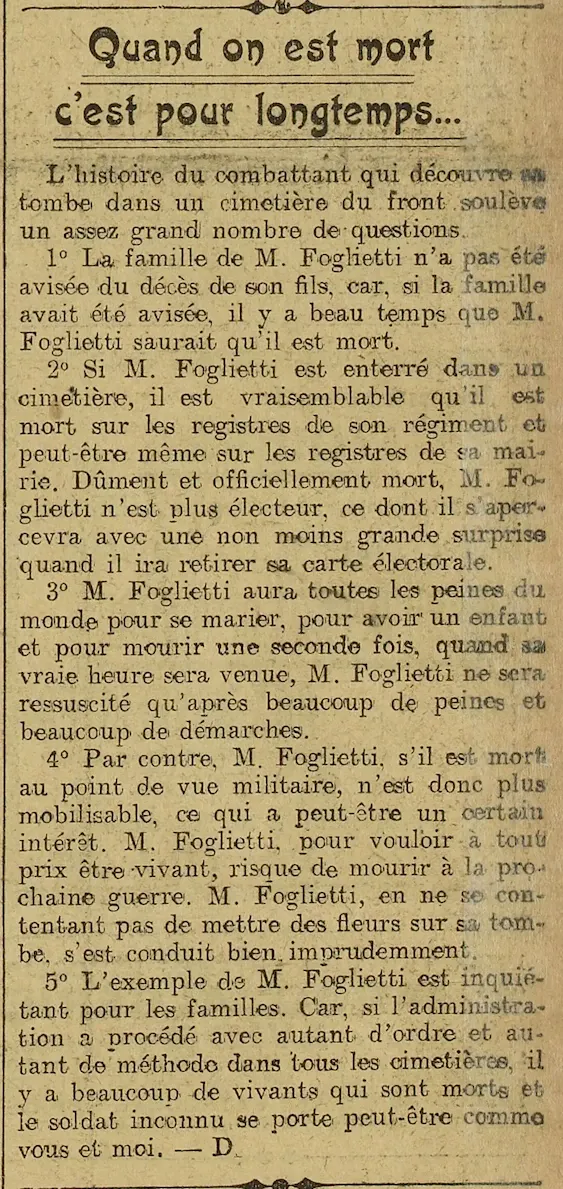
When you're dead it's for a long time... The story of the fighter who discovers his grave in a front cemetery raises quite a number of questions. 1° Mr. Foglietti's family was not informed of the death of his son, because, if the family had been informed, Mr. Foglietti would have known that he was dead a long time ago. 2° If Mr. Foglietti is buried in a cemetery, it is likely that he died in the registers of his regiment and perhaps even in the registers of his town hall. Duly and officially dead, Mr. Foglietti is no longer a voter, which he will realize with no less surprise when he goes to collect his electoral card. 3° Mr. Foglietti will have all the trouble in the world to get married, to have a child and to die a second time, when his true hour has come, Mr. Foglietti will only be resurrected after a lot of trouble and many steps. 4° On the other hand, Mr. Foglietti, if he is dead from a military point of view, is therefore no longer available for mobilization, which perhaps has a certain interest. Mr. Foglietti, for wanting to be alive at all costs, risks dying in the next war. Mr. Foglietti, by not being content with putting flowers on his grave, behaved well, imprudently. 5° The example of Mr. Foglietti is worrying for families. Because, if the administration has proceeded with such order and method in all the cemeteries, there are many living people who have died and the unknown soldier is perhaps like you and me, D. |
| retour-back 24 avril 1924 |