

| Le Provençal de Paris 27 avril 1924 |
 |
|
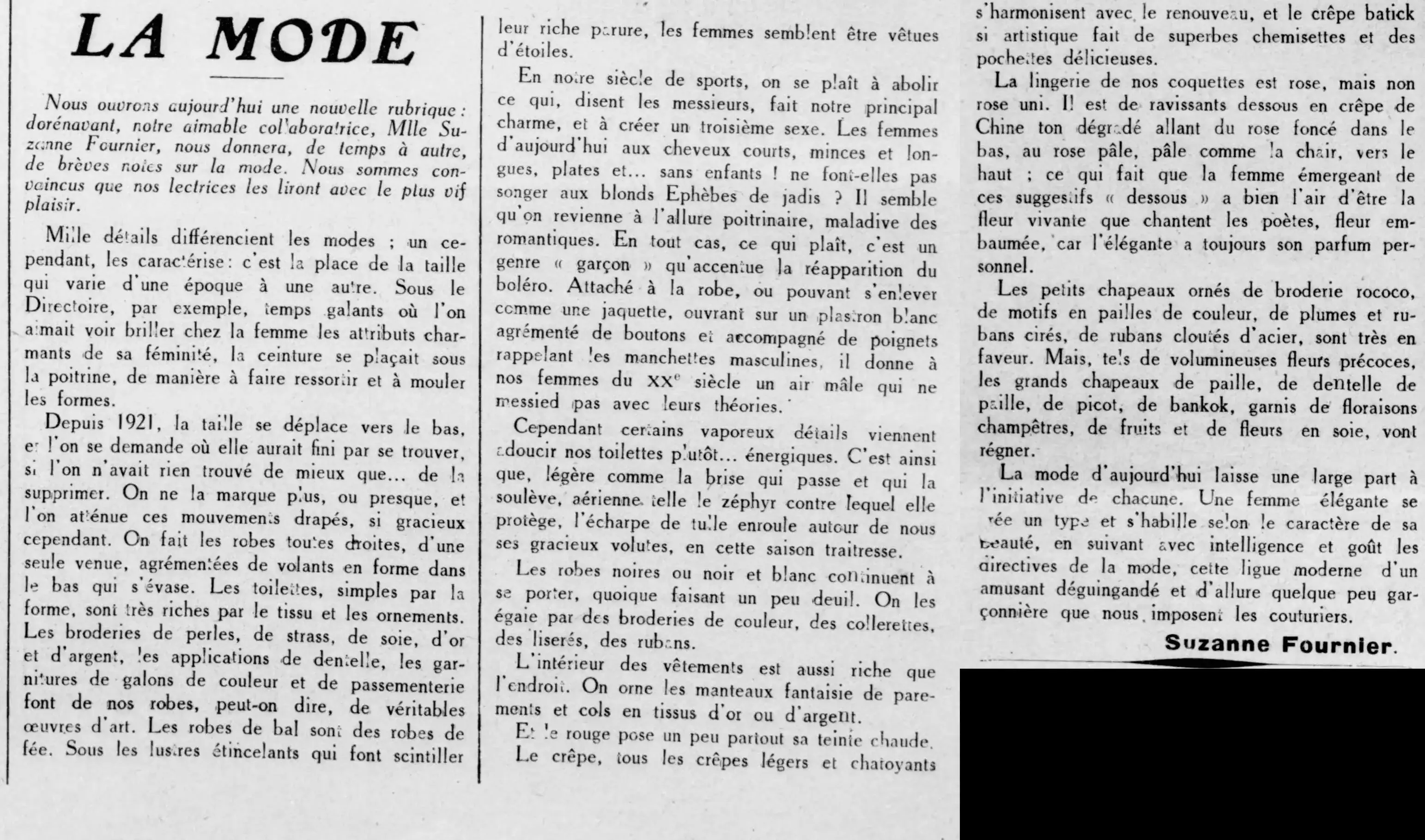
THE FASHION Today we are opening a new section: from now on, our kind collaborator, Miss Suzanne Fournier, will give us, from time to time, brief notes on fashion. We are convinced that our readers will read them with the greatest pleasure. A thousand details differentiate the modes; one, however, characterizes them: it is the place of the size which varies from one era to another. Under the Directory, for example, a gallant time when people liked to see the charming attributes of their femininity shine in women, the belt was placed under the chest, so as to highlight and mold the forms. Since 1921, the size has been moving downwards, and we wonder where it would have ended up, if nothing better had been found than... to eliminate it. We no longer mark it, or almost, and we attenuate these draped movements, although so graceful. We make the dresses straight, in a single outfit, decorated with shaped ruffles at the bottom which flares out. The toilets, simple in form, are very rich in fabric and ornaments. The embroidery of pearls, rhinestones, silk, gold and silver, the lace applications, the trimmings of colored braid and trimmings make our dresses, one could say, true works of art. Ball gowns are fairy dresses. Under the sparkling chandeliers which make their rich finery sparkle, the women seem to be dressed in stars. In our century of sports, we like to abolish what, gentlemen say, is our main charm, and to create a third sex. Today's women with short hair, thin and long, flat and... without children! don't they remind us of the blond Ephebes of yesteryear? It seems that we are returning to the chesty, sickly look of the romantics. In any case, what appeals is a boyish style that is accentuated by the reappearance of the bolero. Attached to the dress, or able to be removed like a jacket, opening onto a white bib decorated with buttons and accompanied by cuffs reminiscent of men's cuffs, it gives our women of the 20th century a masculine air that does not mess with their theories. However, certain vaporous details soften our rather... energetic toilets. This is how, light as the passing breeze which lifts it, airy, like the zephyr against which it protects, the tulle scarf wraps its graceful volutes around us, in this treacherous season. Black or black and white dresses continue to be worn, although a little mournful. We brighten them up with colored embroidery, collars, edging, ribbons. The inside of the clothes is as rich as the place. Fancy coats are adorned with gold or silver fabric facings and collars. And red adds its warm hue almost everywhere. Crepe, all light and shimmering crepes, harmonize with the revival, and the artistic batick crepe makes superb shirts and delicious pocket squares. Our coquettes' lingerie is pink, but not plain pink. It has lovely undergarments in crepe de chine, a gradient tone going from dark pink at the bottom to pale pink, pale as flesh, towards the top; which makes the woman emerging from these suggestive “underneaths” seem to be the living flower that the poets sing about, an embalmed flower, because the elegant always has her personal perfume. Small hats decorated with rococo embroidery, patterns in colored straw, waxed feathers and ribbons, and steel-studded ribbons are very popular. But, like voluminous early flowers, large straw hats, straw lace, picot, bankok, garnished with country blooms, fruits and silk flowers, will reign. Today's fashion leaves a lot of room for individual initiative. An elegant woman creates a type for herself and dresses according to the character of her beauty, following with intelligence and taste the directives of fashion, this modern league of amusing raggedy and somewhat boyish look that we impose the tailors. Suzanne Fournier. |
| retour-back 27avril 1924 |