


| Le Petit Écho de la mode 27 avril 1924 |
 |
|
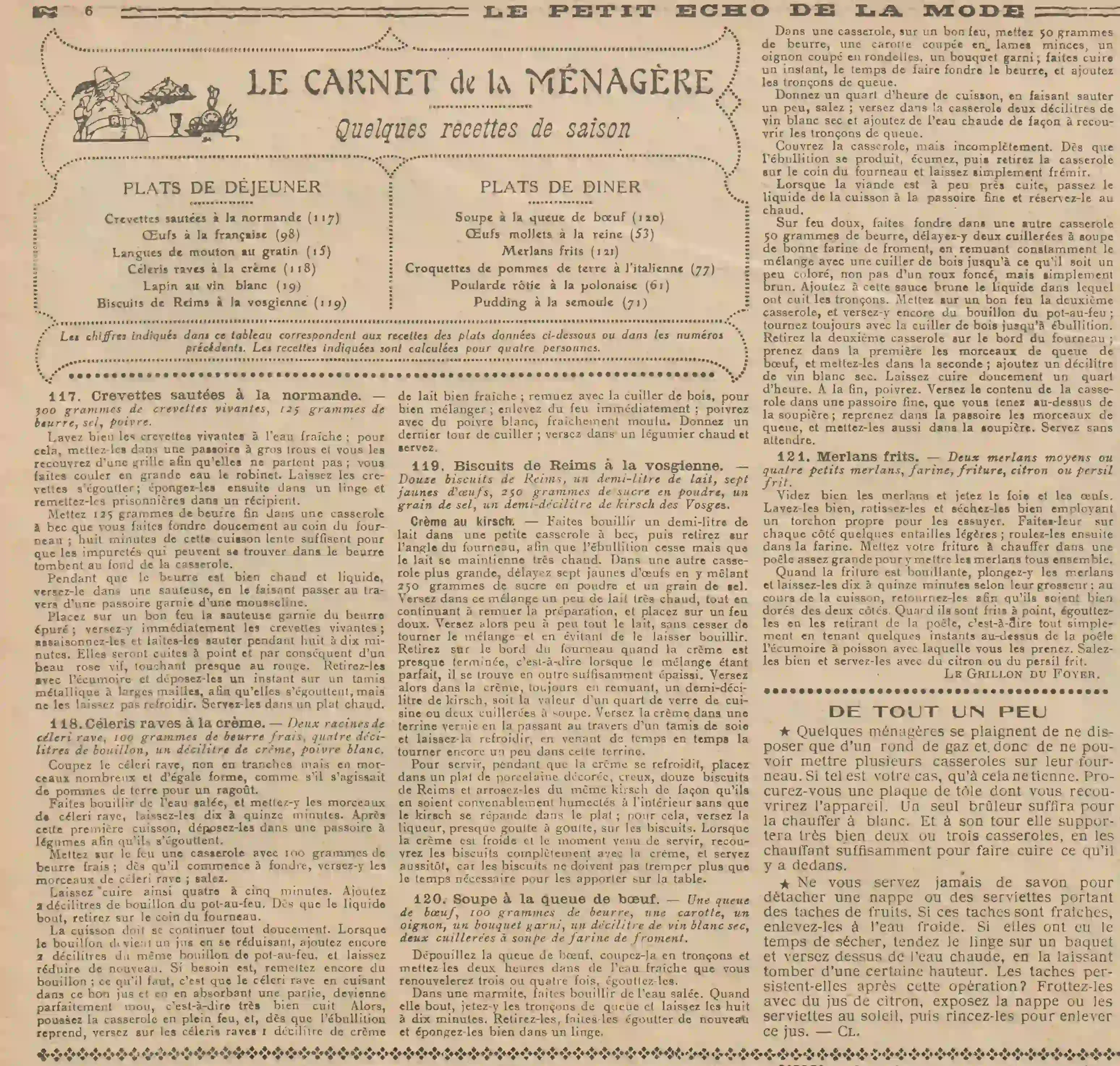
LUNCH DISHES Normandy-style sautéed shrimp (117) DINNER DISHES Oxtail soup (120) 117. Normandy-style sautéed shrimp. 300 grams of live shrimp, 125 grams of butter, salt, pepper. Wash live shrimp well in cool water; to do this, put them in a sieve with large holes and cover them with a grid so that they do not leave; you run a lot of water from the tap. Let the shrimp drain; then dry them in a cloth and put them back in a container. Put 125 grams of fine butter in a saucepan which you melt gently in the corner of the stove; eight minutes of this slow cooking is enough for any impurities that may be in the butter to fall to the bottom of the pan. While the butter is hot and liquid, pour it into a frying pan, passing it through a strainer lined with muslin. Place the frying pan filled with the purified butter over a good heat; immediately pour in the live shrimp; season them and sauté them for eight to ten minutes. They will be cooked to perfection and therefore a beautiful bright pink, almost red. Remove them with the skimmer and place them for a moment on a large mesh metal sieve, so that they drain, but do not let them cool. Serve them in a hot dish. 118. Celery root with cream. Two celeriac roots, 100 grams of fresh butter, four deciliters of broth, one deciliter of cream, white pepper. Cut the celeriac, not into slices but into numerous pieces of equal shape, as if they were potatoes for a stew. Boil salted water, and put the celeriac pieces in it, leave them for ten to fifteen minutes. After this first cooking, place them in a vegetable colander so that they drain. Put a saucepan with 100 grams of fresh butter on the fire; as soon as it begins to melt, pour in the pieces of celery root; salt. Leave to cook for four to five minutes. Add 2 deciliters of broth from the stew. As soon as the liquid boils, remove to the corner of the stove. Cooking should continue slowly. When the broth becomes a juice as it reduces, add another 2 deciliters of the same stew broth, and let it reduce again. If necessary, add more broth; what is necessary is that the celery root, by cooking in this good juice and absorbing a portion of it, becomes perfectly soft, that is to say very well cooked So, put the pan on high heat, and as soon as it starts boiling again, pour 1 deciliter of very cool milk cream over the celeriac; stir with the wooden spoon to mix well; remove from heat immediately; pepper with freshly ground white pepper. Give one last turn of the spoon; pour into a hot vegetable dish and serve. 119. Vosges-style Reims biscuits. Twelve Reims biscuits, half a liter of milk, seven egg yolks, 250 grams of powdered sugar, a grain of salt, half a deciliter of Vosges kirsch. Kirsch cream. Boil half a liter of milk in a small saucepan, then remove to the corner of the stove, so that the boiling stops but the milk remains very hot. In another larger saucepan, dilute seven egg yolks by mixing 250 grams of powdered sugar and a grain of salt. Pour a little very hot milk into this mixture, while continuing to stir the mixture, and place over a low heat. Then gradually pour in all the milk, constantly stirring the mixture and avoiding letting it boil. Remove to the edge of the stove when the cream is almost finished, that is to say when the mixture is perfect, it is also sufficiently thickened. Then pour into the cream, still stirring, half a deciliter of kirsch, or the value of a quarter of a cooking glass or two tablespoons. Pour the cream into a glazed terrine by passing it through a silk sieve and let it cool, turning it a little more from time to time in this terrine. To serve, while the cream is cooling, place twelve Reims biscuits in a hollow decorated porcelain dish and sprinkle them with the same kirsch so that they are suitably moistened inside without the kirsch spilling out. in the dish; To do this, pour the liquor, almost drop by drop, over the biscuits. When the cream is cold and it is time to serve, cover the biscuits completely with the cream, and serve immediately, as the biscuits should not soak more than the time necessary to bring them to the table. 120. Oxtail soup. An oxtail, 100 grams of butter, a carrot, an onion, a bouquet garni, a deciliter of dry white wine, two tablespoons of wheat flour. Skin the oxtail, cut it into sections and put them in fresh water for two hours, changing them three or four times, then drain them. In a pot, boil salted water. When it boils, throw in the tail sections and leave for eight to ten minutes. Remove them, drain them again and dry them well with a cloth. In a saucepan, over a good heat, put 50 grams of butter, a carrot cut into thin slices, an onion cut into slices, a bouquet garni, cook for a moment, long enough to melt the butter, and add the pieces of tail. Cook for a quarter of an hour, stir-fry a little, add salt; pour two deciliters of dry white wine into the saucepan and add hot water to cover the tail sections. Cover the pan, but incompletely. As soon as it boils, skim, then remove the pan to the corner of the stove and simply let it simmer. When the meat is almost cooked, pass the cooking liquid through a fine strainer and keep it warm. Over low heat, melt 50 grams of butter in another saucepan, add two tablespoons of good wheat flour, stirring the mixture constantly with a wooden spoon until it is a little coloured, not a dark red, but simply brown. Add to this brown sauce the liquid in which the sections were cooked. Put the second saucepan on a good fire, and pour in some more broth from the stew; always stir with the wooden spoon until it boils. Remove the second pan to the edge of the stove; take the pieces of oxtail from the first, and put them in the second; add a deciliter of dry white wine. Leave to cook gently for a quarter of an hour. At the end, add pepper. Pour the contents of the saucepan into a fine strainer, which you hold over the soup tureen; take the pieces of tail back into the colander, and also put them in the soup bowl. Serve immediately. Two medium whiting or four small whiting, flour, frying, lemon or parsley Heat your frying in a pan large enough to put the whiting all together. When the frying is boiling, immerse the whiting in it and leave them for ten to fifteen minutes depending on their size; during cooking, turn them over so that they are nicely browned on both sides. When they are fried to perfection, drain them by removing them from the pan, that is to say simply by holding the fish skimmer with which you take them for a few moments above the pan. Salt them well and serve them with lemon or fried parsley. THE HOUSEHOLD CRICKET. |
| retour-back 27avril 1924 |