

| Le Figaro 27 avril 1924 |
 |
|
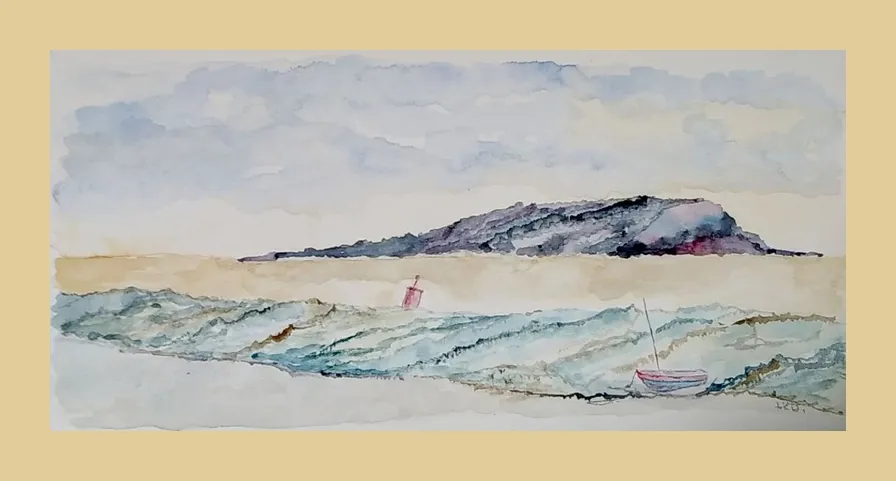
An adventure beyond the grave of René The rumor spread, we don't know where it came from, that the tomb of Chateaubriand on the Grand-Bé, in the harbor of Saint-Malo, was in danger of ruin, that crevasses were opening in its rocky base and that the The tip of the island was quickly crumbling, worn away by the waves. All of Brittany and the press around the world were moved by this ominous prophecy that the current frequency of seismic upheavals made more likely... The Grand-Bé is a gigantic sphinx crouching between the desert of sands and the desert of waters. Its tawny coat is stained with gray patches by the stones that are exposed. And he wears it on his head. camuse which looks out to sea the openwork crown of the funerary gate, where the azure flowers and the cross dominates. Its broad spine supports the fallen walls of one of these dry stone forts, similar to all those that the conquering races of the Orient, Crusaders, Venetians and Ottomans, have abandoned on the fallen islands and the bare promontories of Asia. We would not be surprised to see, at the corner of one of its bastions, the silhouette of a janissary or a palikare silhouetted against the sky. But these solitary places are haunted only by love. In the mild summer nights, a few intertwined couples sleep there in the tall dry grass. During the day, two or three skinny goats graze there and distant sisters from Nausicaa come to hang out their laundry on the edge of the foamy wave. A hypogeum door, filled with shadow, opens at ground level onto a rickety staircase, which seems to descend to hell, but which only leads, in three jumps, to a stony chaos where vipers nest. . At the beginning of spring, the swallow scratches the jagged cliff with this sharp flight, and the seagull interweaves its vain garland between the two blue skies where the milky ways of the currents and the transparent trails of the clouds whiten. Offshore shine the golden beaches of islands where the Hesperides undoubtedly survive. Closer, the Petit-Bé is topped with the granite miter of a fortified castle similar to a Mycenaean temple. Behind us, beneath the low, bogged stern of our ship heavy with glory, Saint-Malo advances and breaks the tide, an admiral frigate, topped by a squat bell tower, like a mast broken by the storm. Chateaubriand wanted that from the window of his birth room we could see his tomb, and that between these two extreme points of his course there should be only a few acres of sand where each day the sea erases all vestiges, an eloquent image which invites us to meditate on the little space where the most magnificent destiny is inscribed... A few worn steps, cut into the rock, take us to the top of this immense altar. We believe we are ascending towards the sky, because we only see it... Here is the peeled glacis of the ruinous fort, and, through a large crack, the tomb emerges at our feet. René rests there, under a nameless stone, gray and rough like a monk's cloak, under a heavy cross, in all the pride of his humility. However far it recedes, the sea, guardian of his last asylum, never completely moves away, so that he always hears its sobbing or its monotonous song. And quickly returning, she throws towards him the foam of her lilies or the leafless carnations of her bitter spray. The chorus of the Oceanides remains faithful to it, and moans its eternal theme, as long ago around the rock where Prometheus was dying. As it appears at low tide, the granite base on which Chateaubriand's tomb rests remains very solid. A vast massif with almost flat planes protects it towards the sea, and powerful buttresses support it. No, the danger is not imminent... Le Grand-Bé will resist the waves as valiantly as Mont Saint-Michel resists the peril of the sea. Before they have conquered it, it will take several centuries. Unless... Unless men of art get involved. For God ! Let them be careful! Let not an overzealous cult disturb the solitary Enchanter in his haughty retreat. Let us spare him the architectural conferences, the commission investigations, the solicitude of municipal councils, the hideousness of cement dykes and rubble retaining walls. And above all ah! Above all ! the horror of exhumation. May he rest in peace, under the sign of the cross, as he wanted. And after all, what a great adventure it would be if the navigator of the abyss received, on a stormy night, the burial of sailors! If he could have foreseen that one day this sea, which he called his eternal mistress, would break the stone of his tomb to carry him away in its fresh arms, would his old heart not have thrilled with joy and joy? pride? Thus the mermaid of the waves would complete this destiny which was first enchanted by the sylph of the woods. Ah! if you ever have to come, rise up, desired storms, which will carry René into the infinity of the Oceans! Jean des Cognets. |
| retour-back 27avril 1924 |