

| L'Œuvre 10 avril 1924 |
|
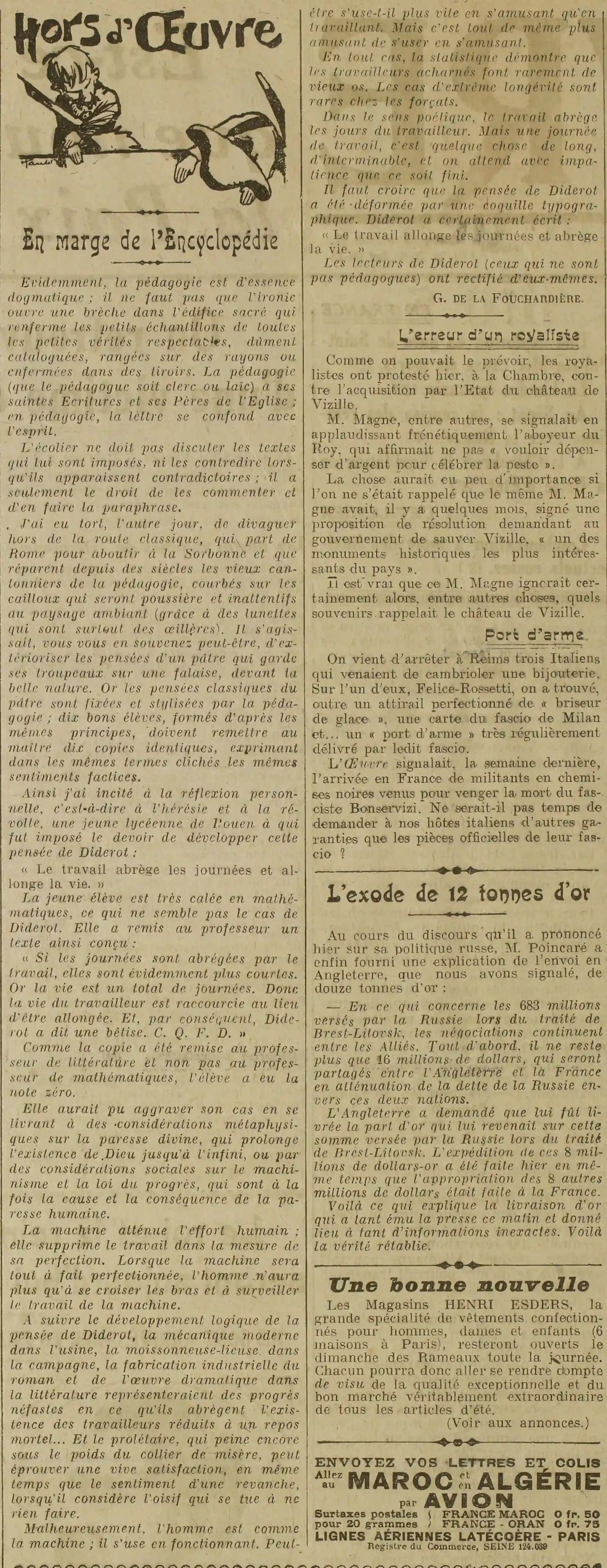
Appetizers On the sidelines of the Encyclopedia Obviously, pedagogy is dogmatic in essence; irony must not open a breach in the sacred edifice which contains the small samples of all the little respectable truths, duly cataloged, arranged on shelves or locked in drawers. Pedagogy (whether the teacher is cleric or layman) has its Holy Scriptures and its Fathers of the Church; in pedagogy, the letter merges with the spirit. The schoolchild must not discuss the texts imposed on him, nor contradict them when they appear contradictory; he only has the right to comment on them and paraphrase them. I was wrong, the other day, to wander off the classic route, which starts from Rome and ends at the Sorbonne and which has been repaired for centuries by the old roadmen of pedagogy, bent over the stones which will become dust and inattentive to the ambient landscape (thanks to glasses which are mainly blinders). It was, you may remember, about externalizing the thoughts of a shepherd who tends his flocks on a cliff, in front of beautiful nature. But the classic thoughts of the shepherd are fixed and stylized by pedagogy; ten good students, trained according to the same principles, must give the master ten identical copies, expressing in the same clichéd terms the same artificial feelings. Thus I incited to personal reflection, that is to say to heresy and revolt, a young high school student from Rouen on whom the duty was imposed to develop this thought of Diderot: “Work shortens the days and extends life. The young student is very knowledgeable in mathematics, which does not seem to be the case for Diderot. She gave the professor a text as follows: “If the days are shortened by work, they are obviously shorter. But life is a total of days. So the worker's life is shortened instead of lengthened. And, therefore, Diderot said something stupid. C.Q.F.D.” As the paper was given to the literature teacher and not the mathematics teacher, the student received a zero mark. She could have aggravated her case by indulging in metaphysical considerations on divine laziness, which extends the existence of God to infinity, or by social considerations on machinery and the law of progress, which are at the same time both the cause and the consequence of human laziness. The machine reduces human effort; it eliminates work to the extent of its perfection. When the machine is completely perfected, man will only have to sit back and watch the work of the machine. Unfortunately, man is like machine; it wears out while operating. Perhaps it wears out more quickly when playing than when working. But it's still more fun to wear out while having fun. In any case, statistics show that hard workers rarely die. Cases of extreme longevity are rare among convicts. In the poetic sense, work shortens the days of the worker. But a day of work is long, endless, and we wait impatiently for it to be over. It must be believed that Diderot's thoughts have been distorted by a typographical typo. Diderot certainly wrote: “Work lengthens the days and shortens life. » Diderot's readers (those who are not teachers) have corrected this on their own. G. DE LA FOUCHARDIERE. A royalist's mistake As could be expected, the royalists protested yesterday in the Chamber against the State's acquisition of the Château de Vizille. It is true that this Mr. Magne certainly did not know then, among other things, what memories the Château de Vizille brought to mind. Carrying a weapon Three Italians have just been arrested in Reims who had just robbed a jewelry store. On one of them, Felice-Rossetti, we found, in addition to sophisticated "ice breaker" paraphernalia, a map of the Milan fascio and... a "weapon port" very regularly issued by said fascio . L'Œuvre reported, last week, the arrival in France of activists in black shirts who had come to avenge the death of the fascist Bonservizi. Wouldn't it be time to ask our Italian hosts for guarantees other than the official documents of their fascio? The exodus of 12 tons of gold During the speech he gave yesterday on his Russian policy, Mr. Poincaré finally provided an explanation for the sending to England, which we have reported, of twelve tons of gold: Concerning the 683 million paid by Russia during the Treaty of Brest-Litovsk, negotiations continue between the Allies. First of all, there is only $16 million left, which will be shared between England and France to alleviate Russia's debt to these two nations. England demanded that the share of gold due to it from this sum paid by Russia during the Treaty of Brest-Litovsk be delivered to it. The shipment of these 8 million gold dollars was made yesterday at the same time as the appropriation of the other 8 million dollars was made to France. This explains the delivery of gold which so excited the press this morning and gave rise to so much inaccurate information. Here is the truth restored. |
 |