

| Paris-midi 10 avril 1924 |
|
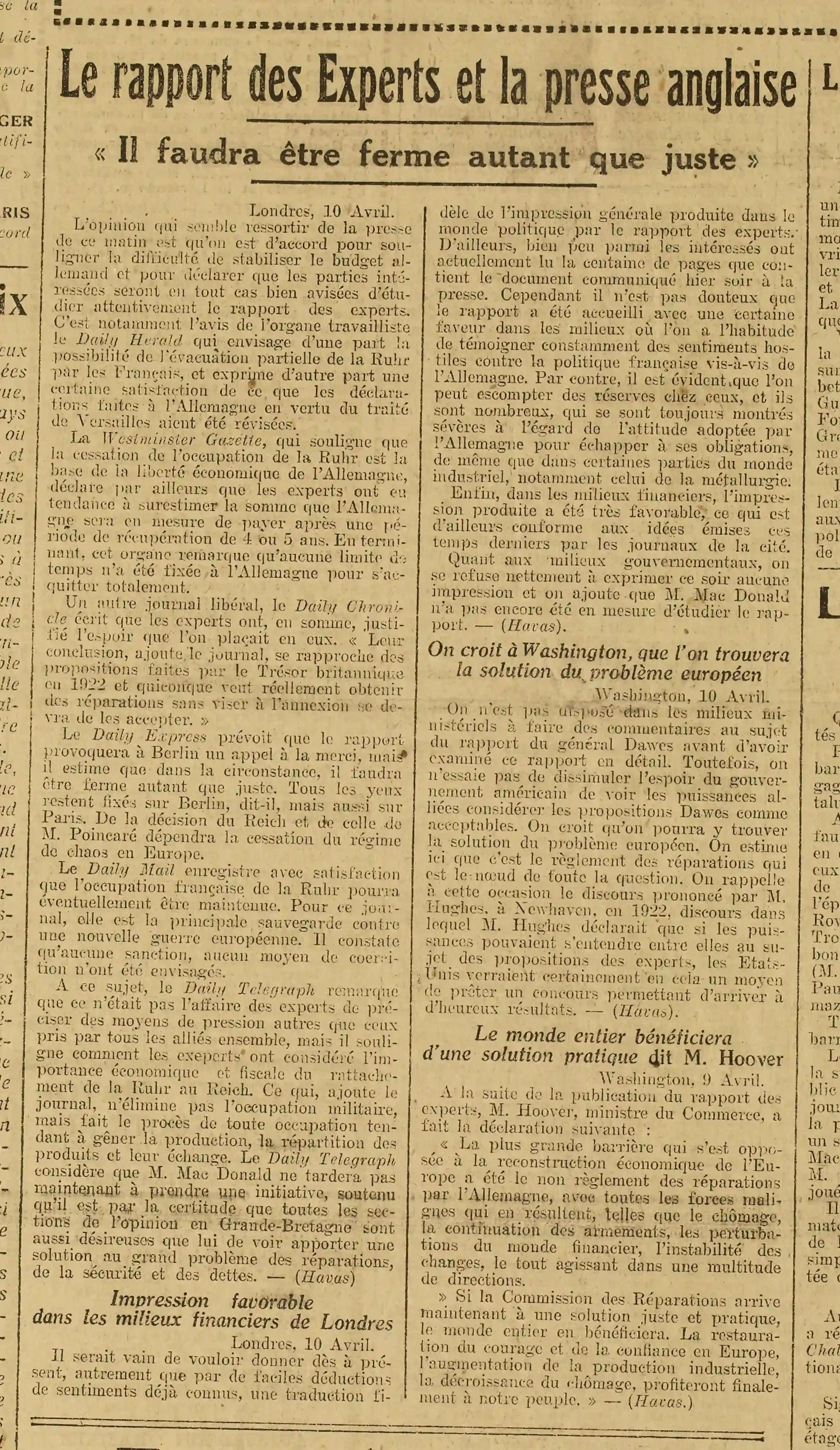
London, April 10. The opinion which seems to emerge from this morning's press is that we agree to emphasize the difficulty of stabilizing the German budget and to declare that interested parties will in any case be well advised to carefully study the experts' report . This is notably the opinion of the Labor organ the Daily Herald which considers on the one hand the possibility of the partial evacuation of the Ruhr by the French, and on the other hand expresses a certain satisfaction with what the declarations made to Germany under the Treaty of Versailles have been revised. The Westminster Gazette, which emphasizes that ending the occupation of the Ruhr is the basis of Germany's economic freedom, also states that experts have tended to overestimate the amount Germany will be able to pay after a recovery period of 4 or 5 years. In conclusion, this body notes that no time limit has been set for Germany to fully comply. Another liberal newspaper, the Daily Chronicle, writes that the experts have, in short, justified the hope placed in them. “Their conclusion,” the newspaper adds, “is close to the proposals made by the British Treasury in 1922 and anyone who really wants to obtain reparations without aiming at annexation will have to accept them. » The Daily Express predicts that the report will provoke a call for mercy in Berlin, but it believes that in the circumstances, it will be necessary to be firm as well as fair. All eyes remain fixed on Berlin, he says, but also on Paris. The cessation of the regime of chaos in Europe will depend on the decision of the Reich and that of Mr. Poincaré. The Daily Mail notes with satisfaction that the French occupation of the Ruhr could possibly be maintained. For this newspaper, it is the main safeguard against a new European war. He notes that no sanctions, no means of coercion have been considered. On this subject, the Daily Telegraph notes that it was not the business of the experts to specify means of pressure other than those taken by all the allies together, but it underlines how the experts considered the economic and fiscal importance of the annexation of the Ruhr to the Reich. Which, the newspaper adds, does not eliminate military occupation, but puts on trial any occupation tending to hinder production, the distribution of products and their exchange. The Daily Telegraph considers that Mr MacDonald will not delay taking an initiative now, supported by the certainty that all sections of opinion in Great Britain are as keen as he is to see a solution to the great problem of repairs, security and debts. (Havas) Favorable impression in London financial circles London, April 10. It would be vain to want to give now, other than by easy deductions from already known sentiments, a faithful translation of the general impression produced in the political world by the experts' report. Moreover, very few of those interested have currently read the hundred pages contained in the document communicated to the press last night. However, there is no doubt that the report was received with a certain favor in circles where there is a habit of constantly displaying hostile feelings against French policy towards Germany. On the other hand, it is obvious that we can expect reservations among those, and there are many of them, who have always been severe with regard to the attitude adopted by Germany to evade its obligations, as well as in certain parts of the industrial world, notably that of metallurgy. Finally, in financial circles, the impression produced was very favorable, which is also in line with the ideas expressed recently by the city's newspapers. As for government circles, they clearly refuse to express any impression this evening and add that Mr. Mac Donald has not yet been able to study the report. (Havas). We believe in Washington that we will find the solution to the European problem Washington, April 10. There is no willingness in ministerial circles to comment on General Dawes' report until it has been examined in detail. However, there is no attempt to disguise the American government's hope that the Allied Powers will consider the Dawes proposals acceptable. We believe that we can find the solution to the European problem there. It is believed here that it is the settlement of reparations which is the crux of the whole question. We recall on this occasion the speech given by Mr. Hughes at Newhaven in 1922, in which Mr. Hughes declared that if the powers could agree among themselves on the subject of the experts' proposals, the United States would certainly see in This is a way of helping to achieve happy results. (Havas). The whole world will benefit from a practical solution says Mr. Hoover Washington, April 9. Following the publication of the experts' report, Mr. Hoover, Minister of Commerce, made the following statement: The greatest barrier to the economic reconstruction of Europe has been the failure to settle reparations by Germany, with all the malignant forces which result from it, such as unemployment, the continuation of armaments, the disturbances of the financial world, the instability of exchanges, all acting in a multitude of directions. If the Reparations Commission comes to a fair and practical solution now, the whole world will benefit. The restoration of courage and confidence in Europe, the increase in industrial production, the decrease in unemployment, will ultimately benefit our people. » (Havas.) |
 |