

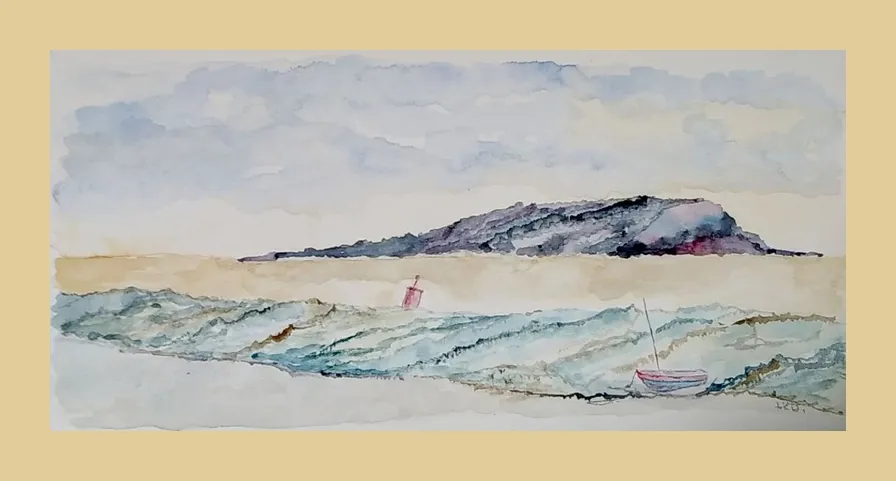
| Ouest-Éclair 27 avril 1924 |
 |
|
THE RIGHT OF PASSAGE ALONG THE COAST Are we finally going to give municipalities, tourist information centers and taxpayers what they are demanding? Our little investigation into the right of passage along the coast continues to excite public opinion, judging by the number of letters we receive each day on this subject. Here is what a tourist, reader of Ouest-Eclair, wrote to us: Mr Editor-in-Chief, If we are not careful, the seaside in France, which is one of our main tourist assets, will, in a few years, be the property of a privileged few, of a very small number of privileged people. , compared to the mass of those who should have the right to benefit from it. Only the regional press is capable of creating the movement of opinion necessary for immediate measures, I insist, energetic and immediate measures, to be taken to ensure the conservation of what is not already monopolized. The initiative unions of the coastal countries, supported if necessary by the initiative unions of the interior (who will no doubt ask for no better), must act on their side and with all their strength, by all lawful means in their power. It is time, high time, very high time. I am convinced that all the major tourism bodies will lend them their support. It is certainly a difficult undertaking! We should act quickly and too many high-ranking personalities, both in the public authorities and in the mainstream press, have a direct interest in... don't insist!!... Newspapers whose speech remains independent (like yours) should consider it a duty to sound a cry of alarm loud enough for it to be heard by those who can still, perhaps, want it with all their might. , passing over all the considerations of particular interests, given the importance of the national interest which is at stake, not going back on what is done (this does not seem possible to me in the current state and according to the principles of the legislation), but at least safeguard for the future what remains accessible to tourists or simple passers-by, on the seaside. The point of law which is the subject of the letter we have just read has already, as is well believed, provided material for several lawsuits. Our readers from the Saint-Malo region certainly remember the Brébion affair which arose regarding the rocks sculpted at Rothéneuf by the famous hermit, now deceased. Mr. Brébion, who became the owner of these rocks, exploited them commercially. He had them blocked up to the limit of the “Plein de Mars” and they could not forbid him. Indeed, the case law on this point is formal. An owner of land overlooking the sea has all the rights conferred by ownership up to the precise place where the flow stops at the highest tide, that of Mars. We will admit that there is an incredible anomaly here. Why does the legal easement that exists for navigable and floatable rivers not exist for the coastline? It is under this law, which is bizarre to say the least, that Pointe de la Malouine in Dinard is in fact closed to the public. The same goes for the part that goes from the launches to Prieuré beach, except for the points occupied by the port. The situation is the same at the tip of Rochebonne, at Rothéneuf, at Lupin, as well as at many places on the coast, at Saint-Lunaire and Saint-Briac, even at Saint-Servan, all along the! Bas-Sablons strike. This means that the “Chemin des Douaniers” has not existed for a long time in these different places. If therefore the Customs administration was unable to prevent this situation, it is because its path was there only by virtue of tolerances. It is moreover to remedy this gap in our legislation that the various municipalities of Dinard have, for 15 years, had to purchase several plots of land along the sea, Port-Riou and others, to safeguard the views of the Channel. It is hard to believe that, in a country of freedom like France, the wishes of municipalities, tourist unions and the mass of taxpayers have not already been heard in high places. Will we always be obliged, when we go to our famous coasts, to walk behind barbed wire and walls, walls behind which the most beautiful sites of our region are hidden? |
| retour-back 27avril 1924 |