

| L'Œuvre 16 avril 1924 |
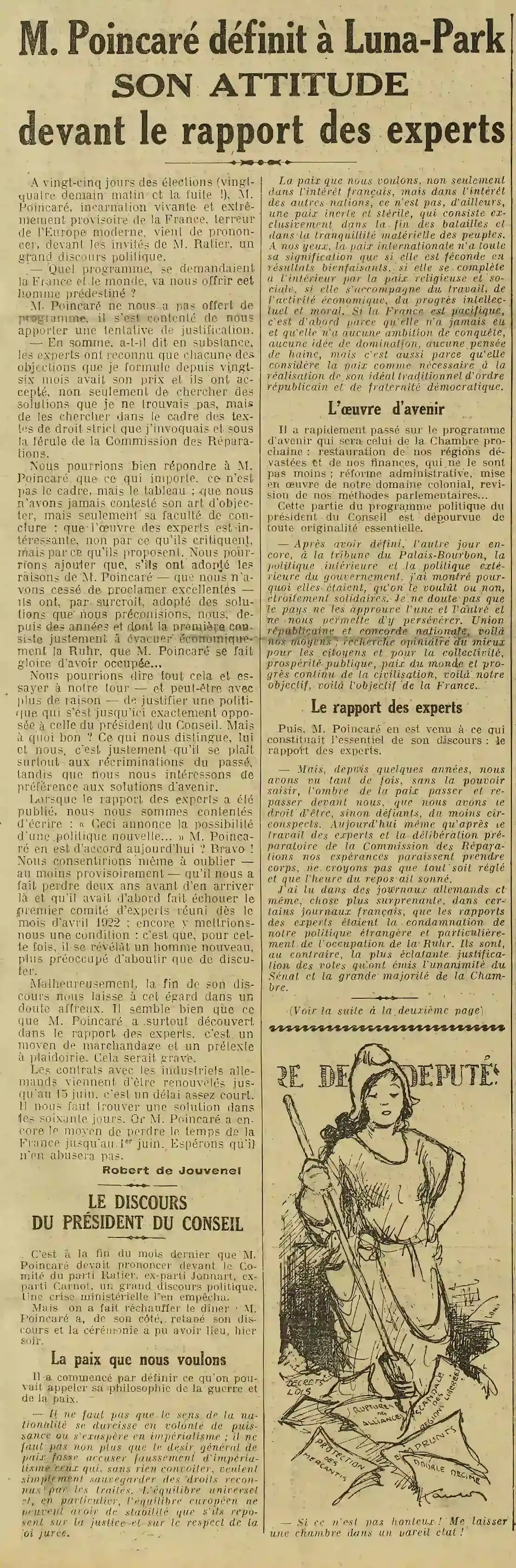 |
THE PRESIDENT OF THE COUNCIL’S SPEECHIt was at the end of last month that Mr. Poincaré was to deliver a major political speech before the Committee of the Ratier party, formerly Jonnart party, formerly Carnot party. a ministerial crisis prevented him from doing so. But the dinner was reheated. Mr. Poincaré, for his part, retyped his speech and the ceremony was able to take place yesterday evening. The peace we wantHe began by defining what could be called his philosophy of war and peace. The sense of nationality must not harden into a desire for power or exasperate into imperialism; nor should the general desire for peace cause those who, without coveting anything, simply want to safeguard rights recognized by treaties to be falsely accused of imperialism. Universal balance. and, in particular, the European balance can only have stability if it is based on justice and respect for the sworn faith. The peace that we want, not only in the French interest, but in the interest of other nations, is not, moreover, an inert and sterile peace, which consists exclusively in the end of battles and in the material tranquility of peoples. In our eyes, international peace only has its full meaning if it is fruitful in beneficial results, if it is completed internally by religious and social peace, if it is accompanied by work and economic activity. , intellectual and moral progress. If France is peaceful, it is first of all because it has never had and has no ambition of conquest, no idea of domination, no thought of hatred, but it is also because it considers peace as necessary for the realization of its traditional ideal of republican order and democratic fraternity. After having defined, again the other day, from the platform of the Palais-Bourbon, the internal policy and the foreign policy of the government, I showed why they were, whether we wanted it or not, closely united. I have no doubt that the country will approve of them both and will allow us to persevere in them. Republican union and national harmony, these are our means, stubborn search for the best for citizens and for the community, public prosperity, world peace and continuous progress of civilization, this is our objective, this is the objective of France. But, for several years, we have seen so many times, without being able to grasp it, the shadow of peace pass and return before us, that we have the right to be, if not distrustful, at least circumspect. Even today, after the work of the experts and the preparatory deliberation of the Reparations Commission, our hopes seem to be taking shape, let us not believe that everything is settled and that the hour of rest has come. (See the rest on the second page) They prove that despite all its denials, Germany has fictitiously become poorer and that it is capable of paying. She allowed six billion 750 million gold marks to escape; she has at home a foreign currency equivalent to 1 billion 200 million gold marks; it did not impose itself as much as the allied nations; Since 1919, it has not stopped improving its tools, perfecting its railway system, its telephone and telegraphic communications, its ports and its canals; its industry is organized with a view to higher production than before the war; the country is well endowed with natural resources and has the means to exploit them widely; its population increases; its agriculture is developing, these are the findings of the experts, and they add that Germany is capable of regaining a favored position in world activity. This is exactly what we said, what Germany contested and what many people among our Allies themselves did not want to believe. On the other hand, the expertise was carried out exactly within the framework that we had drawn up. It does not conclude on the reduction of the figure of the German debt, it thus reserves for us the possibility of linking, as we have always done, the fate of part of our own debt to the settlement of inter-allied debts; it does not determine Germany's capacity for the future; it shows, on the contrary, that this capacity will not cease to increase. On these essential points, it is therefore still the French thesis which prevails. Finally, the payments and benefits proposed for the coming years are much higher, not only than those that Germany declared possible, but those that Mr. Bonar Law envisaged before our entry into the Ruhr. Our occupation, which, moreover, became productive, therefore had the double effect that we had hoped to demonstrate towards the Allies and constraint towards Germany. The objections chapter It will now be up to the Reparations Commission to draw up, within the limits of its powers, a definitive plan, to obtain from Germany that it promptly passes the necessary laws and to precisely organize the controls recommended by the experts. . This entire plan will undoubtedly imply the re-establishment of the economic and fiscal unity of the Reich. But it is not after a declaration of principle, it is not after a lip service acceptance, it is, as the experts expressly write, after the implementation by Germany that we may ask us to exchange our pledges for larger and more remunerative ones. The experts rightly declare that they do not fall within their competence and that it depends on the allied governments to determine their nature and ensure their effectiveness. We will therefore have to consult on this point with our Allies and, since the organizations created by us are in our hands, it will be easier for us than in 1922 to agree and safeguard our interests. As one of these organizations, the railway authority also constitutes an important guarantee of security and supplements, to a certain extent, the assistance pacts promised to us in 1919. We will also deal with with our friends this crucial question, which the awakening of German imperialism forbids us to neglect. The agreement with the allies Apotheosis of Ludendorff, ovations to the imperial crown prince, audacious denials and official lies on the responsibilities of the war, obstacles imposed. to the functioning of control commissions, secret multiplication of military formations and revenge societies, these are symptoms which are becoming widespread and which make us vigilant at all times. The more we love peace, the more we are determined not to tolerate its being disturbed or threatened. Fortunately, this will is as strong among our Allies as it is among us and I am confident that we will succeed in translating it, not into platonic wishes, but into concrete realities. France, for its part, will loyally seek this agreement from the Allies with the awareness of serving well, at the same time, its own cause, that of its friends and that of humankind. |
| page précédente - previous page |