

| Excelsior 16 avril 1924 |
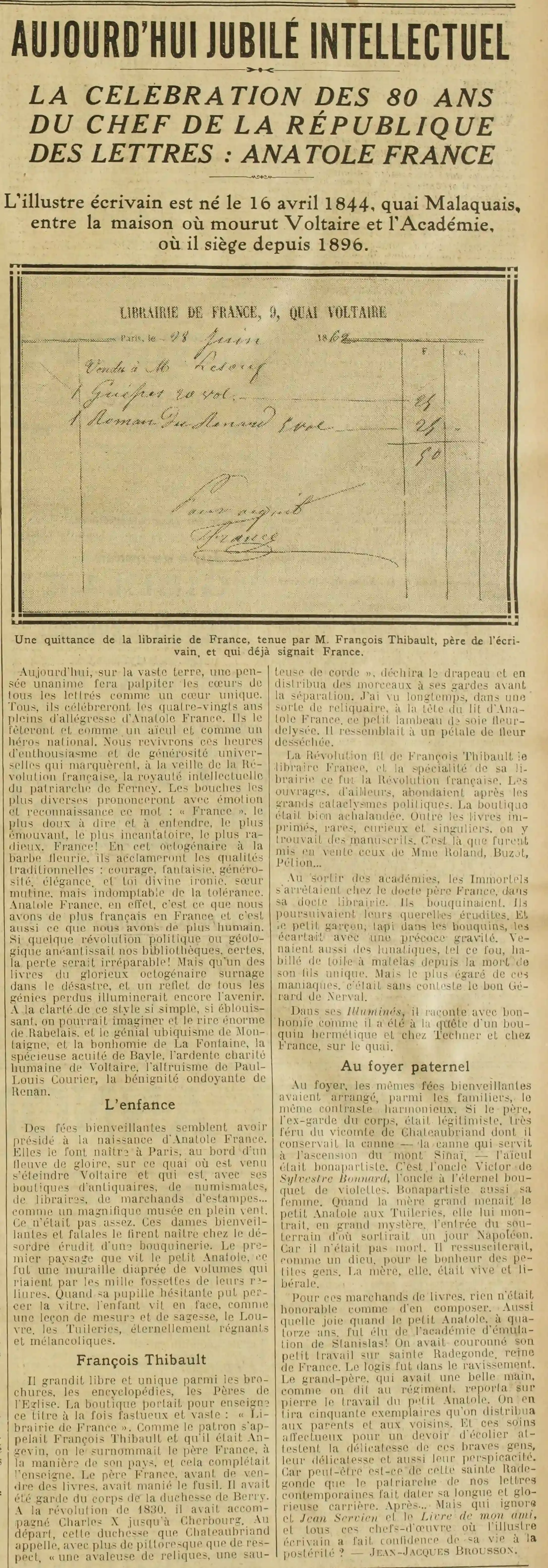 |
Praise of Anatole FranceToday, on the vast earth, a unanimous thought will make the hearts of all scholars beat like a single heart. They will all celebrate the eighty years full of joy of Anatole France. They will celebrate him both as an ancestor and as a national hero. We will relive those hours of universal enthusiasm and generosity which marked, on the eve of the French Revolution, the intellectual royalty of the Patriarch of Ferney. The most diverse mouths will pronounce with emotion and recognition this word “France”, the sweetest to say and to hear, the most moving, the most incantatory, the most radiant. France! In this octogenarian with the flowery beard, they will acclaim the traditional qualities of courage, fantasy, generosity, elegance, and you divine irony, mischievous but indomitable sister of tolerance. Anatole France, in fact, is the most French thing we have in France and it is also the most human thing we have. If some political or geological revolution wiped out our libraries, the loss would certainly be irreparable! But let one of the glorious octogenarian's books survive in the disaster, and a reflection of all the lost geniuses would still illuminate the future. In the clarity of this style, so simple, so dazzling, one could imagine both the enormous laughter of Rabelais, and the brilliant ubiquity of Montaigne, and the good nature of La Fontaine, the specious acuity of Bayle, the ardent human charity of Voltaire, the altruism of Paul-Louis Courier, the undulating benignity of Renan. Childhood Benevolent fairies seem to have presided over the birth of Anatole France. They give birth to it in Paris, on the banks of a river of glory, on this quay where Voltaire died and which is, with its shops of antique dealers, numismatists, booksellers, print dealers... . like a magnificent museum in the open air. It wasn't enough. These benevolent and fatal ladies gave birth to him in the erudite disorder of a second-hand bookstore. The first landscape that little Anatole saw was a wall dotted with volumes that showed through the thousand dimples in their bindings. When his hesitant pupil was able to pierce the window, the child saw opposite, like a lesson in moderation and wisdom, the Louvre, the Tuileries, eternally reigning and melancholy. François Thibault He grew up free and unique among the brochures, the encyclopedias, the Fathers of the Church. The store's sign was this title, both sumptuous and vast: “Librairie de France”. As the boss was called François Thibault and he was from Angevin, he was nicknamed Father France, in the style of his country, and that completed the name. Father France, before selling books, had handled a rifle. He had been bodyguard to the Duchess of Berry. During the revolution of 1830, he accompanied Charles X to Cherbourg. Initially, this duchess whom Chateaubriand calls, with more picturesqueness than respect, "a swallower of relics, a jumper of ropes", tore up the flag and distributed pieces of it to her guards before the separation. I saw for a long time, in a sort of reliquary, at the head of Anatole France's bed, this little scrap of fleur-de-lysée silk. It looked like a dried flower petal. The Revolution made François Thibault the bookseller of France, and the specialty of his bookstore was the French Revolution. The works, moreover, abounded after the great political cataclysms. The store was well stocked. In addition to printed books, rare, curious and singular, there were manuscripts. This is where those of Madame Roland, Buzot, Pétion... were put up for sale. On leaving the academies, the Immortals stopped at the learned Father France, in his learned bookstore. They were reading. They continued their scholarly quarrels. And the little boy, hiding among the books, pushed them aside with precocious gravity. Lunatics also came, like this madman, dressed in mattress canvas since the death of his only son. But the most misguided of these maniacs. he was undoubtedly the good Gérard de Nerval. In his Illuminated, he tells with good nature how he was in search of a hermetic book both at Techner and at France, on the quay. At the paternal home At home, the same benevolent fairies had arranged, among the familiars, the same harmonious contrast. If the father, the ex-bodyguard, was a legitimist, very fond of the Viscount de Chateaubriand whose cane he kept - the cane which was used to climb Mount Sinai, the grandfather was a Bonapartist. This is Sylvestre Bonnard's uncle Victor, the uncle with the eternal bouquet of violets. Bonapartist also his wife. When Grandma took little Anatole to the Tuileries, she showed him, in great mystery, the entrance to the underground from which Napoleon would one day emerge. Because he wasn't dead. He would resurrect, like a god, for the happiness of the little people. The mother was lively and liberal. For these book sellers, nothing was honorable like composing books. Also what joy when little Anatole, at fourteen years old. was elected to Stanislas's emulation academy! His little work on Saint Radegonde, Queen of France, had been crowned. The house was in rapture. The grandfather, who had a beautiful hand, as they say in the regiment. transferred the work of little Anatole onto stone. Fifty copies were made and distributed to parents and neighbors. And this affectionate care for a schoolchild's homework attests to the delicacy of these brave people, their delicacy and also their perspicacity. Because perhaps it is from this Saint Radegonde that the patriarch of our contemporary letters dates his long and glorious career. Afterwards... But who ignores Jean Servien and the Book of my friend, and all these masterpieces in which the illustrious writer confided his life to posterity? JEAN-JACQUES BROUSSON. |
| page précédente - previous page |