

| Comœdia 27 avril 1924 |
 |
|
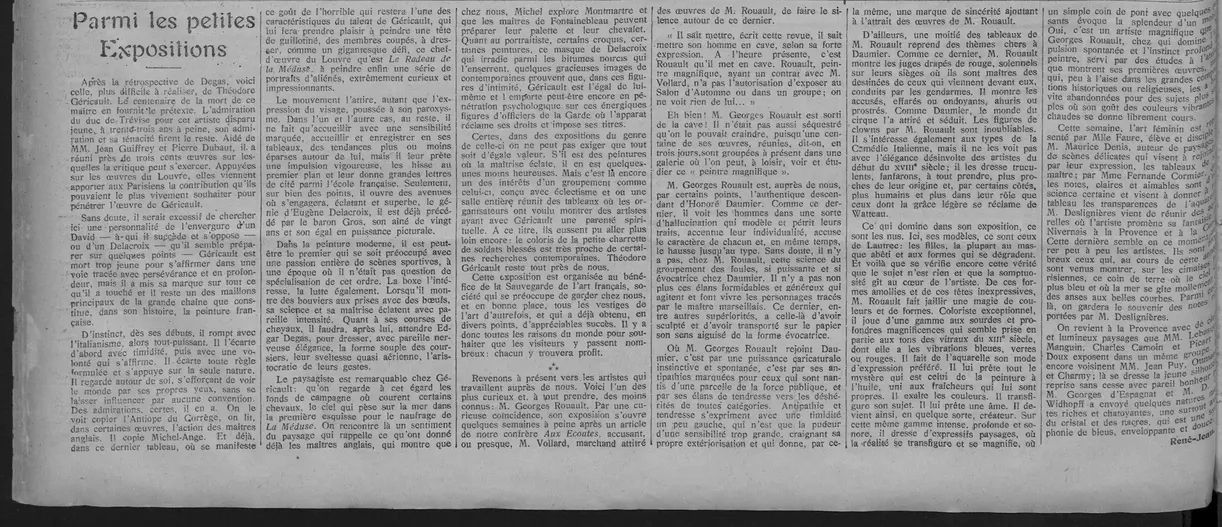
Among the small exhibitions After the retrospective of Degas, here is the one, more difficult to achieve, of Théodore Géricault. The centenary of the death of this master provides the pretext. The admiration of the Duke of Treviso for this artist who died young, at barely thirty-three years old, his admiration and his tenacity did the rest. Helped by MM. Jean Guiffrey and Pierre Dubaut, he brought together nearly three hundred works on which criticism can be exercised. Based on the works of the Louvre, they bring to Parisians the contribution they could most strongly desire to penetrate the work of Géricault. Without doubt, it would be excessive to look here for a personality of the stature of a David whom he succeeds and opposes or a Delacroix whom he seems to prepare on a few points. Géricault died too young to assert himself in a path traced with perseverance and in depth, but he left his mark on everything he touched and he remains one of the main links in the great chain that constitutes, in its history , French painting. Instinctively, from the beginning, he broke with Italianism, then all-powerful. He pushes it aside at first with timidity, then with an assertive will. It rejects any formulated rule and relies on nature alone. He looks around, trying to see the world through his own eyes, without being influenced by any convention. Admirations, certainly, he has some. We see him copying Gorreggio's Antiope, we read, in certain works, the action of the English masters. He copies Michelangelo. And already, in this last painting, where this taste for the horrible is manifested which will remain one of the characteristics of Géricault's talent, which will make him take pleasure in painting a guillotined head, severed limbs, to be erected, like a gigantic challenge, this Louvre masterpiece that is The Raft of the Medusa, to finally paint a series of portraits of insane people, extremely curious and impressive. The movement attracts him, as much as the facial expression, pushed to its climax. In both cases, moreover, he only welcomes with marked sensitivity, welcomes and records in his paintings, tendencies more or less scattered around him, but he gives them a vigorous impulse, the rises to the forefront and gives them great standing among the French school. However, on many points, it opens avenues where the genius of Eugène Delacroix will engage, dazzling and superb, he is already preceded by Baron Gros, his senior by twenty years and his equal in pictorial power. In modern painting, he is perhaps the first to be concerned with sporting scenes with complete passion, at a time when there was no question of specialization of this order. Boxing interests him, as does wrestling. When he shows herdsmen grappling with oxen, his knowledge and mastery shine with equal intensity. As for his horse races, we will have to wait, after him, for Edgar Degas, to portray, with similar nervous elegance, the supple form of the steeds, their almost aerial slenderness, the aristocracy of their gestures. Géricault's landscape design is remarkable: in this respect we look at the countryside where certain horses run, the sky which weighs on the sea in the first sketch for the sinking of La Méduse. We encounter there a feeling of the landscape which recalls what the English masters have already given, which shows that in our country, Michel explored Montmartre and that the masters of Fontainebleau could prepare their palette and their easel. As for the portraitist, certain sketches, certain paintings, this mask of Delacroix which radiates among the blackened bitumen which surround him, some graceful images of contemporaries prove that, in these figures of intimacy, Géricault is the equal of himself and perhaps still prevails in psychological penetration over these energetic figures of officers of the Guard where the pageantry claims its rights and imposes its titles. Certainly, in exhibitions like this one cannot demand that everything be of equal value. If there are paintings where mastery shines, there are some less happy ones. But this is again one of the interests of a group like this, designed with eclecticism and where an entire room brings together paintings where the organizers wanted to show artists having a spiritual kinship with Géricault. In this respect, they could have gone even further: the coloring of the small cart of wounded soldiers is very close to certain contemporary research. Théodore Géricault remains very close to us. This exhibition is organized for the benefit of the Safeguarding of French Art, a company which is concerned with keeping in our country, and in a good place, all the vestiges of the art of yesteryear, and which has already obtained, at various points, appreciable successes. There is therefore every reason in the world to hope that many visitors will pass there: everyone will benefit. Let us now return to the artists who work with us. Here is one of the most curious and, all in all, the least known: Mr. Georges Rouault. By a curious coincidence, his exhibition opens just a few weeks after an article in our colleague Aux Ecoutes, accusing, or almost, Mr. Vollard, official dealer of Mr. Rouault's works, of maintaining silence around the latter. “He knows how to put,” writes this review, “he knows how to put his man in the cellar, according to his strong expression. At present, it is Rouault that he is putting in the cellar. Rouault, a magnificent painter, having a contract with Mr. Vollard, does not have authorization to exhibit at the Salon d'Automne or in a group; we don't see anything of him... Well! Mr. Georges Rouault has come out of the cellar! He was not as sequestered as one might fear, since around a hundred of his works, assembled, it is said, in three days, are now grouped in a gallery where one can, at leisure, see and study this “magnificent painter”. Mr. Georges Rouault is, for us, in certain respects, the authentic descendant of Honoré Daumier. Like the latter, he sees men in a sort of hallucination which shapes and molds their features, accentuates their individuality, highlights the character of each and, at the same time, raises it to the level of type. Without doubt, there is not, in Mr. Rouault, this science of grouping crowds, so powerful and so evocative in Daumier. Nor are there these formidable and generous impulses which stir and bring to life the characters drawn by the master from Marseille. The latter, among other superiorities, has that of having sculpted and having transported on paper his keen sense of evocative form. Where Mr. Georges Rouault joins Daumier, it is by an instinctive and spontaneous caricature power, it is by his marked antipathies for those who are endowed with a particle of public force, and by his outbursts of tenderness towards the disinherited of all categories. Antipathy and tenderness are expressed with a somewhat awkward timidity, which is only the modesty of too great a sensitivity, fearing its own exteriorization and which gives, by this very fact, a mark of sincerity adding to the appeal of the works by Mr. Rouault. Moreover, half of Mr. Rouault's paintings take up themes dear to Daumier. Like the latter, Mr. Rouault shows the judges draped in red, solemn on their seats where they are masters of the destinies of those who come before them, led by the gendarmes. It shows the accused, frightened or waving, stunned prostrate. Like Daumier, the world of the circus attracted and seduced him. The clown figures by M. Rouault are unforgettable. He is also interested in the types of Italian Comedy, but he does not see them with the casual elegance of the artists of the early 18th century; he portrays them as truculent, boastful, all in all, closer to their origin and, in certain ways, more human and more in their role than those whose light grace claims to be Watteau. What dominates in his exhibition are the nudes. Here, his models are those of Lautrec: the girls, most of them with stupid masks and deteriorating shapes. And here the truth is once again verified that the subject is nothing and that sumptuousness lies in the heart of the artist. From these softened forms and these inexpressive heads, Mr. Rouault brings forth a magic of colors and shapes. An exceptional colorist, he plays with a range of muted and deep magnificence which seems partly taken from the tones of the 13th century stained glass windows, of which it has blue, green or red vibrations. He makes watercolor his favorite mode of expression. He gives it all the mystery that is that of oil painting, united with the freshness that is specific to it. It enhances the colors. He transfigures his subject. He lends him a soul. He thus becomes, in a way, creator. On this same intense, deep and sonorous range, he creates expressive landscapes, reality is transfigured and magnified, where a simple corner of a bridge with a few passers-by evokes the splendor of a world. Yes, Georges Rouault is a magnificent artist, in whom spontaneous impulse and the deep instinct of the painter dominate, served by studies in the workshop that his first works show, but who, little at ease in the great historical or religious compositions, quickly abandoned them for paler subjects where his taste for warm vibrant colors gives free rein. This week, female art is represented by Miss Faure, student and disciple of Mr. Maurice Denis, author of landscapes of delicate scenes which aim to join, through their expression, the paintings of his master; Among these, we will remember the notes carried by Mr. Deslignières. We return to Provence with clear and luminous landscapes that MM. Lebasq Manguin, Charles Camoin and Picart Le Doux exhibit in the same group. Here again neighbors MM. Jean Puy, Ottmane and Charmy; there stands the young silhouette, constantly repeated with such happiness. M. Georges d'Espagnat and M. D. Widhopff sent some rich and shimmering still lifes, one especially with crystal and mother-of-pearl, which is a symphony of blues, enveloping and soft. René-Jean |
| retour-back 27avril 1924 |