

| La Dépêche de Brest 20 avril 1924 |
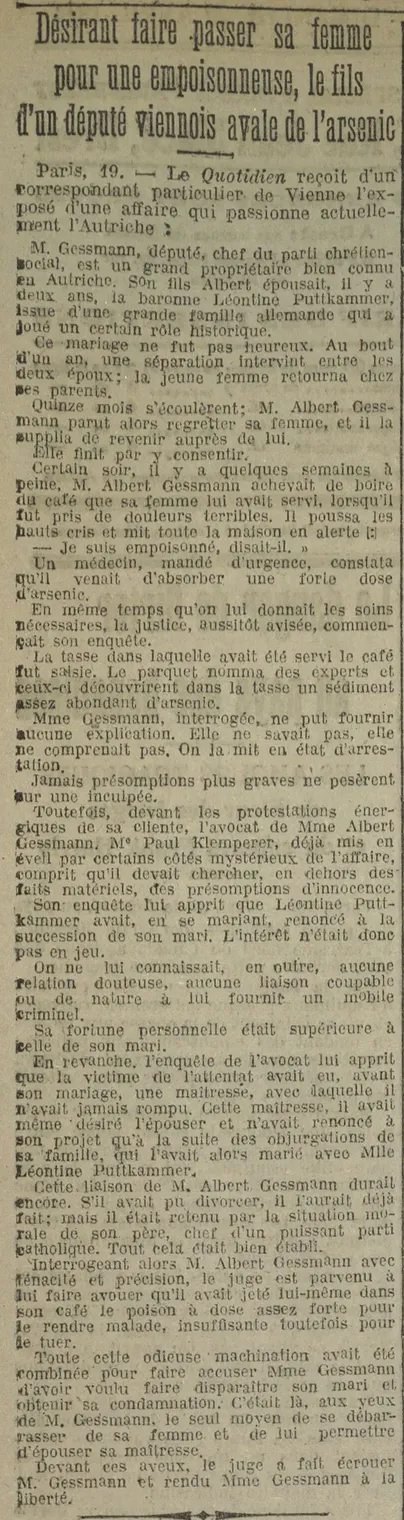 |
Wanting to make his wife look like a poisoner, the son of a Viennese deputy swallows arsenicParis, 19. Le Quotidien receives from a private correspondent from Vienna the presentation of an affair which currently excites Austria, Mr. Gessmann, deputy, leader of the Christian Social Party, is a large landowner well known in Austria. His son Albert married, two years ago, Baroness Léontine Puttkammer, from a large German family which played a certain historical role. This marriage was not happy. After a year, a separation occurred between the two spouses; the young woman returned to her parents. Fifteen months passed; Mr. Albert Gessmann then seemed to miss his wife, and he begged her to come back to him. She ends up agreeing. One evening, just a few weeks ago, Mr. Albert Gessmann was finishing coffee that his wife had served him, when he was seized with terrible pain. He cried out loudly and put the whole house on alert. “I’m poisoned,” he said. A doctor, summoned urgently, noted that he had just absorbed a large dose of arsenic. At the same time as he was given the necessary care, the justice system, immediately informed, began its investigation. The cup in which the coffee had been served was seized. The prosecution appointed experts and they discovered a fairly abundant sediment of arsenic in the cup. Ms. Gessmann, when questioned, could provide no explanation. She didn't know, she didn't understand. She was placed under arrest. Never have more serious presumptions weighed on an accused person. However, faced with energetic protests from his client, Ms. Albert Gessmann's lawyer. M Paul Klemperer, already aroused by certain mysterious aspects of the affair, understood that he had to look, apart from the material facts, for presumptions of innocence. His investigation taught him that Léontine Puttkammer had, by getting married, renounced her husband's inheritance. Interest was therefore not at stake. In addition, he was not known to have any questionable relationships, any guilty liaison or one likely to provide him with a criminal motive. Her personal fortune was greater than that of her husband. On the other hand, the lawyer's investigation told him that the victim of the attack had had, before his marriage, a mistress, with whom he had never broken up. He had even wanted to marry this mistress and had only given up his plan following the urgings of his family, who had then married him to Miss Léontine Puttkammer. Questioning Mr. Albert Gessmann with tenacity and precision, the judge managed to get him to admit that he himself had thrown the poison into his coffee in a dose strong enough to make him sick, but not enough to kill him. All this odious plotting had been combined to accuse Mrs. Gessmann of having wanted to make her husband disappear and obtain his conviction. This was, in Mr. Gessmann's eyes, the only way to get rid of his wife and allow him to marry his mistress. Faced with these confessions, the judge had Mr. Gessmann imprisoned and released Mrs. Gessmann. |
| retour-back 20 avril 1924 |