

| Le Petit Journal illustré 27 avril 1924 |
 |
|
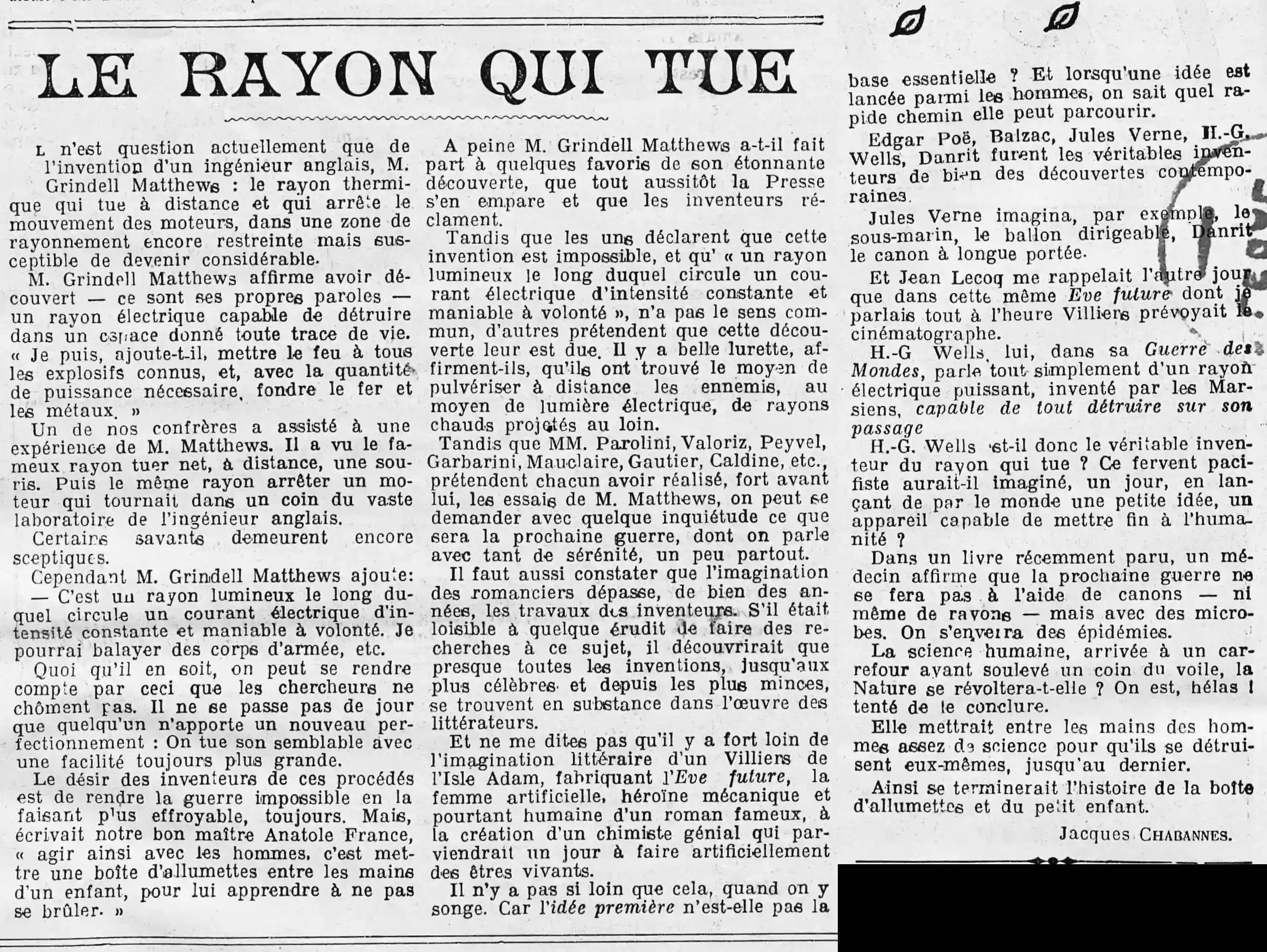
There is currently only talk of the invention of an English engineer, Mr. Grindell Matthews: the thermal ray which kills at a distance and which stops the movement of motors, in a radiation zone which is still restricted but likely to become considerable. Mr. Grindell Matthews claims to have discovered, these are his own words, an electric ray capable of destroying all traces of life in a given space. “I can,” he adds, “set fire to all known explosives, and, with the necessary quantity of power, melt iron and metals. One of our colleagues witnessed an experiment by Mr. Matthews. He saw the famous ray kill a mouse cleanly, from a distance. Then the same ray stopped a motor which was running in a corner of the English engineer's vast laboratory. Some scholars still remain skeptical However, Mr. Grindell Matthews adds: It is a ray of light along which an electric current of constant intensity circulates and can be manipulated at will. I will be able to sweep away army corps, etc. In any case, we can see from this that researchers are not idle. Not a day goes by that someone does not bring a new improvement: We kill our fellow human beings with ever greater ease. The desire of the inventors of these processes is to make war impossible by making it always more frightening. But, wrote our good master Anatole France, “to act in this way with men is to put a box of matches in the hands of a child, to teach him not to burn himself.” Mr. Grindell Matthews had barely informed a few favorites of his astonishing discovery when the Press immediately took hold of it and the inventors clamored for it. While some declare that this invention is impossible, and that "a ray of light along which circulates an electric current of constant intensity and can be manipulated at will", does not make common sense, others claim that this discovery is due to them. A long time ago, they claim, they found a way to pulverize enemies from a distance, using electric light and hot rays projected far away. While MM. Parolini, Valoriz, Peyvel, Garbarini, Mauclaire, Gautier, Caldine, etc. each claim to have carried out, long before him, the tests of Mr. Matthews, we can wonder with some concern what will be the next war, of which we speak with so much serenity, almost everywhere. It must also be noted that the imagination of novelists exceeds, by many years, the work of inventors. If it were possible for some scholar to do research on this subject, he would discover that almost all inventions, from the most famous to the most insignificant, are found in substance in the work of writers. And don't tell me that it is very far from the literary imagination of Villiers de l'Isle Adam, manufacturing the future Eve, the artificial woman, mechanical and yet human heroine of a famous novel, à la creation of a brilliant chemist who would one day succeed in creating living beings artificially. It's not that far away when you think about it. Because isn't the first idea the essential basis? And when an idea is launched among men, we know how quickly it can travel. Edgar Poë, Balzac, Jules Verne, H.-G. Wells, Danrit were the true inventors of many contemporary discoveries. Jules Verne imagined, for example, submarines, the airship, Danrit the long-range cannon. And Jean Lecoq reminded me the other day that in this same future Eve that I was talking about earlier Villiers was planning the cinematography. H.-G Wells, in his War of the Worlds, quite simply speaks of a powerful electric ray, invented by the Marsians, capable of destroying everything on its In a recently published book, a doctor claims that the next war will not be fought with cannons or even rams but with microbes. We will send each other epidemics. Human science, having reached a crossroads having lifted a corner of the veil, will Nature revolt? We are, alas! tried to conclude it. It would put enough science in the hands of men to destroy themselves, down to the last man. Thus would end the story of the matchbox and the little child. Jacques CHABANNES. |
| retour-back 27avril 1924 |