

| La Dépêche de Brest 20 avril 1924 |
 |
|
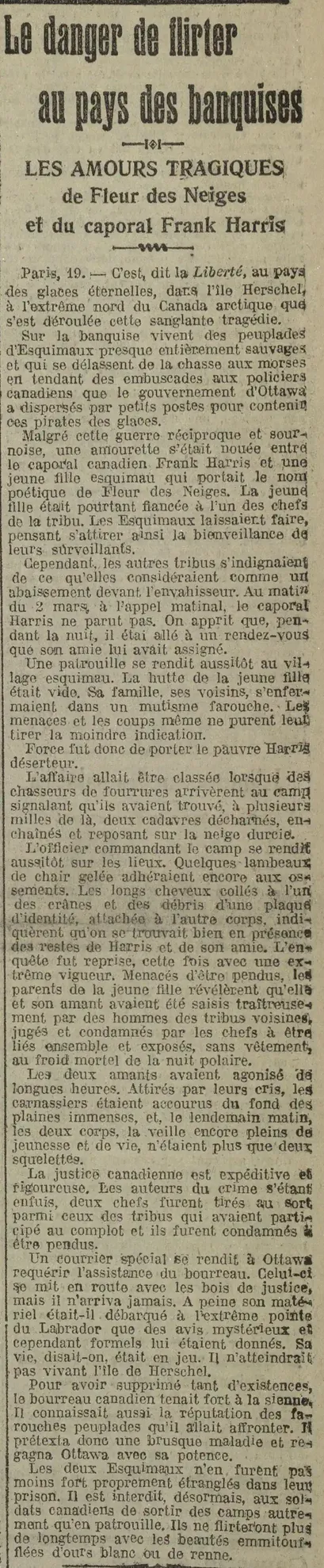
The danger of flirting in the land of ice floes THE TRAGIC LOVES of Fleur des Neiges and Corporal Frank Harris Paris, 19. It was, says Liberty, in the land of eternal ice, on Herschel Island, in the extreme north of Arctic Canada, that this bloody tragedy took place. On the ice floe live tribes of almost entirely wild Eskimos who take pleasure in hunting walruses by ambushing Canadian police officers whom the Ottawa government has dispersed into small posts to contain these ice pirates. Despite this reciprocal and devious war, a love affair was formed between Canadian Corporal Frank Harris and a young Eskimo girl who bore the poetic name of Snow Flower. The young girl was, however, engaged to one of the chiefs of the tribe. The Eskimos let this happen, thinking that they would attract the goodwill of their supervisors. However, the other tribes were indignant at what they considered to be a degradation before the invader. On the morning of March 2, at the morning roll call, Corporal Harris did not appear. We learned that, during the night, he had gone to a meeting that his friend had assigned to him. A patrol immediately went to the Eskimo village. The girl's hut was empty. His family, his neighbors, locked themselves into fierce silence. Even threats and blows could not get the slightest clue from them. It was therefore necessary to carry poor deserter Harris. The case was about to be closed when fur hunters arrived at the camp reporting that they had found, several miles away, two emaciated corpses, chained and lying on the hardened snow. The officer commanding the camp immediately went to the scene. A few scraps of frozen flesh still adhered to the bones. The long hair stuck to one of the skulls and the remains of an identity tag, attached to the other body, indicated that we were indeed in the presence of the remains of Harris and her friend. The investigation was resumed, this time with extreme vigor. Threatened with being hanged, the girl's parents revealed that she and her lover had been treacherously seized by men from neighboring tribes, tried and condemned by the chiefs to be bound together and exposed, without clothing, to the deadly cold. of the polar night. The two lovers had agonized for long hours. Attracted by their cries, the carnivores came running from the bottom of the immense plains, and, the next morning, the two bodies, the day before still full of youth and life, were no more than two skeletons. Canadian justice is expeditious and rigorous. The perpetrators of the crime having fled, two chiefs were chosen by lot from among those of the tribes who had participated in the plot and they were condemned to be hanged. A special courier went to Ottawa to request the executioner's assistance. He set off with the woods of justice, but he never arrived. No sooner had his equipment landed at the extreme tip of Labrador than mysterious yet formal notices were given to him. His life, it was said, was at stake. He would not reach Herschel Island alive. Having suppressed so many lives, the Canadian executioner held dearly to his own. He also knew the reputation of the fierce people he was going to face. He therefore claimed a sudden illness and returned to Ottawa with his gallows. The two Eskimos were nonetheless very cleanly strangled in their prison. Canadian soldiers are now prohibited from leaving the camps other than on patrol. They will no longer flirt with beauties wrapped in polar bears or reindeer. |
| retour-back 20 avril 1924 |