

| La Dépêche de Brest 20 avril 1924 |
 |
|
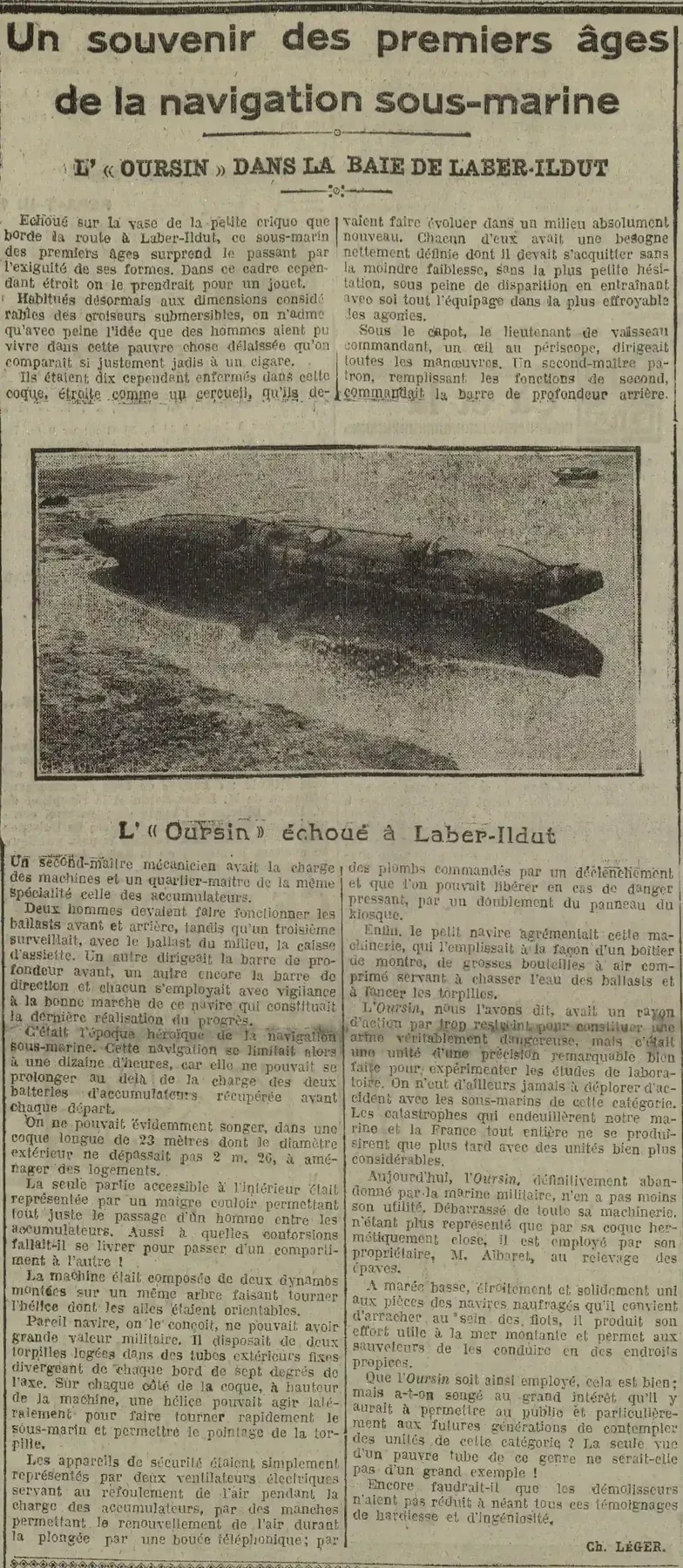
Stranded on the mud of the small cove bordering the road at Laber-Ildut, this early submarine surprises passers-by with the smallness of its shape. In this narrow framework, however, we would take it for a toy. Now accustomed to the considerable dimensions of submersible cruisers, we only accept with difficulty the idea that men could have lived in this poor abandoned thing that we once so aptly compared to a cigar. However, there were ten of them locked in this shell, as narrow as a coffin, which they had to make evolve in an absolutely new environment. Each of them had a clearly defined task which he had to carry out without the slightest weakness, without the slightest hesitation, under penalty of disappearance by dragging the entire crew with him into the most terrible agony. Under the hood, the lieutenant in command, with one eye on the periscope, directed all the maneuvers. A chief mate, performing the duties of first mate, commanded the rear elevator bar. A second master mechanic was in charge of the machines and a quartermaster of the same specialty was in charge of the accumulators. Two men had to operate the front and rear ballast tanks, while a third monitored the trim box with the middle ballast tank. Another steered the forward depth tiller, yet another the steering tiller and everyone worked vigilantly to ensure the smooth running of this ship which constituted the latest achievement of progress. It was the heroic era of underwater navigation. This navigation was then limited to around ten hours, because it could not be extended beyond the charge of the two accumulator batteries recovered before each departure. We obviously could not imagine, in a hull 23 meters long whose external diameter did not exceed 2 m. 26, to develop housing. The only accessible part inside was represented by a narrow corridor barely allowing a man to pass between the accumulators. Also what contortions had to be undertaken to pass from one compartment to another! The machine was composed of two dynamos mounted on the same shaft turning the propeller whose wings were adjustable. Such a ship, it is clear, could not have much military value. It had two torpedoes housed in fixed outer tubes diverging from each edge seven degrees from the axis. On each side of the hull, at machine height, a propeller could act laterally to quickly turn the submarine and allow the torpedo to be aimed. The safety devices were simply represented by two electric fans used to repress the air during the charging of the accumulators, by sleeves allowing the renewal of the air, during the dive by a telephone buoy; by pellets controlled by a trigger and which could be released in the event of pressing danger, by doubling the kiosk panel. Finally, the small ship adorned this machinery, which filled it like a watch case, with large compressed air bottles used to expel water from the ballast tanks and launch torpedoes. The Urchin, as we have said, had too limited a range to constitute a truly dangerous weapon, but it was a unit of remarkable precision well suited to experimenting with laboratory studies. Moreover, we never had to deplore an accident with submarines of this category. The catastrophes which bereaved our navy and the whole of France only occurred later with much larger units. Today, the Sea Urchin, definitively abandoned by the military navy, nevertheless has its usefulness. Stripped of all its machinery. being no longer represented except by its hermetically sealed hull, it is employed by its owner, Mr. Albaret, in lifting wrecks. At low tide, closely and solidly joined to the pieces of the wrecked ships which must be torn away, within the waves, it produces its useful force in the rising sea and allows the rescuers to lead them to suitable places. That the sea urchin is thus used is good; but have we thought about the great interest that there would be in allowing the public and particularly future generations to contemplate units of this category? Wouldn't the only view of a poor tube of this kind be a great example! It would still be necessary that the demolition workers have not reduced to nothing all these testimonies of boldness and ingenuity, Ch. LIGHT. |
| retour-back 20 avril 1924 |