

| Le Petit Écho de la mode 27 avril 1924 |
 |
|
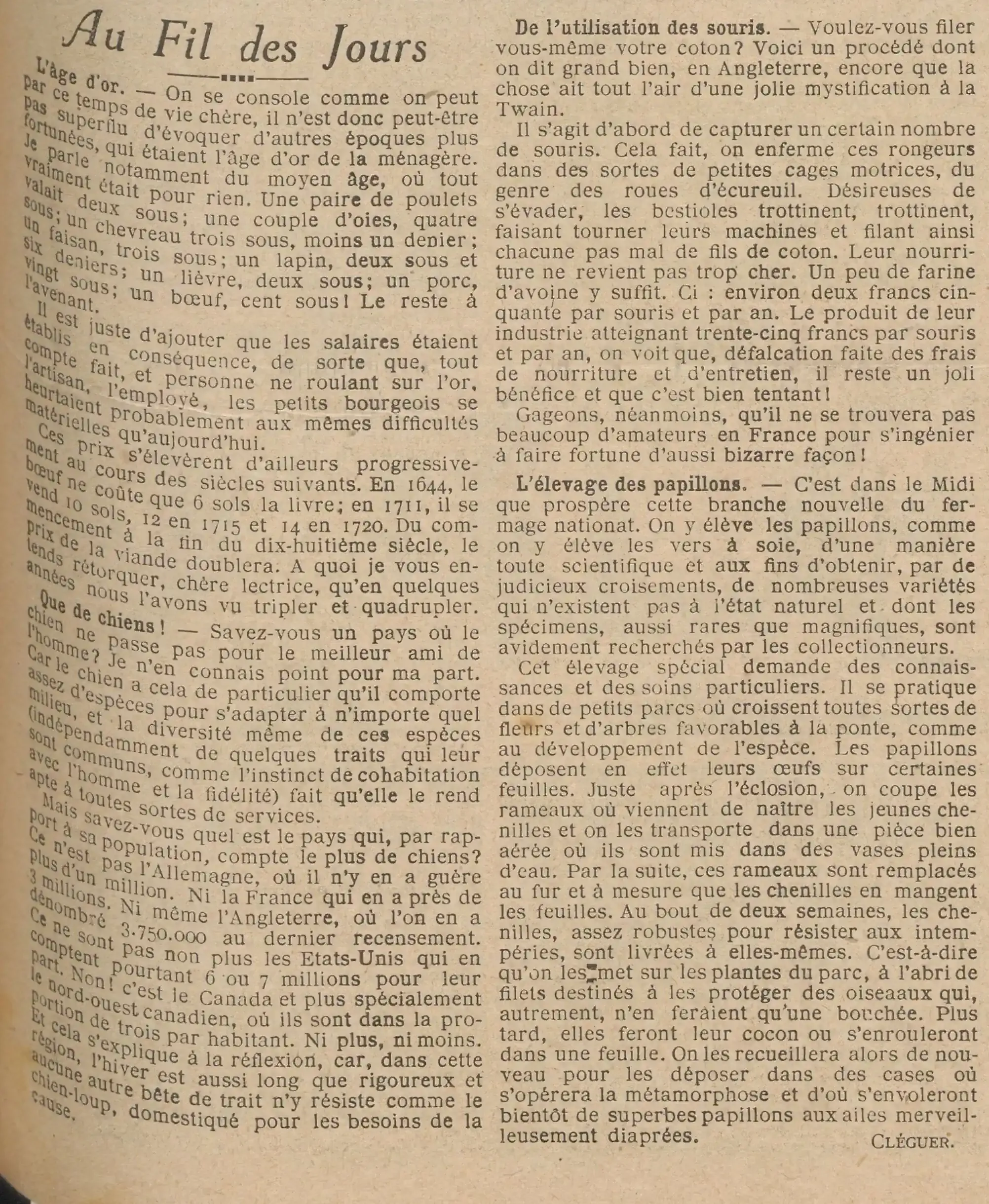
As the days go by Golden age. We console ourselves as best we can by this time of high cost of living, so it is perhaps not superfluous to evoke other, more fortunate eras, which were the golden age of the housewife. I'm talking in particular about the Middle Ages, where everything really was for nothing. A pair of chickens was worth two sous; a pair of geese, four sous; a kid three sous, less a denier; a pheasant, three sous; a rabbit, two sous and six pence; a hare, two sous; a pig, twenty sous; an ox, a hundred sous! The rest of it is fair to add that wages were established accordingly, so that all the craftsmen, the employees, the petty bourgeoisie, and no one rolling in gold, probably encountered the same problems. material difficulties than today. These prices rose gradually over the following centuries. In 1644, beef cost only 6 sols per pound; in 1711, it sold for 10 sols, 12 in 1715 and 14 in 1720. From the beginning to the end of the eighteenth century, the price of meat doubled. To which I hear you retort, dear reader, that in a few years we have seen it triple and quadruple. So many dogs! : Do you know a country where dogs are not considered man's best friend? I don't know any for my part. Because the dog is unique in that it includes enough species to adapt to any environment, and the very diversity of these species (independently of some traits that are common to them, such as the instinct to cohabit with man and fidelity) makes him suitable for all kinds of services But do you know which country, relative to its population, has the most dogs? This is not Germany, where there are barely more than a million. Nor France which has nearly 3 million. Nor even England, where there were 3,750,000 in the last census. Nor is it the United States, which has 6 or 7 million for its part. No! This is Canada and more especially the Canadian northwest, where they are in the proportion of three per capita. No more no less. And this is explained on reflection, because, in this region, the winter is as long as it is harsh and no other draft animal resists it like the wolfdog, domesticated for the needs of the cause. On the use of mice. Do you want to spin your own cotton? Here is a process that is said to be very good in England, even though the thing has all the air of a pretty Twain-style mystification. The first step is to capture a certain number of mice. Once this is done, we lock these rodents in a sort of small motor cage, like squirrel wheels. Eager to escape, the creatures trot and trot, turning their machines and thus each spinning quite a few cotton threads. Their food is not too expensive. A little oatmeal is enough. Ci: around two francs fifty per mouse per year. The product of their industry reaching thirty-five francs per mouse per year, we see that, after deducting food and maintenance costs, there remains a nice profit and that it is very tempting! Raising butterflies. It is in the South that this new branch of national tenancy flourishes. Butterflies are raised there, as silkworms are raised, in a very scientific manner and with the aim of obtaining, through judicious crossbreeding, numerous varieties which do not exist in the natural state and whose specimens , as rare as they are magnificent, are eagerly sought after by collectors. This special breeding requires special knowledge and care. It is practiced in small parks where all kinds of flowers and trees grow which are favorable for egg-laying and the development of the species. Butterflies actually lay their eggs on certain leaves. Just after hatching, we cut the branches where the young caterpillars have just been born and we transport them to a well-ventilated room where they are placed in vases full of water. Subsequently, these branches are replaced as the caterpillars eat the leaves. After two weeks, the caterpillars, robust enough to withstand bad weather, are left to their own devices. That is to say, they are placed on the plants in the park, sheltered by nets intended to protect them from birds which would otherwise make short work of them. Later, they will make their cocoon or wrap themselves in a leaf. We will then collect them again to place them in boxes where the metamorphosis will take place and from which superb butterflies with wonderfully colored wings will soon fly away. CLEGUER. |
| retour-back 27avril 1924 |