

| Le Provençal de Paris 20 avril 1924 |
 |
|
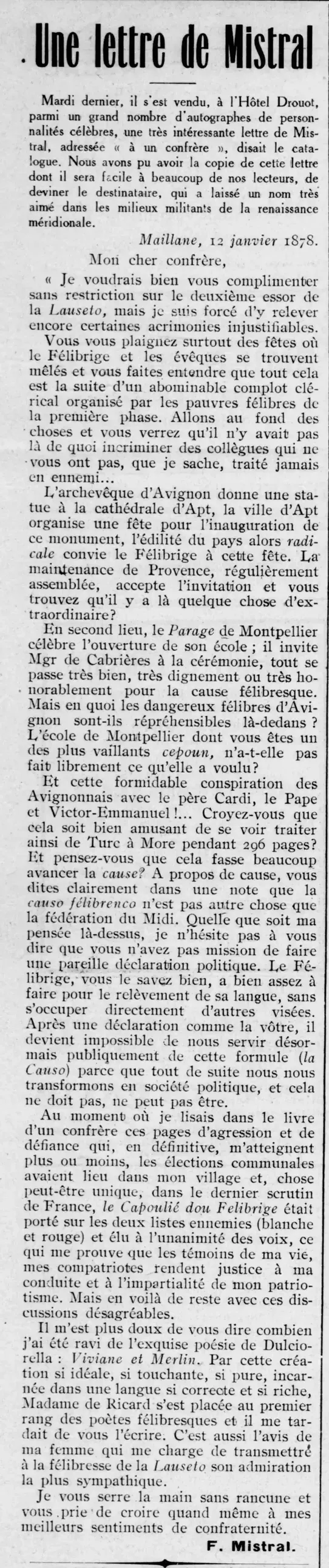
A letter from Mistral Last Tuesday, a very interesting letter from Mistral, addressed “to a colleague,” said the catalog, was sold at the Hôtel Drouot, among a large number of autographs of famous personalities. We were able to have a copy of this letter, which will be easy for many of our readers to guess the recipient, who left a very beloved name in the militant circles of the southern renaissance. Maillane, January 12, 1878. My dear colleague, You complain especially about the festivals where the Félibrige and the bishops find themselves mixed up and you make it understood that all this is the result of an abominable clerical plot organized by the poor felibres of the first phase. Let's get to the bottom of things and you will see that there was nothing there to incriminate colleagues who have not, as far as I know, ever treated you as an enemy... The Archbishop of Avignon gave a statue to Apt Cathedral, the town of Apt organized a party for the inauguration of this monument, the country's then radical council invited the Félibrige to this party. The maintenance of Provence, regularly assembled, accepts the invitation and you find that there is something extraordinary there? Secondly, the Parage de Montpellier celebrates the opening of its school; he invites Mgr de Cabrières to the ceremony, everything goes very well, very dignifiedly or very honorably for the felibresque cause. But how are the dangerous felibres of Avignon reprehensible in this? Didn't the Montpellier school, of which you are one of the most valiant, not freely do what it wanted? And this formidable conspiracy of the Avignon people with Father Cardi, the Pope and Victor-Emmanuel!... Do you think it is very amusing to see yourself treated like a Turk to More for 296 pages? And do you think that does much to advance the cause? Regarding the cause, you clearly say in a note that the "causo félibrenco" is nothing other than the federation of the Midi. Whatever my thoughts on this, I have no hesitation in telling you that it is not your mission to make such a political statement. Félibrige, as you well know, has quite enough to do to raise his tongue, without being directly concerned with other aims. After a declaration like yours, it becomes impossible for us to publicly use this formula ("la Causo") because we immediately transform ourselves into a political society, and that must not, cannot be. At the time when I was reading in a colleague's book these pages of aggression and distrust which, ultimately, affected me more or less, the municipal elections were taking place in my village and, perhaps uniquely, in the last election in France, Capoulié dou Felibrige was included on the two enemy lists (white and red) and elected unanimously, which proves to me that the witnesses of my life, my compatriots, do justice to my conduct and to the impartiality of my patriotism. But that's the end of these unpleasant discussions. It is sweeter for me to tell you how delighted I was with Dulciorella's exquisite poetry: Viviane and Merlin. Through this creation so ideal, so touching, so pure, embodied in a language so correct and so rich, Madame de Ricard placed herself in the first rank of felibresque poets and I longed to write it to you. This is also the opinion of my wife who asks me to convey to the felibresse of the "Lauseto" her most sympathetic admiration. I shake your hand without rancor and ask you to believe in my best feelings of brotherhood. F. Mistral. |
| retour-back 20 avril 1924 |