

| Le Journal des débats 18 septembre 1924 |
|
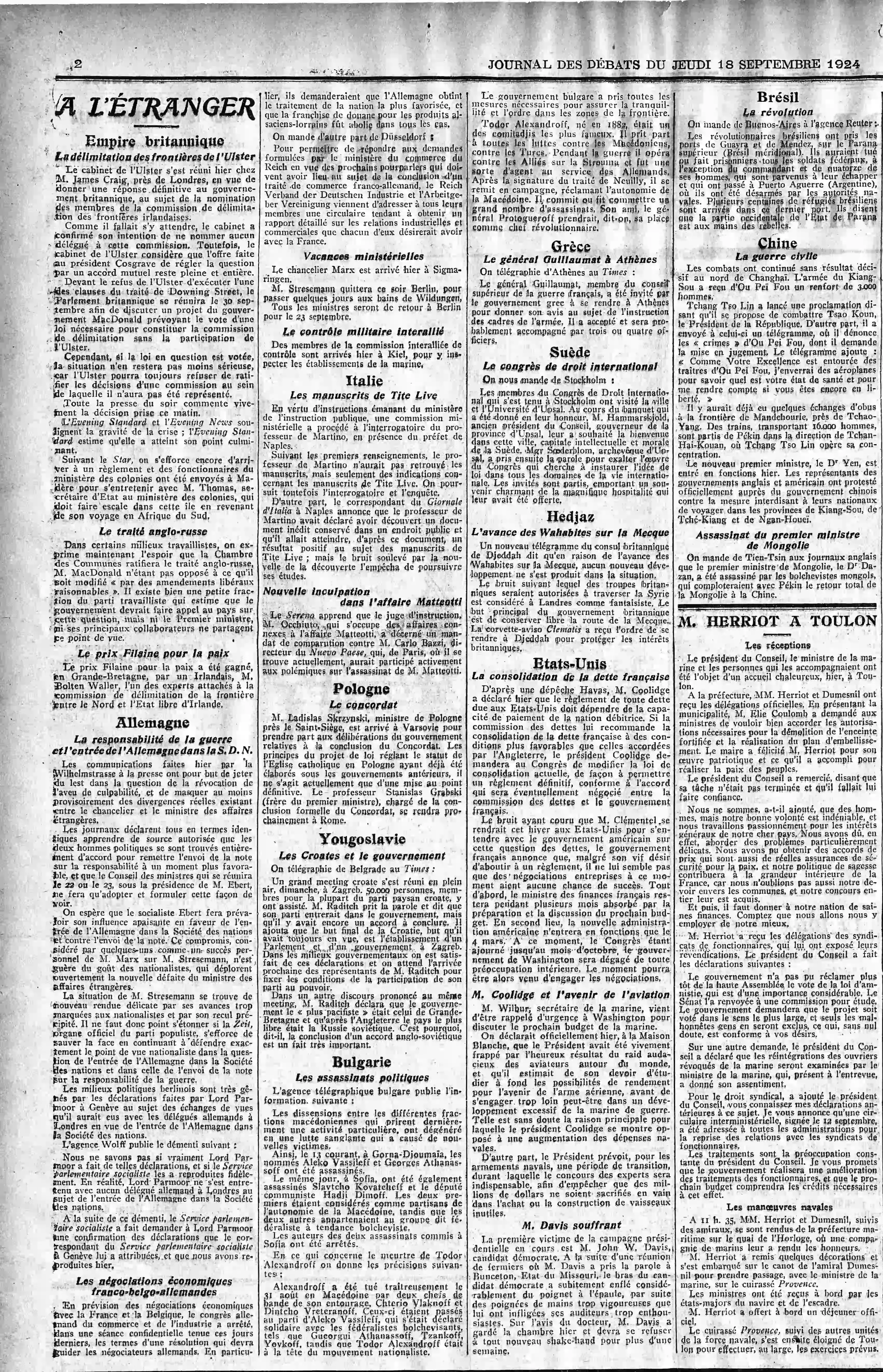
ABROAD British Empire The Ulster Boundaries The Ulster Cabinet met yesterday at the house of Mr. James Craig, near London, with a view to giving a final answer to the British Government, on the subject of the appointment of members of the Irish Boundaries Commission. The Anglo-Russian Treaty In some Labour circles the hope is now expressed that the House of Commons will ratify the Anglo-Russian Treaty, Mr. MacDonald not being averse to its being modified by reasonable Liberal amendments. There is a small section of the Labour Party which believes that the Government should appeal to the country on this question, but neither the Prime Minister nor his principal aides share this view. The Filaine Peace Prize The Filaine Peace Prize was won in Great Britain by an Irishman, Mr. Bolten Waller, one of the experts attached to the Boundary Commission between the North and the Irish Free State, Germany Responsibility for the War and Germany's Entry into the League of Nations The communications made yesterday by Wilhelmstrasse to the Press are intended to throw some ballast into the question of the revocation of the confession of guilt, and to mask at least temporarily real differences existing between the Chancellor and the Foreign Secretary. It is hoped that the socialist Ebert will make his calming influence prevail in favor of Germany's entry into the League of Nations and against the sending of the note. This compromise, considered by some as a personal success of Mr. Marx over Mr. Stresemann, is hardly to the taste of the nationalists, who openly deplore the new defeat of the Minister of Foreign Affairs. Mr. Stresemann's situation is again made delicate by his overly marked advances to the nationalists and by his hasty retreat. It is therefore not surprising that Zeit, the official organ of the populist party, is trying to save face by continuing to defend exactly the nationalist point of view on the question of Germany's entry into the League of Nations and on the issue of the note on responsibility for the war. Berlin political circles are very embarrassed by the statements made by Lord Parmoor in Geneva about the exchanges of views he is said to have had with the German delegates in London with a view to Germany's entry into the League of Nations. The Wolff Agency publishes the following denial: We do not know whether Lord Parmoor really made such statements, and whether the Socialist Parliamentary Service has reproduced them faithfully. In reality, Lord Parmoor did not talk to any German delegate in London about Germany's entry into the League of Nations. Following this denial, the Socialist Parliamentary Service asked Lord Parmoor for confirmation of the statements attributed to him by the Socialist Parliamentary Service correspondent in Geneva, which we reproduced yesterday, Franco-Belgian-German Economic Negotiations In anticipation of the economic negotiations with France and Belgium, the German Congress of Commerce and Industry has decided, in a confidential session held in recent days, on the terms of a resolution which will guide the German negotiators. In particular, they would ask that Germany obtain most-favored-nation treatment, and that the customs exemption for Alsatian-Lorraine products be abolished in all cases. It is also sent from Düsseldorf: In order to respond to the requests formulated by the Reich Ministry of Commerce in view of the forthcoming negotiations which are to take place on the subject of the conclusion of a Franco-German trade treaty, the "Reich Verband der Deutschen Industrie" and the "Arbeitgeber Vereinigung" have just sent to all their members a circular tending to obtain a detailed report on the industrial and commercial relations which each of them would like to have with France. Ministerial vacation Chancellor Marx arrived yesterday in Sigmaringen. M. Stresemann will leave Berlin this evening to spend a few days at the baths of Wildungen. All the ministers will be back in Berlin by September 23. Inter-allied military control Members of the inter-allied control commission arrived yesterday in Kiel to inspect the naval establishments there. Italy The manuscripts of Titus Livius By virtue of instructions from the Ministry of Public Education, a ministerial commission proceeded to question Professor di Martino, in the presence of the Prefect of Naples. According to initial information, Professor di Martino had not found the manuscripts, but only indications concerning the manuscripts of Titus Livius. However, the questioning and investigation are continuing. On the other hand, the correspondent of the Giornale d'Italia in Naples announces that Professor di Martino had declared that he had discovered an unpublished document preserved in a public place and that he was going to reach, according to this document, a positive result concerning the manuscripts of Titus Livius; but the noise raised by the news of the discovery prevented him from continuing his studies. New indictment in the Matteotti affair Le Sereno learns that the investigating judge, Mr. Occhiuto, who is dealing with cases connected with the Matteotti affair, has issued a summons for the appearance of Mr. Carlo Bazzi, director of the Nuevo Paese, who, from Paris, where he is currently, is said to have actively participated in the controversies over the assassination of Mr. Matteotti. Poland The Concordat Mr. Ladislas Skrzynski, Polish Minister to the Holy See, has arrived in Warsaw to take part in the government's deliberations concerning the conclusion of the Concordat. The principles of the bill regulating the status of the Catholic Church in Poland having already been worked out under previous governments, it is now only a question of a final adjustment. Professor Stanislas Grabski (brother of the Prime Minister), charged with the formal conclusion of the Concordat, will shortly go to Rome. Yugoslavia The Croats and the Government A telegraph from Belgrade to the Times: A large Croatian meeting was held in the open air on Sunday in Zagreb, attended by 50,000 people, mostly members of the Croatian Peasant Party. Mr. Raditch spoke and said that his party would enter the government, but that there was still an agreement to be concluded. He added that the final aim of Croatia, an aim which he always had in view, was the establishment of a Parliament and a government in Zagreb. In government circles, these statements are satisfied and the imminent arrival of Mr. Raditch's representatives is expected to set the conditions for his party's participation in power. In another speech at the same meeting, Mr. Raditch declared that the "most pacifist" government was that of Great Britain and that after England the freest country was Soviet Russia. That is why, he said, the conclusion of an Anglo-Soviet agreement is a very important fact. Bulgaria Political Assassinations The Bulgarian Telegraph Agency publishes the following information: The dissensions between the various Macedonian factions, which have recently become particularly active, have degenerated into a bloody struggle that has caused new victims. Regarding the murder of Todor Alexandroff, the following details are given: Alexandroff was treacherously killed on August 31 in Macedonia by two gang leaders from his entourage, Chterio Vlaknoff and Dintcho Vreteranoff. They had gone over to the party of Aleko Vassileff, who had declared solidarity with the Bolshevist federalists, such as Georgy Athanassoff, Tzankoff, Yevkoff, while Todor Alexandroff was at the head of the nationalist movement. The Bulgarian government took all necessary measures to ensure peace and order in the border areas. Todor Alexandroff, born in 1882, was one of the most famous comitadjis. He took part in all the struggles against the Macedonians, against the Turks. During the war he operated against the Allies on the Struma and was a sort of agent in the service of the Germans. After the signing of the Treaty of Neuilly, he resumed his campaign, demanding the autonomy of Macedonia. He committed or had committed a large number of assassinations. His friend, General Protogueroff, is said to be taking his place as revolutionary leader. Greece General Guillaumat in Athens A telegraph from Athens to the Times: General Guillaumat, a member of the French High Council of War, has been invited by the Greek government to go to Athens to give his opinion on the subject of the training of army officers. He has accepted and will probably be accompanied by three or four officers. Sweden The Congress of International Law We are sent word from Stockholm: The members of the Congress of International Law held in Stockholm have visited the city and the University of Uppsala. At the banquet given in their honor, Mr. Hammarskjold, former Prime Minister, Governor of the Province of Uppsala, welcomed them to this city, the intellectual and moral capital of Sweden. Archbishop Soderblom of Uppsala then spoke to extol the work of the Congress which seeks to establish the idea of law in all areas of international life. The guests departed with a charming souvenir of the magnificent hospitality which had been extended to them, Hedjaz The Advance of the Wahabis on Mecca A new telegram from the British Consul at Jeddah says that owing to the advance of the Wahabis on Mecca, no new development has occurred in the situation, The rumour that British troops are being permitted to pass through Syria is considered fanciful in London. The main object of the British Government is to keep the road to Mecca free. The corvette-aviso Clematis has been ordered to Jeddah to protect British interests. United States The Consolidation of the French Debt According to a Havas dispatch, Mr. Coolidge declared yesterday that the settlement of any debt owed to the United States must depend on the debtor nation's ability to pay. If the Debt Commission recommends to him the consolidation of the French debt on terms more favorable than those granted by England, President Coolidge will ask Congress to amend the present Consolidation Act, so as to permit a final settlement, in accordance with the agreement which may eventually be negotiated between the Debt Commission and the government. The rumor having circulated that Mr. Clementel would go this winter to the United States to come to an agreement with the American government on this question of debts, the French government announces that, in spite of its strong desire to arrive at a settlement, it does not seem to it that negotiations undertaken at this time have any chance of success. Mr. Coolidge and the Future of Aviation Mr. Davis suffering The first casualty of the current presidential campaign is Mr. John W. Davis, the Democratic candidate. Following a farmers' meeting at Bunceton, Missouri, where Mr. Davis spoke, the Democratic candidate's arm suddenly swelled considerably from the wrist to the shoulder, as a result of the excessively vigorous handshakes inflicted on him by his over-enthusiastic listeners. On the doctor's advice, Mr. Davis stayed in bed yesterday and will have to refrain from any further handshakes for more than a week, Brazil The Revolution Reuter news agency receives from Buenos Aires: The Brazilian revolutionaries have taken the ports of Guayra and Mendez, on the upper Parana (southern Brazil). They are said to have killed or taken prisoner all the federal soldiers, except the commander and fourteen of his men, who managed to escape and went to Puerto Aguerre (Argentina), where they were disarmed by the naval authorities. China The civil war The fighting continued without decisive results north of Shanghai. The army of Kiang-Sou received from Ou Pei Fou a reinforcement of 3000 men, There have already been some exchanges of shells on the Manchurian frontier, near Tchao-Yang. Trains, carrying 16,000 men, have left Peking in the direction of Tchan-Hai-Kouan, where Tchang Tso Lin is concentrating. The new Prime Minister, Dr. Yen, took office yesterday. The representatives of the English and American governments have officially protested to the Chinese government against the measure prohibiting their nationals from travelling in the provinces of Kiang-Sou, Tche-Kiang and Ngan-Hueï. Assassination of the Prime Minister of Mongolia |
 |
| Retour - Back 18 septembre 1924 |