

| Le journal des débats 21 septembre 1924 |
|
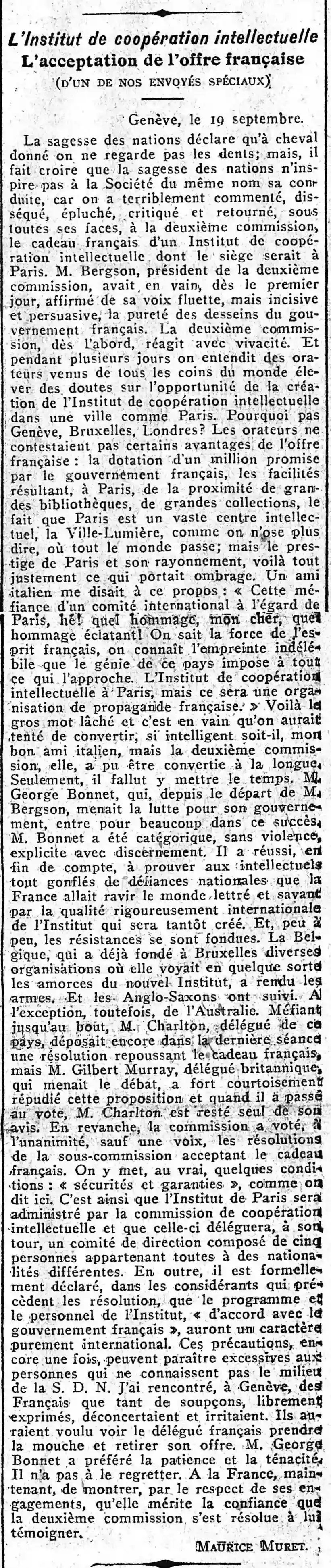
The Institute of Intellectual Cooperation Acceptance of the French Offer Geneva, September 19. The second commission, from the outset, reacted with vivacity. And for several days we heard speakers from all corners of the world raising doubts about the advisability of creating the Institute of Intellectual Cooperation in a city like Paris. Why not Geneva, Brussels, London? The speakers did not dispute certain advantages of the French offer: the endowment of a million promised by the French government, the facilities resulting, in Paris, from the proximity of large libraries, large collections, the fact that Paris is a vast intellectual center, the City of Light, as we no longer dare say, where everyone passes; but the prestige of Paris and its influence, that is precisely what was causing offense. An Italian friend said to me on this subject: "This distrust of an international committee with regard to Paris, hey! what a tribute, my dear, what a resounding tribute! We know the strength of the French spirit, we know the indelible imprint that the genius of this country imposes on everything that approaches it. The Institute of Intellectual Cooperation in Paris, but it will be a French propaganda organization. » That is the dirty word uttered and it is in vain that one would have tried to convert, however intelligent he may be, my good Italian friend, but the second commission, it, was able to be converted in the long run, Only, it took time. Mr. George Bonnet, who, since the departure of Mr. Bergson, led the fight for his government, is largely responsible for this success, Mr. Bonnet was categorical, without violence, explicit with discernment. He succeeded, in the end, in proving to the intellectuals all swollen with national distrust that France was going to delight the literary and learned world by the rigorously international quality of the Institute which would soon be created. And, little by little, the resistance melted away. Belgium, which had already founded various organizations in Brussels where it saw in some way the beginnings of the new Institute, laid down its arms. And the Anglo-Saxons followed. With the exception, however, of Australia. Suspicious to the end, Mr. Charlton, the delegate of his country, still tabled in the last session a resolution rejecting the French gift, but Mr. Gilbert Murray, the British delegate, who led the debate, very courteously repudiated this proposal and when it came to the vote, Mr. Charlton remained the only one of his opinion. On the other hand, the committee voted unanimously, except for one vote, the resolutions of the subcommittee accepting the French gift. In fact, some conditions are attached: securities and guarantees, as they say here. Thus the Paris Institute will be administered by the Intellectual Cooperation Committee and that the latter will delegate, in turn, a management committee composed of five people all belonging to different nationalities. Furthermore, it is formally declared, in the preambles preceding the resolutions, that the program and personnel of the Institute, "in agreement with the French government," will have a purely international character. These precautions, once again, may seem excessive to people who are not familiar with the League of Nations environment. I met French people in Geneva who were disconcerted and irritated by so many freely expressed suspicions. They would have liked to see the French delegate get angry and withdraw his offer. Mr. George Bonnet preferred patience and tenacity. He has no reason to regret it. It is now up to France to show, by respecting its commitments, that it deserves the confidence that the second commission has decided to show it. MAURICE MURET. |
 |
| Retour - Back 21 septembre 1924 |