

| L'Œuvre 21 septembre 1924 |
|
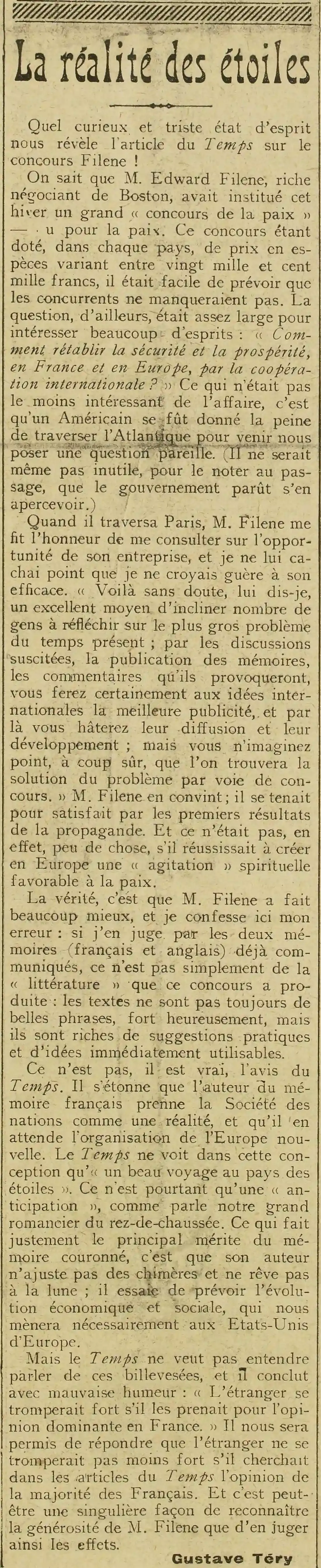
The Reality of the Stars What a curious and sad state of mind the article in Le Temps on the Filene competition reveals to us! We know that Mr. Edward Filene, a wealthy Boston merchant, had instituted a great "peace competition" this winter. Since this competition was endowed, in each country, with cash prizes varying between twenty thousand and one hundred thousand francs, it was easy to foresee that there would be no shortage of competitors. The question, moreover, was broad enough to interest many minds: How can security and prosperity be reestablished in France and Europe through international cooperation?" What was not the least interesting about the affair was that an American had taken the trouble to cross the Atlantic to come and ask us such a question. (It would not even be useless, to note in passing, if the government appeared to notice it.) When he passed through Paris, Mr. Filene did me the honor of consulting me on the advisability of his enterprise, and I did not hide from him that I did not believe in its effectiveness. "This is doubtless," I said to him, "an excellent means of inciting a number of people to reflect on the greatest problem of the present time; by the discussions raised, the publication of the memoirs, the comments that they will provoke, you will certainly give international ideas the best publicity, and by that you will hasten their diffusion and their development; but you do not imagine, for sure, that the solution to the problem will be found by way of competition." Mr. Filene agreed; he considered himself satisfied by the first results of the propaganda. And it was not, in fact, a small thing, if he succeeded in creating in Europe a spiritual "agitation" favorable to peace. The truth is that Mr. Filene has done much better, and I confess here my error if I judge by the two memoirs (French and English) already communicated, it is not simply literature that this competition has produced: the texts are not always beautiful sentences, fortunately, but they are rich in practical suggestions and immediately usable ideas. This is not, it is true, the opinion of Le Temps. It is surprised that the author of the French memoir takes the League of Nations as a reality, and that he expects from it the organization of the new Europe. Le Temps sees in this conception only "a beautiful voyage to the land of the stars". It is however only an "anticipation", as our great novelist of the ground floor speaks. What constitutes precisely the principal merit of the crowned memoir is that its author does not adjust chimeras and does not dream of the moon; he tries to predict the economic and social evolution, which will necessarily lead us to the United States of Europe. But Le Temps does not want to hear about this nonsense, and it concludes with bad humor: "The foreigner would be very mistaken if he took them for the dominant opinion in France. We will be allowed to answer that the foreigner would be no less mistaken if he sought in the articles of Le Temps the opinion of the majority of the French. And it is perhaps a singular way of recognizing the generosity of Mr. Filene to judge its effects in this way. Gustave Téry |
 |
| Retour - Back 21 septembre 1924 |