

| L'Ouest-Éclair 16 septembre 1924 |
|
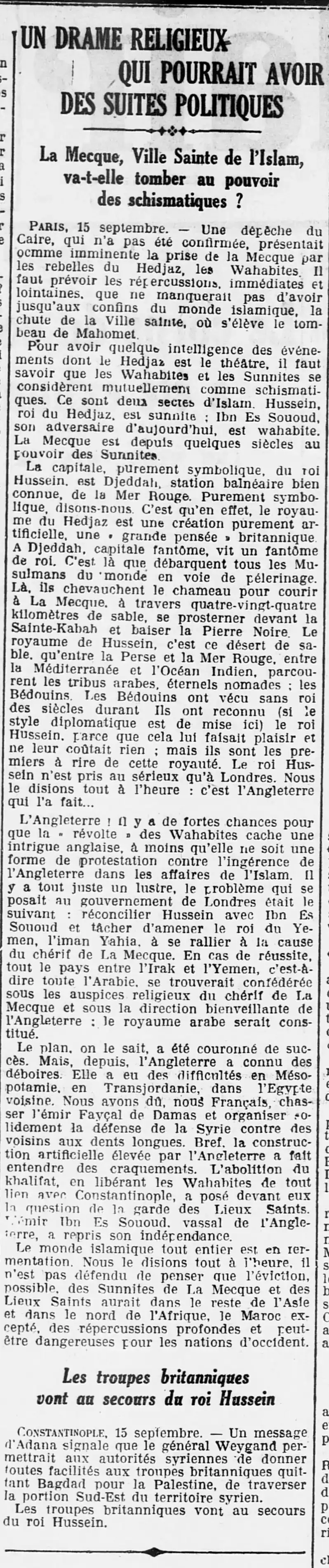
A RELIGIOUS DRAMA THAT COULD HAVE POLITICAL CONSEQUENCES Will Mecca, the Holy City of Islam, fall to the schismatics? PARIS, September 15. A dispatch from Cairo, which has not been confirmed, presented as imminent the capture of Mecca by the rebels of the Hedjaz, the Wahabis. We must foresee the immediate and distant repercussions that the fall of the Holy City, where the tomb of Mahomet stands, would not fail to have, even to the confines of the Islamic world. To have some understanding of the events of which the Hedjaz is the theater, it is necessary to know that the Wahabis and the Sunnis mutually consider each other as schismatics. They are two sects of Islam. Hussein, king of the Hedjaz, is a Sunni; Ibn Es Sououd, his adversary today, is a Wahabi. Mecca has been in the power of the Sunnis for several centuries. The capital, purely symbolic, of Toi Hussein, is Jeddah, a well-known seaside resort on the Red Sea. Purely symbolic, we say. This is because, in fact, the kingdom of Hedjaz is a purely artificial creation, a great British thought. In Jeddah, the phantom capital, lives a phantom king. This is where all the Muslims of the world disembark on their way to pilgrimage. There, they ride camels to run to Mecca, across eighty-four kilometers of sand, to prostrate themselves before the Holy Kabah and kiss the Black Stone. The kingdom of Hussein is this desert of sand, which between Persia and the Red Sea, between the Mediterranean and the Indian Ocean, the Arab tribes, eternal nomads; the Bedouins, roam. The Bedouins have lived without a king for centuries. They recognized (if diplomatic style is appropriate here) King Hussein. because it pleased him and cost them nothing; but they are the first to laugh at this royalty. King Hussein is taken seriously only in London. As we said earlier: it was England who did it… England! There is a strong chance that the Wahhabi revolt hides an English intrigue, unless it is a form of protest against English interference in the affairs of Islam. Just a few years ago, the problem facing the government in London was to reconcile Hussein with Ibn Es Sououd and to try to bring the King of Yemen, Imam Yahia, to rally to the cause of the Sharif of Mecca. If successful, the entire country between Iraq and Yemen, that is to say all of Arabia, would be confederated under the religious auspices of the Sharif of Mecca and under the benevolent direction of England the Arab kingdom would be constituted. The plan, as we know, was crowned with success. But, since then, England has experienced setbacks. She had difficulties in Mesopotamia, in Transjordan, in neighboring Egypt. We, the French, had to chase Emir Faisal from Damascus and solidly organize the defense of Syria against neighbors with long teeth. In short, the artificial construction erected by England has made cracks heard. The abolition of the caliphate, by freeing the Wahhabis from all ties with Constantinople, posed before them the question of the guard of the Holy Places. Emir Ibn Es Sououd, vassal of England, regained his independence. British troops go to the aid of King Hussein CONSTANTINOPLE, September 15. A message from Adana reports that General Weygand would allow the Syrian authorities to give all facilities to the British troops leaving Baghdad for Palestine, to cross the south-eastern portion of Syrian territory. British troops go to the aid of King Hussein. |
 |
| Retour - Back 16 septembre 1924 |