

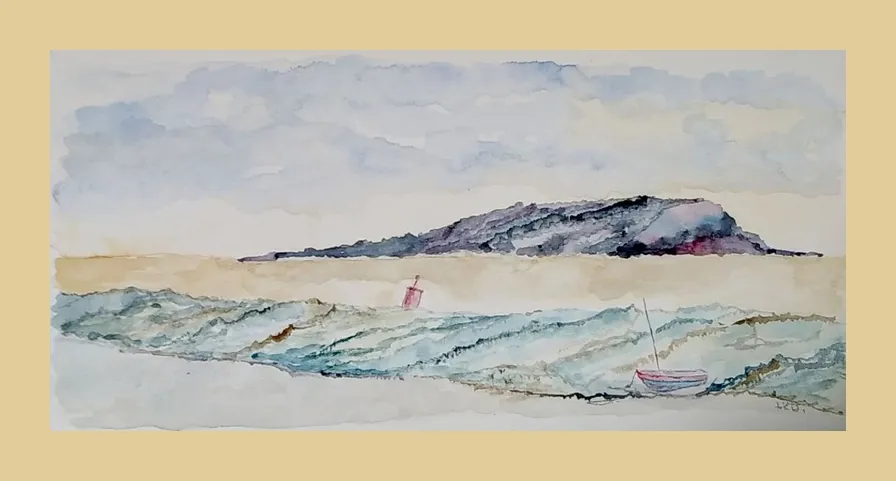
| Le Petit Journal illustré 07 septembre 1924 |
|
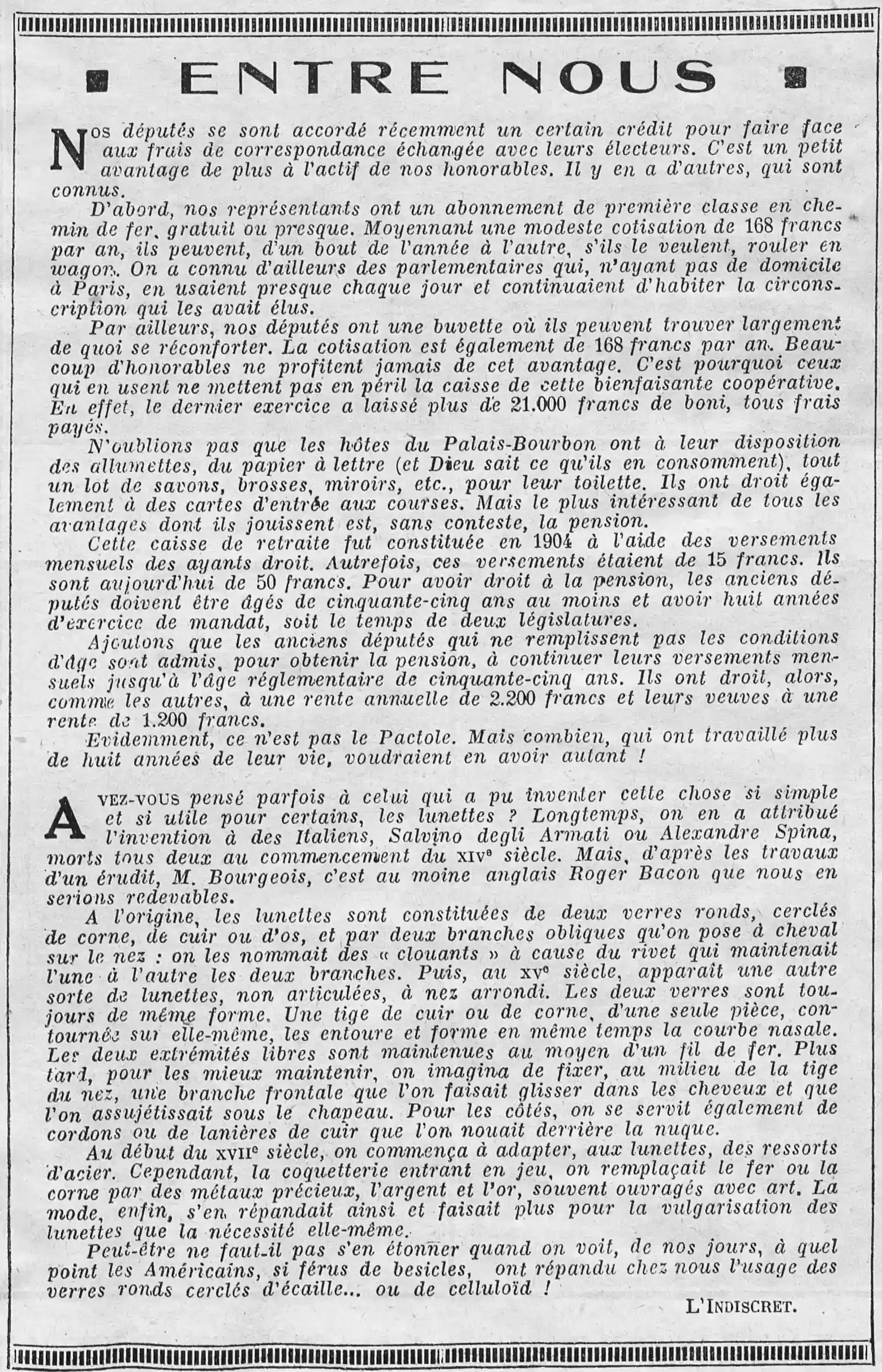
BETWEEN US Our deputies have recently granted themselves a certain amount of credit to cover the costs of correspondence exchanged with their constituents. This is one more small advantage to the credit of our honourable members. There are others, which are well known. First, our representatives have a first-class rail pass, free or almost free. For a modest contribution of 168 francs per year, they can, from one end of the year to the other, if they wish, travel in a carriage. We have also known parliamentarians who, not having a home in Paris, used it almost every day and continued to live in the constituency that had elected them. Furthermore, our deputies have a refreshment bar where they can find plenty to comfort themselves. The contribution is also 168 francs per year. Many honourable members never take advantage of this advantage. This is why those who use it do not jeopardize the funds of this benevolent cooperative. Indeed, the last financial year left more than 21,000 francs in surplus, all expenses paid. Let us not forget that the guests of the Palais-Bourbon have at their disposal matches, writing paper (and God knows what they use of it), a whole lot of soaps, brushes, mirrors, etc., for their toilet. They are also entitled to entry cards to the races. But the most interesting of all the advantages they enjoy is, without a doubt, the pension. This pension fund was set up in 1904 with the help of monthly payments from beneficiaries. Formerly, these payments were 15 francs. Today they are 50 francs. To be entitled to the pension, former deputies must be at least fifty-five years old and have served eight years in office, or the time of two legislatures. HAVE YOU sometimes thought about who could have invented this thing so simple and so useful for some, glasses? For a long time, their invention was attributed to Italians, Salvino degli Armati or Alexandre Spina, both of whom died at the beginning of the 14th century. But, according to the work of a scholar, Mr. Bourgeois, it is to the English monk Roger Bacon that we are indebted. Originally, glasses were made up of two round lenses surrounded by horn, leather or bone, and by two oblique branches that were placed astride the nose. They were called "clouants" because of the rivet that held the two branches together. Then, in the 15th century, another type of glasses appeared, non-articulated, with a rounded nose. The two lenses were always the same shape. A rod of leather or horn, in one piece, bent on itself, surrounds them and at the same time forms the nasal curve. The two free ends are held in place by means of an iron wire. Later, to hold them in place better, it was thought of fixing, in the middle of the nose rod, a front branch that was slid into the hair and secured under the hat. For the sides, cords or leather straps were also used that were tied behind the neck. At the beginning of the 17th century, steel springs began to be adapted to spectacles. However, as coquetry came into play, iron or horn was replaced by precious metals, silver and gold, often artfully worked. Fashion, finally, spread in this way and did more to popularize spectacles than necessity itself. Perhaps we should not be surprised when we see, nowadays, to what extent the Americans, so fond of spectacles, have spread among us the use of round lenses rimmed with tortoiseshell... or celluloid! THE INDISCREET. |
 |
| Retour - Back 07 septembre 1924 |