|
Interfaith Schools in Alsace
The school strike apparently only took place in villages. In towns, only 15 to 20 percent of students were out of school.
The Prime Minister will likely make a statement today, as soon as the debate on the abolition of the Strasbourg police station resumes.
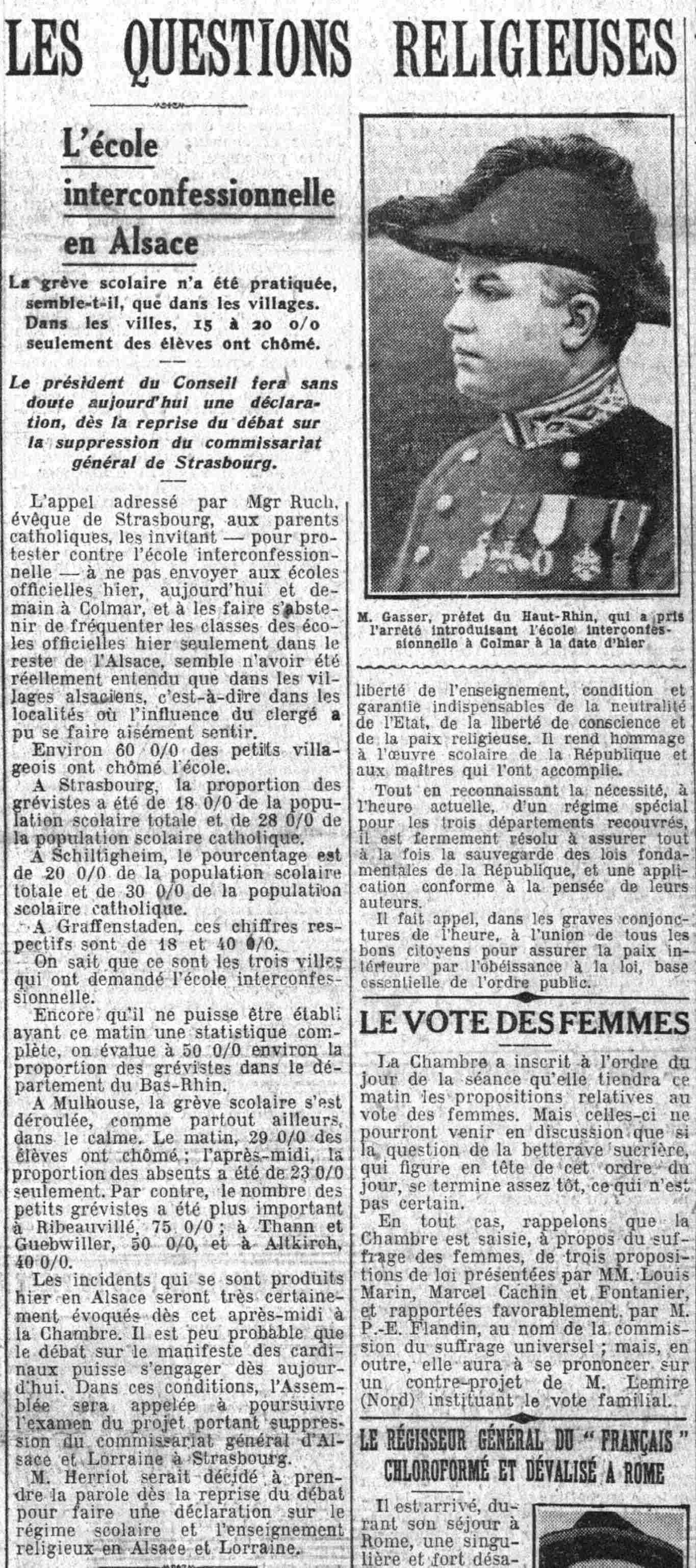
The appeal made by Bishop Ruch of Strasbourg to Catholic parents, urging them to protest against the interdenominational school system by not sending students to official schools yesterday, today, and tomorrow in Colmar, and by refraining from attending official schools only yesterday in the rest of Alsace, seems to have been truly heeded only in Alsatian villages, that is, in places where the influence of the clergy could easily be felt.
Approximately 60 percent of the small villagers were out of school. In Strasbourg, the proportion of strikers was 18% of the total school population and 28% of the Catholic school population.
In Schiltigheim, the percentage was 20% of the total school population and 30% of the Catholic school population.
In Graffenstaden, these figures are 18% and 40%, respectively.
It is known that these are the three towns that requested interdenominational schools.
Although it is not possible to establish complete statistics this morning, the proportion of strikers in the Bas-Rhin department is estimated at around 50%.
In Mulhouse, the school strike, as everywhere else, took place peacefully. In the morning, 29% of students were off work; in the afternoon, the proportion of absentees was only 23%. However, the number of minor strikers was higher in Ribeauvillé, at 75%. in Thann and Guebwiller, 50%, and in Altkirch, 40%.
The incidents that occurred yesterday in Alsace will most likely be discussed this afternoon in the House. It is unlikely that the debate on the cardinals' manifesto will be able to begin today. Under these circumstances, the Assembly will be called upon to continue examining the bill to abolish the General Commissariat of Alsace and Lorraine in Strasbourg.
Mr. Herriot is said to be determined to speak as soon as the debate resumes to make a statement on the school system and religious education in Alsace and Lorraine.
Freedom of education is an essential condition and guarantee of state neutrality, freedom of conscience, and religious peace. He pays tribute to the educational work of the Republic and to the teachers who accomplished it. While recognizing the current need for a special regime for the three recovered departments, he is firmly resolved to ensure both the safeguarding of the fundamental laws of the Republic and their application in accordance with the intentions of their authors.
He calls, in the grave circumstances of the moment, for the unity of all good citizens to ensure domestic peace through obedience to the law, the essential basis of public order.
WOMEN'S VOTE
The Chamber has placed proposals relating to women's suffrage on the agenda for the session it will hold this morning. However, these proposals will only be able to be discussed if the sugar beet issue, which is at the top of the agenda, is concluded early enough, which is not certain.
In any case, let us recall that the Chamber is considering, regarding women's suffrage, three bills presented by Messrs. Louis Marin, Marcel Cachin and Fontanier, and reported favorably by Mr. P.-E. Flandin, on behalf of the universal suffrage commission; but, in addition, it will have to decide on a counter-project by Mr. Lemire (North) instituting family voting.
| It was not until 1945 that women obtained the right to vote in France. |
|