|
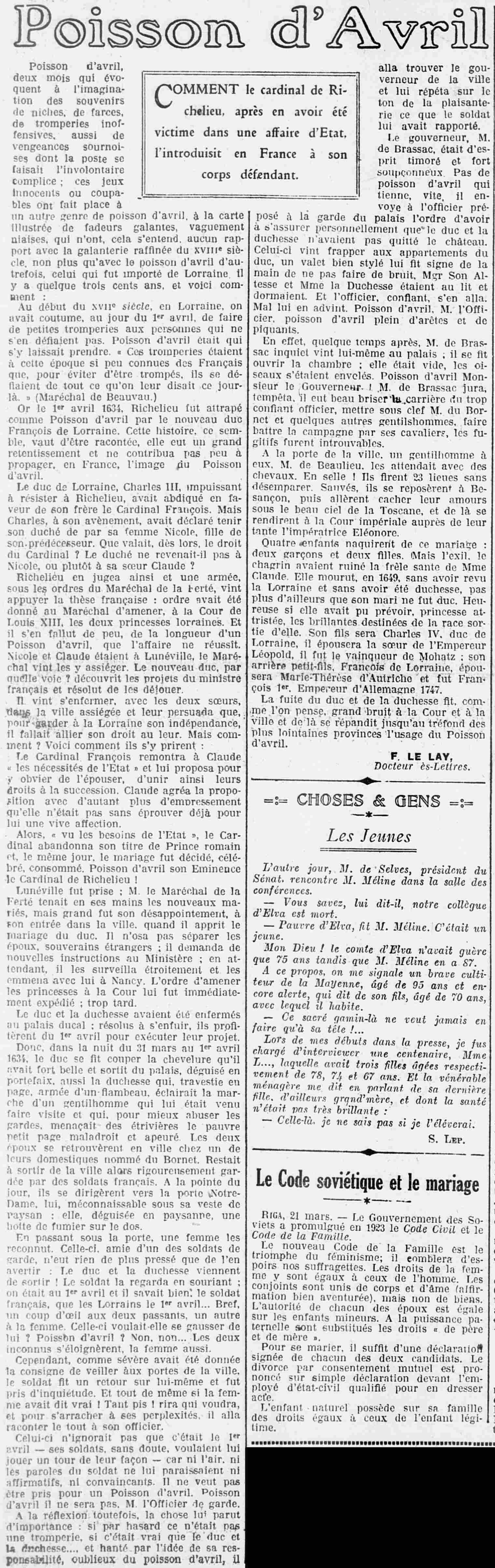
April Fools' Day, two months that evoke memories of pranks, pranks, harmless deceptions, and even sneaky revenge in which the post office was an unwitting accomplice; these innocent or guilty games have given way to another kind of April Fools' Day, with a card illustrated with insipid, vaguely silly gallantries, which have, it is understood, no connection with the refined gallantry of the 18th century, nor with the April Fools' Day of yesteryear, the one imported from Lorraine some three hundred years ago, and here is how:
At the beginning of the 17th century, in Lorraine, it was customary, on April 1st, to play small tricks on people who were not suspicious. An April Fool was anyone who fell for it. "These deceptions were so little known to the French at that time that, to avoid being deceived, they distrusted everything they were told that day." (Marshal de Beauvau)
Now, on April 1, 1634, Richelieu was caught as an April Fool's joke by the new Duke Francis of Lorraine. This story, it seems, is worth telling; it caused a great stir and contributed significantly to spreading the image of April Fool's Day in France.
The Duke of Lorraine, Charles III, powerless to resist Richelieu, had abdicated in favor of his brother, Cardinal Francis. But Charles, upon his accession, had declared that he held his duchy through his wife, Nicole, daughter of his predecessor. What, then, was the value of the Cardinal's right? Didn't the duchy revert to Nicole, or rather to her sister, Claude? Richelieu judged it thus, and an army, under the command of Marshal de la Ferté, came to support the French thesis: the Marshal had been ordered to bring the two Lorraine princesses to the Court of Louis XIII. And it was a close call, the length of an April Fool's joke, that the affair failed to succeed. Nicole and Claude were in Lunéville, and the Marshal came to besiege them. The new duke—by what means?—discovered the French minister's plans and resolved to thwart them.
He came to lock himself, with the two sisters, in the besieged city and persuaded them that, to preserve Lorraine's independence, they had to ally his rights with theirs. But how? Here's how they went about it:
Cardinal François reminded Claude of "the necessities of the State" and proposed that, to overcome them, he marry her, thus uniting their rights to the succession. Claude accepted the proposal with all the more eagerness since she already felt a deep affection for him.
Then, "given the needs of the State," the Cardinal abandoned his title of Roman Prince, and the marriage was decided, celebrated, and consummated that same day. April Fool's Day, His Eminence Cardinal Richelieu!
Lunéville was taken; Marshal de la Ferté held the newlyweds in his hands, but great was his disappointment upon entering the city when he learned of the Duke's marriage. He did not dare separate the spouses, foreign sovereigns; he requested new instructions from the Ministry; in the meantime, he kept a close watch on them and took them with him to Nancy. The order to bring the princesses to Court was immediately sent to him; too late.
The Duke and Duchess had been imprisoned in the ducal palace; determined to escape, they took advantage of April 1st to carry out their plan. So, on the night of March 31st to April 1st, 1634, the Duke had his beautiful hair cut and left the palace disguised as a porter. The Duchess, disguised as a page and armed with a torch, lit the way for a gentleman who had come to visit her and, to further deceive the guards, threatened the poor, clumsy, and frightened little page with his stirrup leathers. The couple met in town at the home of one of their servants named du Bornet. All that remained was to escape the city, which was then strictly guarded by French soldiers. At daybreak, they headed for the Porte Notre-Dame. He was unrecognizable in his peasant jacket; she, disguised as a peasant woman, carried a basket of manure on her back.
As they passed through the gate, a woman recognized them. The latter, a friend of one of the soldiers on guard, was in no hurry to warn him: The Duke and Duchess have just left! The soldier looked at her, smiling; it was April Fool's Day, and he knew the French soldier well, that the Lorrainers celebrated April Fool's Day... In short, a glance at the two passersby, another at the woman. Was she trying to mock him? April Fool's Day? No, no... The two strangers moved away, and so did the woman.
However, as the strict order to keep watch at the city gates had been given, the soldier looked back and became worried. And all the same, what if the woman had spoken the truth? Too bad! Whoever wants to laugh, and to free himself from his perplexity, he went to tell his officer everything. He was not unaware that it was April Fool's Day; his soldiers, no doubt, wanted to play a trick on him in their own way, for neither the soldier's manner nor his words seemed affirmative or convincing to him. He does not want to be taken for an April Fool. He will not be an April Fool, Mr. Officer of the Guard. On reflection, however, the thing seemed to him 'of importance: if by chance it was not a deception, if it were true that the Duke and the Duchess... and haunted by the idea of his responsibility, forgetting the April Fool's Day, he went to find the governor of the city and repeated to him in a joking tone what the soldier had told him. The governor, Mr. de Brassac, was of a timid and very suspicious mind. No April Fool's joke, he quickly sent an order to the officer in charge of the palace guard to personally ensure that the Duke and Duchess had not left the castle. The officer came to knock on the Duke's apartments, a well-dressed valet signaled to him not to make any noise, His Highness and the Duchess were in bed and asleep. And the officer, confident, left. Bad news befell him. April Fool's joke, Mr. Officer, April Fool's joke full of bones and prickles.
Indeed, some time later, a worried Mr. de Brassac came to the palace himself; he had his room opened; it was empty, the birds had flown away. April Fool's joke, Mr. Governor. M. de Brassac swore and raged. He tried to break the career of the overconfident officer, lock up M. du Bornet and a few other gentlemen, and have his horsemen scour the countryside, but the fugitives were nowhere to be found.
At the city gate, a gentleman of theirs, M. de Beaulieu, was waiting for them with horses. Saddle up! They rode 23 leagues without stopping. Rescued, they rested in Besançon, then went to hide their loves under the beautiful Tuscan sky, and from there went to the Imperial Court to be with their aunt, the Empress Eleanor. Four children were born of this marriage: two boys and two girls. But exile and grief had ruined Madame Claude's frail health. She died in 1649, without having seen Lorraine again and without having been a duchess, any more than her husband had been a duke. Happy if she had been able to foresee, saddened princess, the brilliant destiny of the race that sprang from her. Her son would be Charles IV, Duke of Lorraine, he would marry the sister of Emperor Leopold, he would be the victor of Mohatz. Her great-grandson, Francis of Lorraine, would marry Maria Theresa of Austria and become Francis I, Emperor of Germany in 1747.
The flight of the Duke and Duchess caused, as one might imagine, a great stir at Court and in the city, and from there the custom of April Fool's Day spread to the depths of the most distant provinces.
F. LE LAY, Doctor of Letters.
|