|
Three Unpublished Poems by J.-H. Fabre
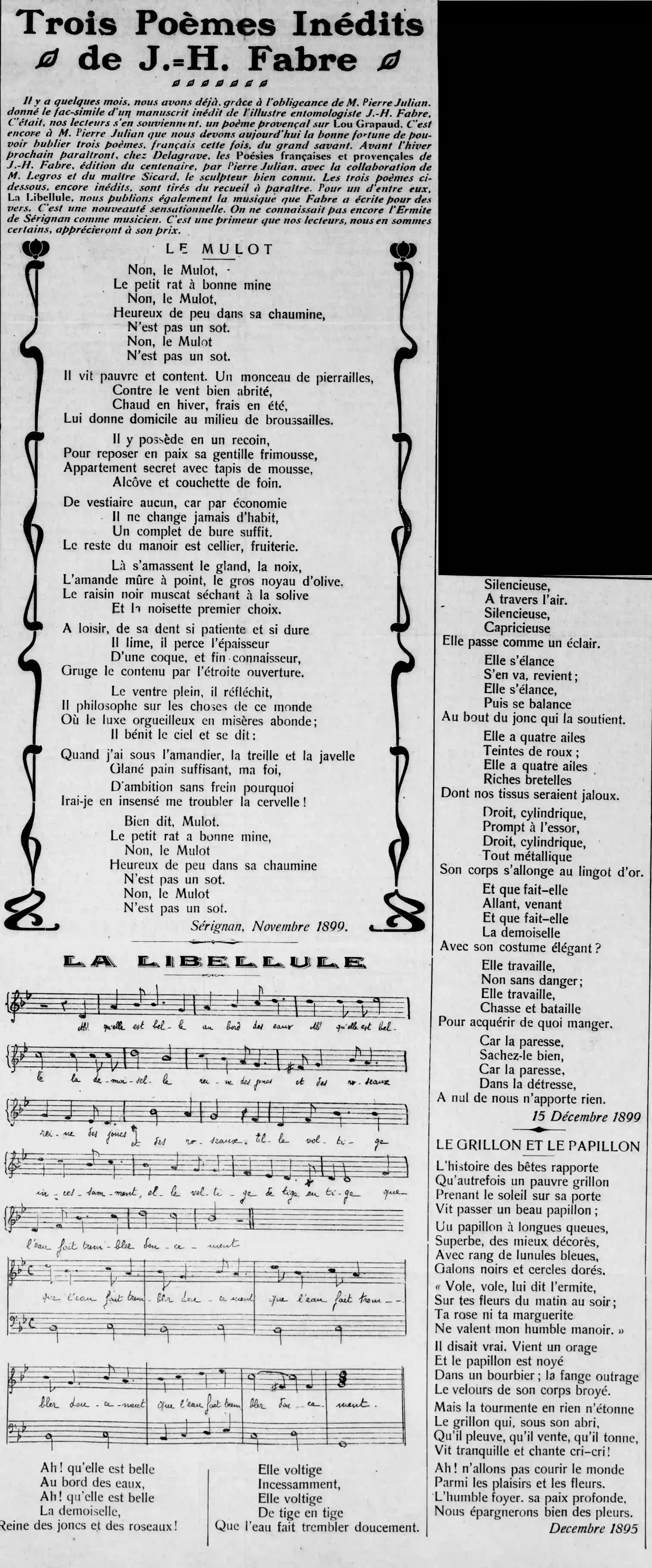
A few months ago we already have. thanks to the kindness of Mr. Pierre Julian given the facsimile of an unpublished manuscript by the illustrious entomologist J.-H. Fabre. It was, our readers remember, a Provençal poem about Lou Grapaud. It is again to Mr. Pierre Julian that we owe today the good fortune of being able to publish three poems, French this time, by the great scholar. Before next winter, the Poésies françaises et provençales by J.-H. will be published by Delagrave. Fabre, centenary edition, by Pierre Julian, with the collaboration of Mr. Legros and master Sicard, the well-known sculptor. The three poems below, still unpublished, are taken from the forthcoming collection. For one of them La Libellule, we are also publishing the music that Fabre wrote for these verses. This is a sensational novelty. We did not yet know the Hermit of Sérignan as a musician. This is a first that our readers, we are certain, will appreciate at its price.
THE MOUSE
No, the Field Mouse,
The little rat looks good
No, the Field Mouse,
Happy with little in his cottage,
Not a fool.
No, the Field Mouse
Not a fool.
He lives poor and content.
A pile of stones,
Against the well sheltered wind,
Warm in winter, cool in summer,
He makes his home in the middle of the bushes.
In one corner he has,
To rest his sweet face in peace,
Secret apartment with moss carpet,
Alcove and hay bunk.
No cloakroom, because for economy
He never changes his clothes,
A household suit is enough.
The rest of the manor is a cellar and fruit store.
There are gathered the acorn, the nut,
The ripe almond, the large olive stone.
Black Muscat grapes drying on the joist
And the first choice hazelnut.
At leisure, with his tooth so patient and so hard
He files, he pierces the thickness
Of a shell, and a fine connoisseur,
Chews contents through narrow opening.
With a full stomach, he thinks,
He philosophizes about the things of this world
Where proud luxury in miseries abounds;
He blessed the sky and said to himself:
When I have under the almond tree, the trellis and the bleach
Gleaned sufficient bread, my faith,
Unbridled ambition why
Shall I fool my brains!
Well said, Mulot.
The little rat looks good,
No, the Field Mouse
Happy with little in his cottage
Not a fool.
No, the Field Mouse
Not a fool.
Sérignan, November 1899.
THE DRAGONFLY
Ah! that she is beautiful
At the edge of the waters,
Ah! that she is beautiful
Lady,
Queen of rushes and reeds!
She flutters
Incessantly,
She flutters
From stem to stem
That the water makes it tremble gently.
Silent,
Through the air.
Silent,
Capricious
It passes like lightning.
She rushes
Goes away, comes back;
She rushes,
Then swings
At the end of the rush that supports it.
She has four wings
Tints of red;
She has four wings
Rich straps
Of which our fabrics would be jealous.
Straight, cylindrical,
Quick to rise,
Straight, cylindrical,
All metal
His body stretches to the gold bar.
And what does she do
Coming, coming
And what does she do
Lady
With his elegant suit?
She works,
Not without danger;
She works,
Hunting and battle
To acquire something to eat.
Because laziness,
Know this well,
Because laziness,
In distress,
None of us brings anything.
December 15, 1899
THE CRICKET AND THE BUTTERFLY
The story of beasts relates
That once a poor cricket
Taking the sun on her door
A beautiful butterfly passes by;
A butterfly with long tails,
Superb, of the best, decorated,
With a row of blue lunulae,
Black braids and golden circles,
“Fly, fly,” said the hermit to him,
On your flowers from morning to evening;
Your rose nor your daisy
Not worth my humble mansion.
He was telling the truth. Comes a storm
And the butterfly is drowned
In a quagmire; the mire outrage
The velvet of his crushed body.
But the turmoil in no way surprises
The cricket which, under its shelter,
Whether it rains, whether it winds, whether it thunders,
Live quietly and sing cry-cri!
Ah! let's not run around the world
Among pleasures and flowers.
The humble home, its deep peace,
We will save ourselves a lot of tears.
December 1895
|