

| Excelsior 16 novembre 1924 |
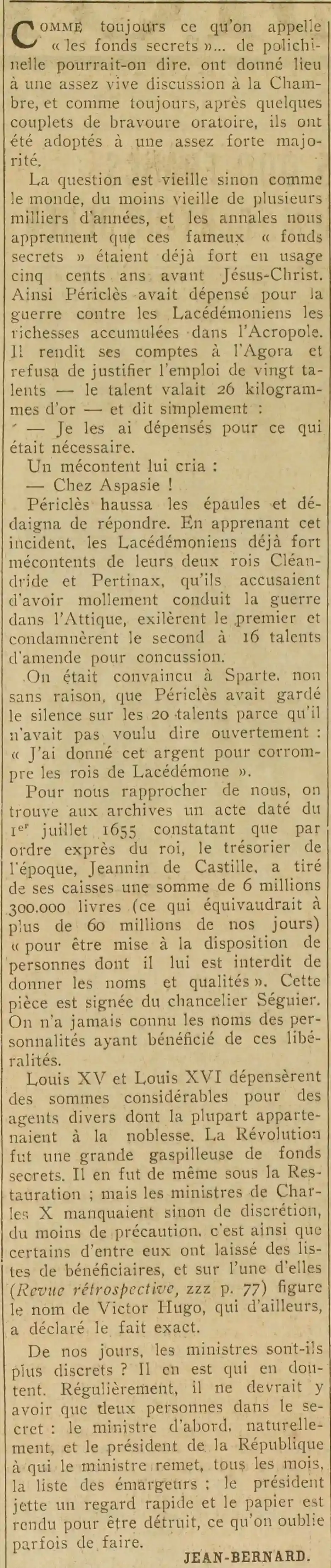
As always, what are called "secret funds"... one might say, open-ended. gave rise to a fairly lively discussion in the House, and as always, after a few verses of oratorical bravado, they were adopted by a fairly large majority. The question is as old as the world, if not as old as the world, at least several thousand years old, and the annals tell us that these famous "secret funds" were already in great use five hundred years before Jesus Christ. Thus Pericles had spent the wealth accumulated in the Acropolis on the war against the Lacedaemonians. He gave his accounts to the Agora and refused to justify the use of twenty talents - the talent was worth 26 kilograms of gold - and simply said: To bring us closer to us, we find in the archives a document dated July 1, 1655 stating that by express order of the king, the treasurer of the time, Jeannin of Castile, drew from his coffers a sum of 6,300,000 livres (which would be equivalent to more than 60 million today) "to be placed at the disposal of people whose names and qualities he is forbidden to give". This document is signed by Chancellor Séguier. The names of the personalities who benefited from these generosity have never been known. Are ministers more discreet these days? Some doubt it. Regularly, there should only be two people in the secret, the minister first, naturally, and the President of the Republic to whom the minister gives, every month, the list of signatories; the President takes a quick look and the paper is returned to be destroyed, which is sometimes forgotten. JEAN-BERNARD . |
| Retour - Back 16 novembre 1924 |