

| L'Éclaireur du dimanche 09 novembre 1924 |
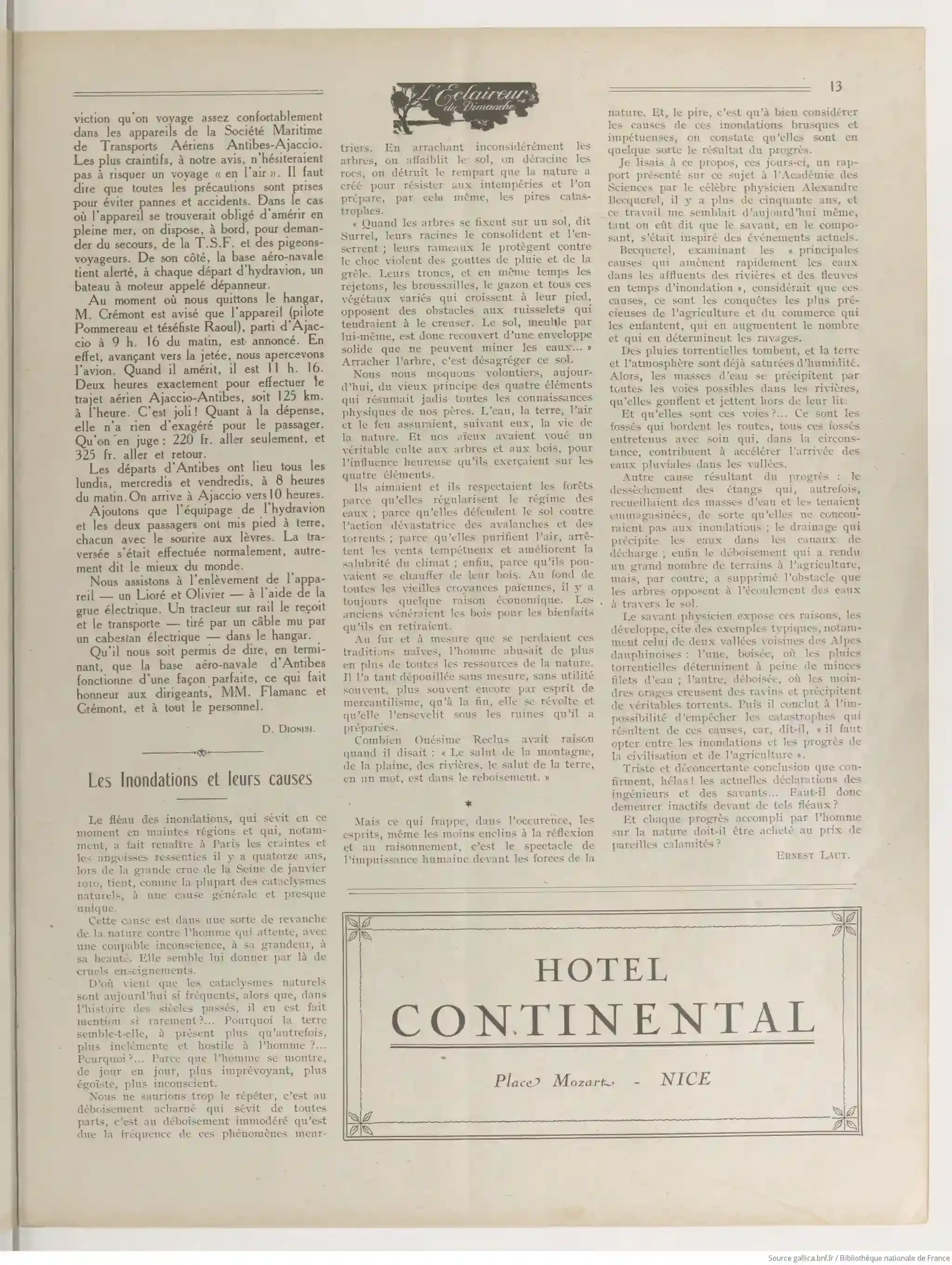
Floods and their causes The scourge of floods, which is currently raging in many regions and which, in particular, has revived in Paris the fears and anxieties felt fourteen years ago, during the great flood of the Seine in January 1910, is due, like most natural cataclysms, to a general and almost unique cause. How is it that natural cataclysms are so frequent today, while in the history of past centuries they are so rarely mentioned? ... Why does the earth seem, now more than ever, more inclement and hostile to man? ... Why? ... Because man shows himself, day by day, more improvident, more selfish, more unconscious. We cannot repeat it too often, it is to the relentless deforestation that is raging everywhere, it is to the immoderate deforestation that the frequency of these deadly phenomena is due. By thoughtlessly uprooting trees, we weaken the soil, we uproot the rocks, we destroy the rampart that nature has created to resist bad weather and we prepare, by this very fact, the worst catastrophes. Today we readily mock the old principle of the four elements that once summed up all the physical knowledge of our fathers. Water, earth, air and fire ensured, according to them, the life of nature. And our ancestors had devoted a real cult to trees and woods, for the happy influence that they exercised on the four elements. They loved and respected the forests because they regulate the water regime; because they defend the soil against the devastating action of avalanches and torrents; because they purify the air, stop stormy winds and improve the healthiness of the climate; finally, because they could heat themselves with their wood. At the bottom of all the old pagan beliefs, there is always some economic reason. The ancients venerated the woods for the benefits they derived from them. As these naive traditions were lost, man increasingly abused all the resources of nature. He has stripped it so without measure, often without utility, even more often out of a spirit of mercantilism, that in the end, it revolts and buries him under the ruins he has prepared. But what strikes, in this case, the minds, even those least inclined to reflection and reasoning, is the spectacle of human impotence in the face of the forces of nature. And, the worst thing is that when we consider the causes of these sudden and impetuous floods, we see that they are in some way the result of progress. I was reading on this subject, these days, a report presented on this subject to the Academy of Sciences by the famous physicist Alexandre Becquerel, more than fifty years ago, and this work seemed to me to be from today itself, so much so that one would have said that the scientist, in composing it, had been inspired by current events. Becquerel, examining the "principal causes that rapidly bring water into the tributaries of rivers and streams in times of flooding," considered that these causes are the most precious conquests of agriculture and commerce that give rise to them, increase their number, and determine their ravages. Torrential rains fall, and the earth and the atmosphere are already saturated with humidity. Then, the masses of water rush by all possible routes into the rivers, which they swell and throw out of their beds. And what are these routes? ... They are the ditches that line the roads, all these carefully maintained ditches that, in the circumstances, contribute to accelerating the arrival of rainwater in the valleys. Another cause resulting from progress: the drying up of the ponds that, formerly, collected masses of water and kept them stored, so that they did not contribute to flooding; drainage which precipitates water into the discharge channels; finally deforestation which has returned a large number of lands to agriculture, but, on the other hand; has removed the obstacle that trees oppose to the flow of water through the soil. The learned physicist sets out these reasons, develops them, cites typical examples, notably that of two neighboring valleys of the Dauphiné Alps: one, wooded, where torrential rains barely determine thin streams of water; the other, deforested, where the slightest storms dig ravines and precipitate real torrents. Then he concludes that it is impossible to prevent the catastrophes which result from these causes, because, he says, "we must choose between floods and the progress of civilization and agriculture". A sad and disconcerting conclusion which is confirmed, alas! by the current declarations of engineers and scientists... Should we therefore remain inactive in the face of such scourges? And must every progress made by man over nature be bought at the price of such calamities? ERNEST LAUT. |
| Retour - Back 09 novembre 1924 |