

| Le Petit Parisien - January 29, 1925 |
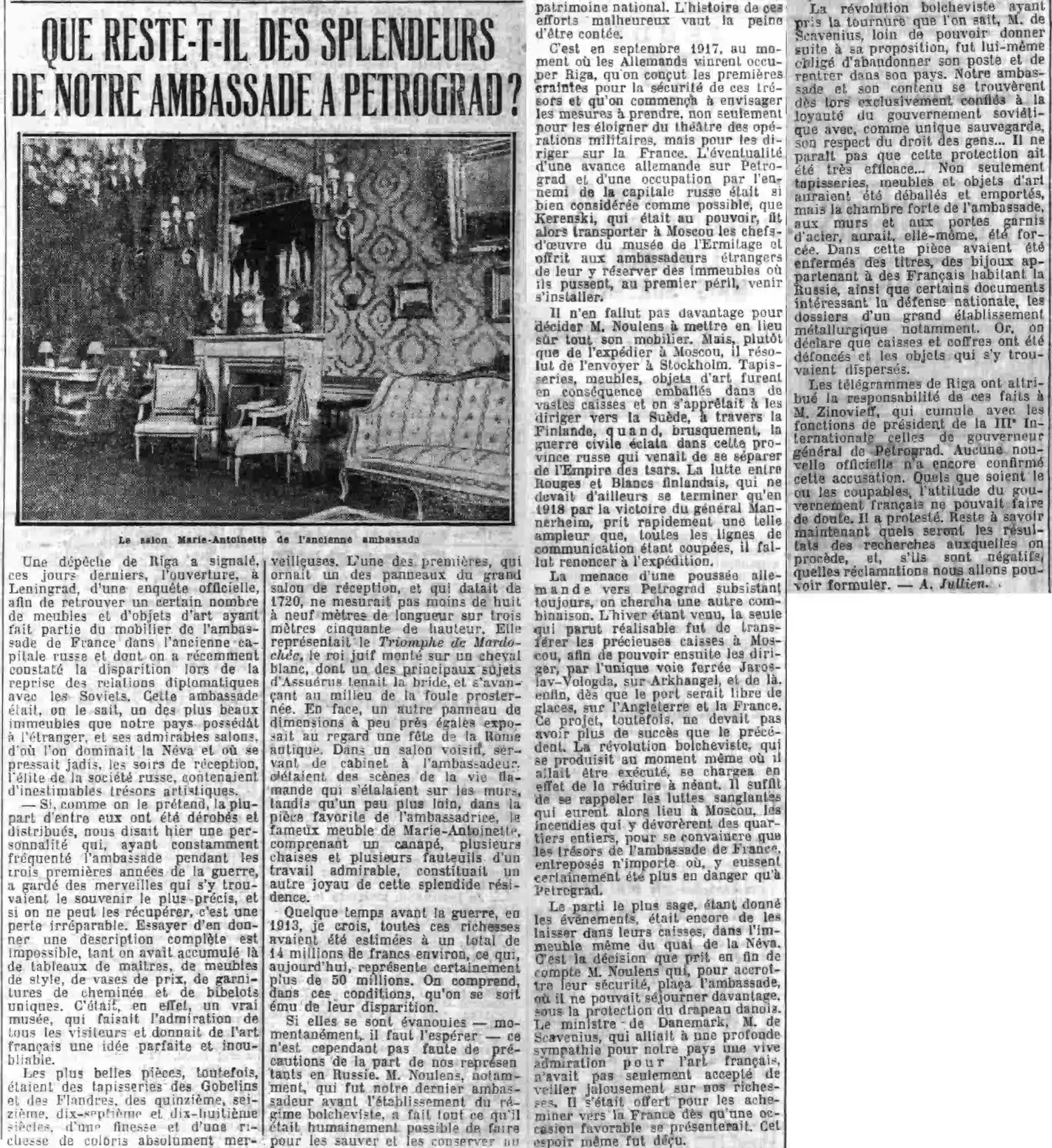 A dispatch from Riga has reported, in recent days, the opening, in Leningrad, of an official investigation, in order to find a certain number of pieces of furniture and objects of art which were part of the furniture of the French embassy in the former Russian capital and which were recently discovered to have disappeared during the resumption of diplomatic relations with the Soviets. This embassy was, as we know, one of the most beautiful buildings that our country possessed abroad, and its admirable salons, from which one could overlook the Neva and where the elite of Russian society used to gather on reception evenings, contained inestimable artistic treasures. A dispatch from Riga has reported, in recent days, the opening, in Leningrad, of an official investigation, in order to find a certain number of pieces of furniture and objects of art which were part of the furniture of the French embassy in the former Russian capital and which were recently discovered to have disappeared during the resumption of diplomatic relations with the Soviets. This embassy was, as we know, one of the most beautiful buildings that our country possessed abroad, and its admirable salons, from which one could overlook the Neva and where the elite of Russian society used to gather on reception evenings, contained inestimable artistic treasures.If, as is claimed, most of them have been stolen and distributed, a personality told us yesterday who, having constantly frequented the embassy during the first three years of the war, has kept the marvels which were there the most precise memory, and if they cannot be recovered, it is an irreparable loss. To attempt to give a complete description of it is impossible, so many paintings by masters, period furniture, expensive vases, mantelpieces and unique trinkets had been accumulated there. It was, in fact, a real museum, which was the admiration of all visitors and gave a perfect and unforgettable idea of French art. The most beautiful pieces, however, were tapestries from the Gobelins and Flanders, from the fifteenth, sixteenth, seventeenth and eighteenth centuries, of an absolutely marvelous finesse and richness of colour. One of the first, which decorated one of the panels of the large reception room, and which dated from 1720, measured no less than eight to nine metres in length by three and a half metres in height. It represented the Triumph of Mordecai, the Jewish king mounted on a white horse, of which one of the principal subjects of Ahasuerus held the bridle, and advancing in the midst of the prostrate crowd. Opposite, another panel of approximately the same size displayed a festival in ancient Rome. In a neighboring salon, which served as the ambassador's office, scenes from Flemish life were spread out on the walls, while a little further away, in the ambassador's favorite room, Marie-Antoinette's famous piece of furniture, comprising a sofa, several chairs, and several armchairs of admirable workmanship, constituted another jewel of this splendid residence. Some time before the war, in 1913, I believe, all these riches had been estimated at a total of about 14 million francs, which today certainly represents more than 50 million. Under these conditions, one can understand why people were upset by their disappearance. If they have vanished momentarily, one must hope that it is not for want of precautions on the part of our representatives in Russia. Mr. Noulens, in particular, who was our last ambassador before the establishment of the Bolshevik regime, did everything that was humanly possible to save them and preserve them in national heritage. The story of these unfortunate efforts is worth telling.
This was enough to persuade Mr. Noulens to put all his furniture in a safe place. But, rather than sending it to Moscow, he decided to send it to Stockholm. Tapestries, furniture, and works of art were consequently packed in large crates and were about to be sent to Sweden, through Finland, when, suddenly, civil war broke out in this Russian province which had just separated from the Empire of the Tsars. The struggle between the Finnish Reds and Whites, which was not to end until 1918 with the victory of General Mannerheim, quickly took on such proportions that, with all lines of communication cut, the expedition had to be abandoned. A. Jullien.
|
| Back - January 29, 1925 |