

| Excelsior january 18, 1925 |
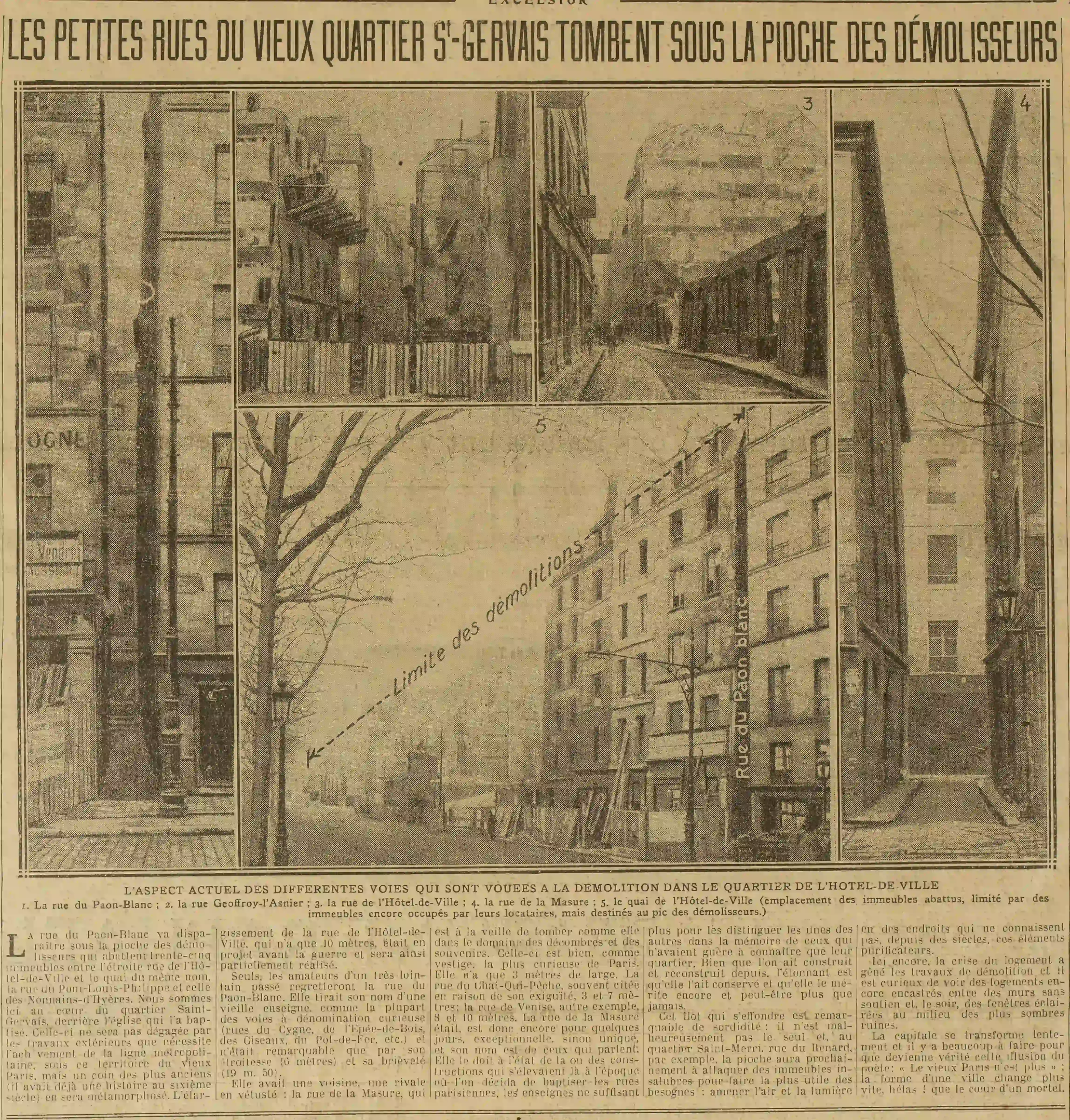
THE SMALL STREETS OF THE OLD ST-GERVAIS DISTRICT FALL UNDER THE DEMOLISHERS' PICKAXE The current appearance of the different roads that are determined for demolition in the Hôtel-de-Ville district The rue du Paon-Blanc will disappear under the pickaxe of the demolitionists who will demolish thirty-five buildings between the narrow rue de l'Hôtel-de-Ville and the quay of the same name, the rue du Pont-Louis-Philippe and that of the Nonnains-d'Hyères. We are here in the heart of the Saint-Gervais district, behind the church that named it. This will not be cleared by the exterior work required for the completion of the metropolitan line, under this territory of old Paris, but one of the oldest corners (it already had a history in the sixth century) will be transformed. The widening of the rue de l'Hôtel-de-Ville, which is only 10 meters, was planned before the war and will thus be partially completed. which is on the verge of falling like it into the realm of rubble and memories. This one is indeed, as a vestige, the most curious in Paris. It is only 3 meters wide. The rue du Chat-Qui-Pêche, often cited because of its narrowness, 3 and 7 meters; the rue de Venise, another example, 8 and 10 meters. Rue de la Masure was, and is still for a few days, exceptional, if not unique, and its name is one of those that speak. It owes this to the state of the building(s) that stood there at the time when it was decided to name Parisian streets, the signs no longer being enough to distinguish them from each other in the memory of those who had little to know except their neighborhood. Although it has been built and rebuilt since then, the astonishing thing is that it has retained it and that it still deserves it, perhaps more than ever.
|
| Back January 18, 1925 |