

| Excelsior january 18, 1925 |
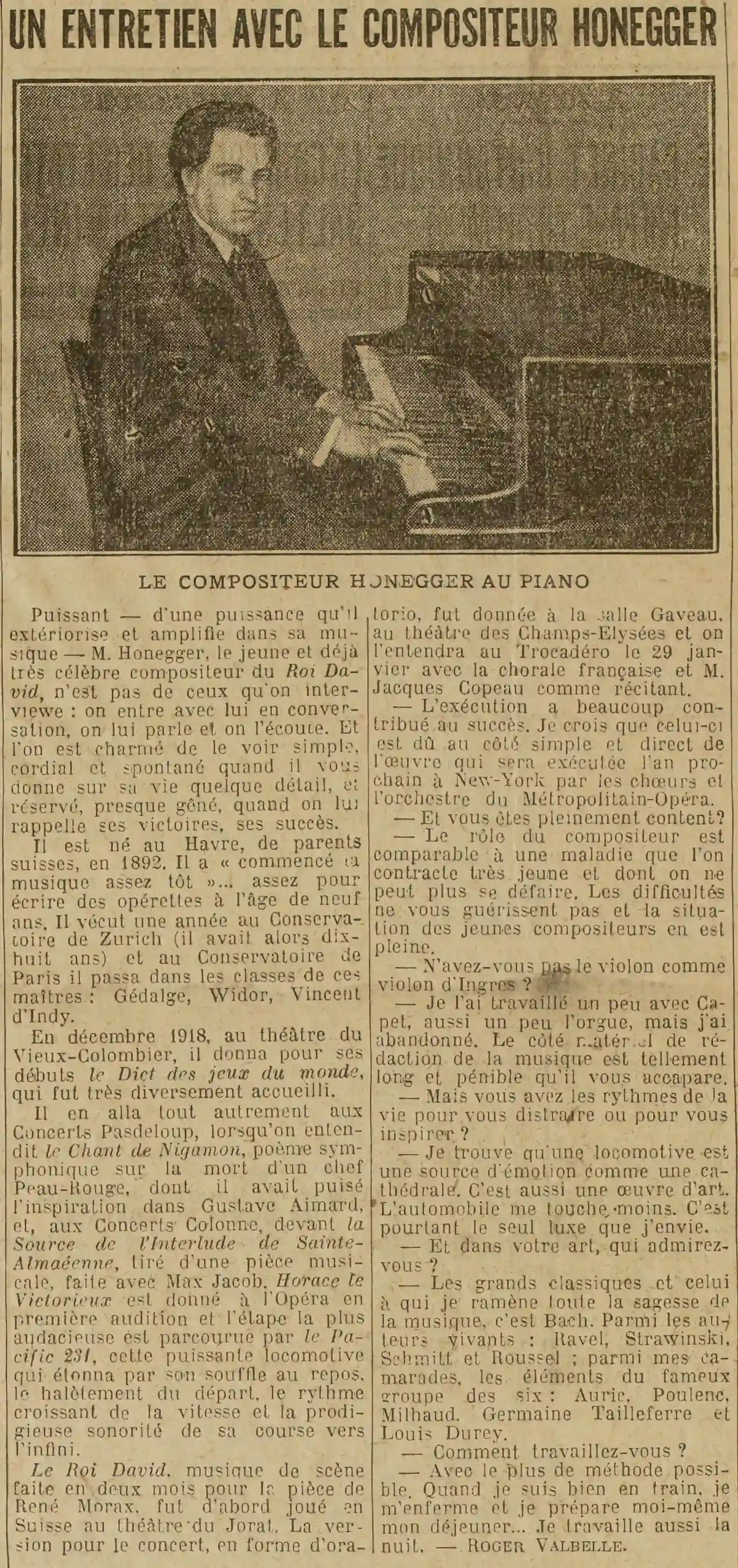
AN INTERVIEW WITH THE COMPOSER HONEGGER Powerful with a power that he externalizes and amplifies in his music, Mr. Honegger, the young and already very famous composer of King David, is not one to interview: you enter into conversation with him, you talk to him and you listen to him. And you are charmed to see him simple, cordial and spontaneous when he gives you some detail about his life, and reserved, almost embarrassed, when you remind him of his victories, his successes. In December 1918, at the Théâtre du Vieux-Colombier, he gave his debut performance of Le Dict des jeux du monde, which was very mixedly received. — And you are fully satisfied?
— The role of the composer is comparable to an illness that one contracts very young and from which one can no longer get rid. Difficulties do not cure you and the situation of young composers is full of them. — Don't you have the violin as your hobby? — I worked on it a little with Capet, also the organ a little, but I gave up. The material side of writing music is so long and painful that it takes up your time. — But do you have the rhythms of life to distract you or inspire you? — I find that a locomotive is a source of emotion like a cathedral. It is also a work of art. The automobile touches me, less. Yet it is the only luxury that I envy. — And in your art, who do you admire? — The great classics and the one to whom I attribute all the wisdom of music is Bach. Among the living authors: Ravel, Stravinsky, Schmitt and Roussel; among my comrades, the elements of the famous group of six: Auric, Poulenc, Milhaud. Germaine Tailleferre and Louis Durey. — How do you work? With as much method as possible. — When I'm really going, I lock myself away and prepare my own lunch... I also work at night. - ROGER VALBELLE.
|
| Back January 18, 1925 |