|
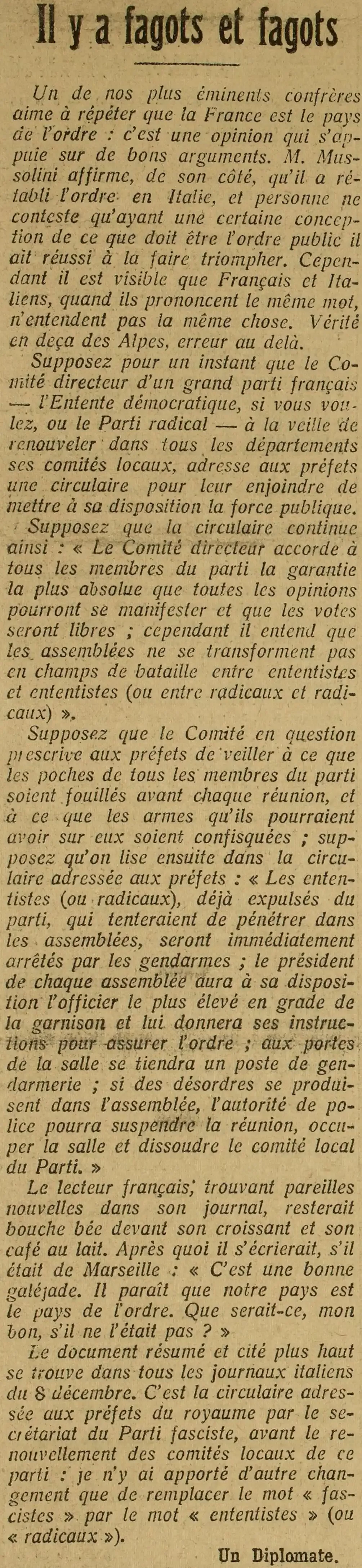
One of our most eminent colleagues likes to repeat that France is the country of order: it is an opinion based on good arguments. Mr. Mussolini asserts, for his part, that he has reestablished order in Italy, and no one disputes that having a certain conception of what public order should be, he succeeded in making it triumph. However, it is visible that French and Italians, when they pronounce the same word, do not mean the same thing. Truth on this side of the Alps, error beyond.
Suppose for a moment that the Steering Committee of a large French party, the Democratic Entente, if you like, or the Radical Party, on the eve of renewing its local committees in all departments, addresses a circular to the prefects to order them to put the public force is at its disposal.
Suppose the circular continues as follows: “The Steering Committee grants to all members of the party the most absolute guarantee that all opinions will be able to be expressed and that votes will be free; However, he intends that the assemblies should not be transformed into battlefields between agreementists and agreementists (or between radicals and radicals).”
Suppose that the Committee in question instructs the prefects to ensure that the pockets of all party members are searched before each meeting, and that any weapons they may have on them are confiscated; suppose that we then read in the circular addressed to the prefects: “Contentists (or radicals), already expelled from the party, who attempt to enter the assemblies, will be immediately arrested by the gendarmes; the president of each assembly will have at his disposal the highest ranking officer of the garrison and will give him instructions to ensure order; at the doors of the room will be a gendarmerie post; If disturbances occur in the assembly, the police authority may suspend the meeting, occupy the room and dissolve the local party committee. »
The French reader, finding such news in his newspaper, would remain speechless in front of his croissant and his café au lait. After which he would exclaim, if he were from Marseille: “It’s a good joke. It seems that our country is the country of order. What would it be, my good fellow, if it were not? »
The document summarized and cited above can be found in all Italian newspapers on December 8. This is the circular addressed to the prefects of the kingdom by the secretariat of the Fascist Party, before the renewal of the local committees of this party: I have made no other change than to replace the word “fascists” with the word “agreementists” (or “radicals”).
A diplomat.
|