|
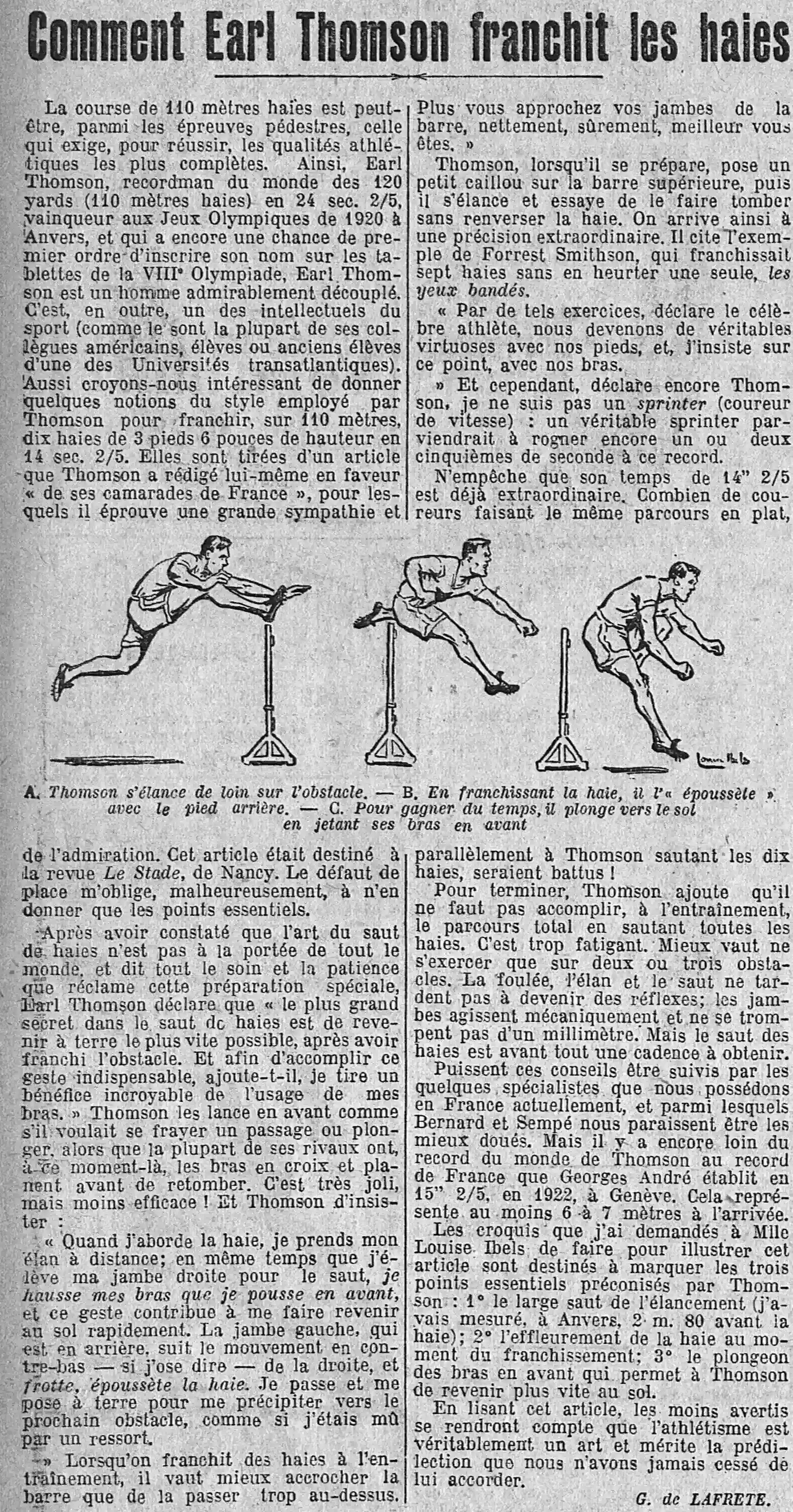
The 110 meter hurdles race is perhaps, among the walking events, the one which requires, to succeed, the most complete athletic qualities. Thus, Earl Thomson, world record holder for the 120 yards (110 meters hurdles) in 24 sec. 2/5, winner at the 1920 Olympic Games in Antwerp, and who still has a prime chance of inscribing his name on the shelves of the VIII Olympiad, Earl Thomson is an admirably uncoupled man. He is, moreover, one of the intellectuals of sport (as are most of his American colleagues, students or former students of one of the transatlantic universities). We therefore believe it is interesting to give some notions of the style used by Thomson to overcome, over 110 meters, ten hurdles of 3 feet 6 inches in height in 14 seconds. 2/5. They are taken from an article that Thomson himself wrote in favor of his "comrades from France", for whom he felt great sympathy and admiration. This article was intended for the magazine Le Stade, in Nancy. Unfortunately, lack of space forces me to only give the essential points.
After noting that the art of hurdle jumping is not within everyone's reach, and expressing all the care and patience that this special preparation requires, Barl Thomson declares that "the greatest secret in hurdle jumping hurdles is to return to the ground as quickly as possible, after having overcome the obstacle. And in order to accomplish this essential gesture, he adds, I derive incredible benefit from the use of my arms. » Thomson throws them forward as if he wanted to force a passage or dive, while most of his rivals, at this moment, have their arms crossed and are gliding before falling back. It's very pretty, but less effective! And Thomson insists: “When I approach the hedge, I take my momentum from a distance; at the same time as I raise my right leg for the jump, I raise my arms which I push forward, and this gesture helps to bring me back to the ground quickly. The left leg, which is behind, follows the movement downwards, if I dare say, from the right, and rubs and dusts the hedge. I pass and land on the ground to rush towards the next obstacle, as if I were moved by a spring.
“When jumping hurdles in training, it’s better to hang on to the bar than to pass it too far over. The closer you bring your legs to the bar, clearly, surely, the better you are. »
Thomson, when he is getting ready, places a small stone on the upper bar, then he rushes forward and tries to knock it down without overturning the hedge. We thus achieve extraordinary precision. He cites the example of Forrest Smithson, who crossed seven hurdles without hitting a single one, blindfolded,
“Through such exercises,” declared the famous athlete, “we become true virtuosos with our feet, and, I insist on this point, with our arms.” And yet, says Thomson, I am not a sprinter: a real sprinter would manage to shave another fifth of a second off this record.
Nevertheless, his time of 14" 2/5 is already extraordinary. How many runners doing the same flat course, parallel to Thomson jumping the ten hurdles, would be beaten!
Finally, Thomson adds that you should not complete the entire course in training by jumping all the hurdles. It's too tiring. It's better to only practice on two or three obstacles. Stride, momentum and jump soon become reflexes; the legs act mechanically and do not go wrong by a millimeter. But jumping hurdles is above all a cadence to obtain. May this advice be followed by the few specialists that we currently have in France, and among whom Bernard and Sempé appear to us to be the best gifted. But there is still a long way from Thomson's world record to the French record that Georges André established in 15" 2/5, in 1922, in Geneva. This represents at least 6 to 7 meters at the finish. The sketches that I I asked Miss Louise Ibels to do to illustrate this article are intended to mark the three essential points recommended by Thomson: 1° the wide jump of the slenderness (I had measured, in Antwerp, 2 m. 80 before the hurdle ); 2° the brushing of the hedge when crossing; 3° the dive of the arms forward which allows Thomson to return to the ground more quickly.
By reading this article, the less informed will realize that athletics is truly an art and deserves the predilection that we have never ceased to grant it.
G. de LAFRETE.
|