Nouvelles des ports

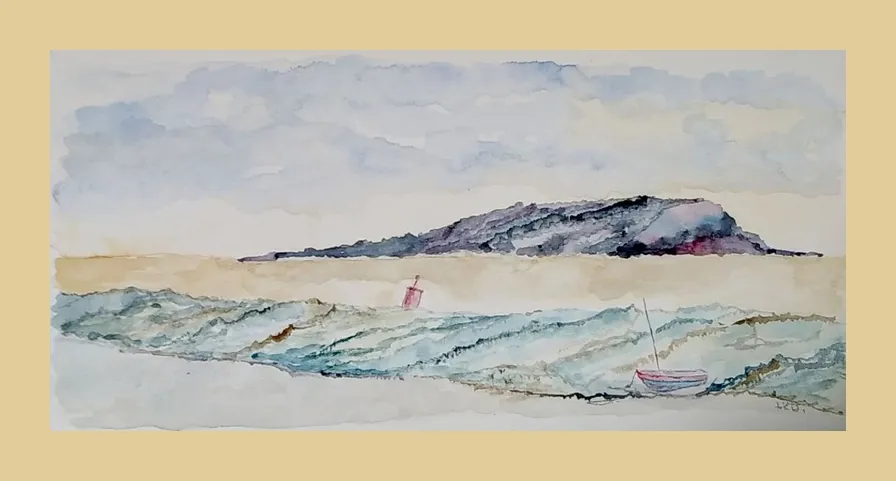
aquarelle marine - marine watercolor

Rafiots et compagnies

aquarelle marine cargo au mouillage - marine watercolor cargo ship at anchor

Nouvelles des escales

aquarelle marine - marine watercolor


L'Œuvre


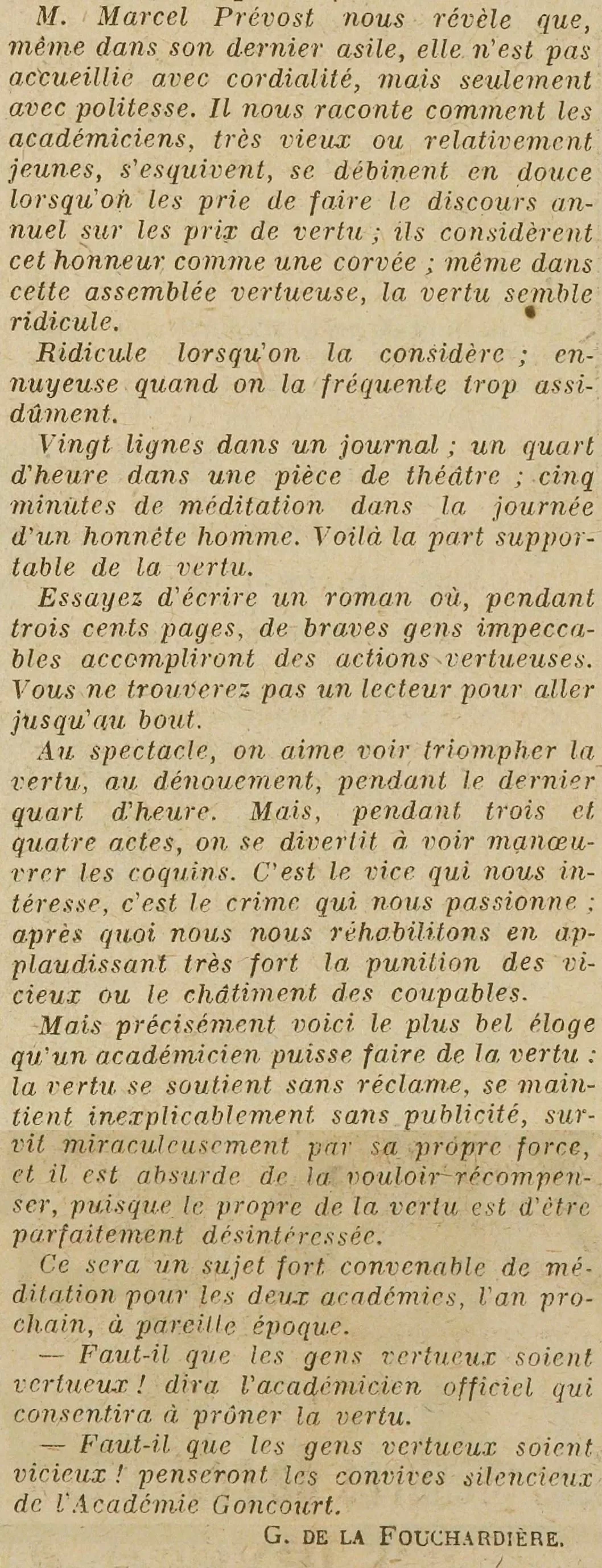
LOEuvre 1923 12 10 02. Mr. Marcel Prévost reveals to us that, even in its last asylum, it (virtue) is not received with cordiality, but only with politeness. He tells us how academicians, very old or relatively young, slip away, sneak away when they are asked to give the annual speech on the prizes of virtue; they consider this honor a chore; even in this virtuous assembly, virtue seems ridiculous. Ridiculous when considered; boring when you frequent it too assiduously. Twenty lines in a newspaper; a quarter of an hour in a play; five minutes of meditation in the day of an honest man. This is the bearable part of virtue. Try writing a novel where, for three hundred pages, good, impeccable people perform virtuous actions. You won't find a drive to go all the way. At the show, we like to see virtue triumph, at the end, during the last quarter of an hour. But, for three and four acts, we have fun watching the rascals maneuver. It is vice that interests us, it is crime that fascinates us; after which we rehabilitate ourselves by applauding very loudly the punishment of the vicious or the punishment of the guilty. But here is precisely the finest praise that an academician can give to virtue: virtue supports itself without admonishment, maintains itself inexplicably without publicity, survives miraculously by its own strength, and it is absurd to want to reward it, since the property of virtue is to be perfectly disinterested. This will be a very suitable subject of meditation for the two academies next year, at this time. -- Must virtuous people be virtuous! will say the official academician who agrees to advocate virtue. Should virtuous people be, vicious! will think the silent guests of the Académie Goncourt.  G. DE LA FOUCHARDIERE.

Mr. Marcel Prévost reveals to us that, even in its last asylum, it (virtue) is not received with cordiality, but only with politeness. He tells us how academicians, very old or relatively young, slip away, sneak away when they are asked to give the annual speech on the prizes of virtue; they consider this honor a chore; even in this virtuous assembly, virtue seems ridiculous.
Ridiculous when considered; boring when you frequent it too assiduously.
Twenty lines in a newspaper; a quarter of an hour in a play; five minutes of meditation in the day of an honest man. This is the bearable part of virtue.
Try writing a novel where, for three hundred pages, good, impeccable people perform virtuous actions. You won't find a drive to go all the way.
At the show, we like to see virtue triumph, at the end, during the last quarter of an hour. But, for three and four acts, we have fun watching the rascals maneuver. It is vice that interests us, it is crime that fascinates us; after which we rehabilitate ourselves by applauding very loudly the punishment of the vicious or the punishment of the guilty.
But here is precisely the finest praise that an academician can give to virtue: virtue supports itself without admonishment, maintains itself inexplicably without publicity, survives miraculously by its own strength, and it is absurd to want to reward it, since the property of virtue is to be perfectly disinterested.
This will be a very suitable subject of meditation for the two academies next year, at this time.
-- Must virtuous people be virtuous! will say the official academician who agrees to advocate virtue.
Should virtuous people be, vicious! will think the silent guests of the Académie Goncourt.

G. DE LA FOUCHARDIERE.