|
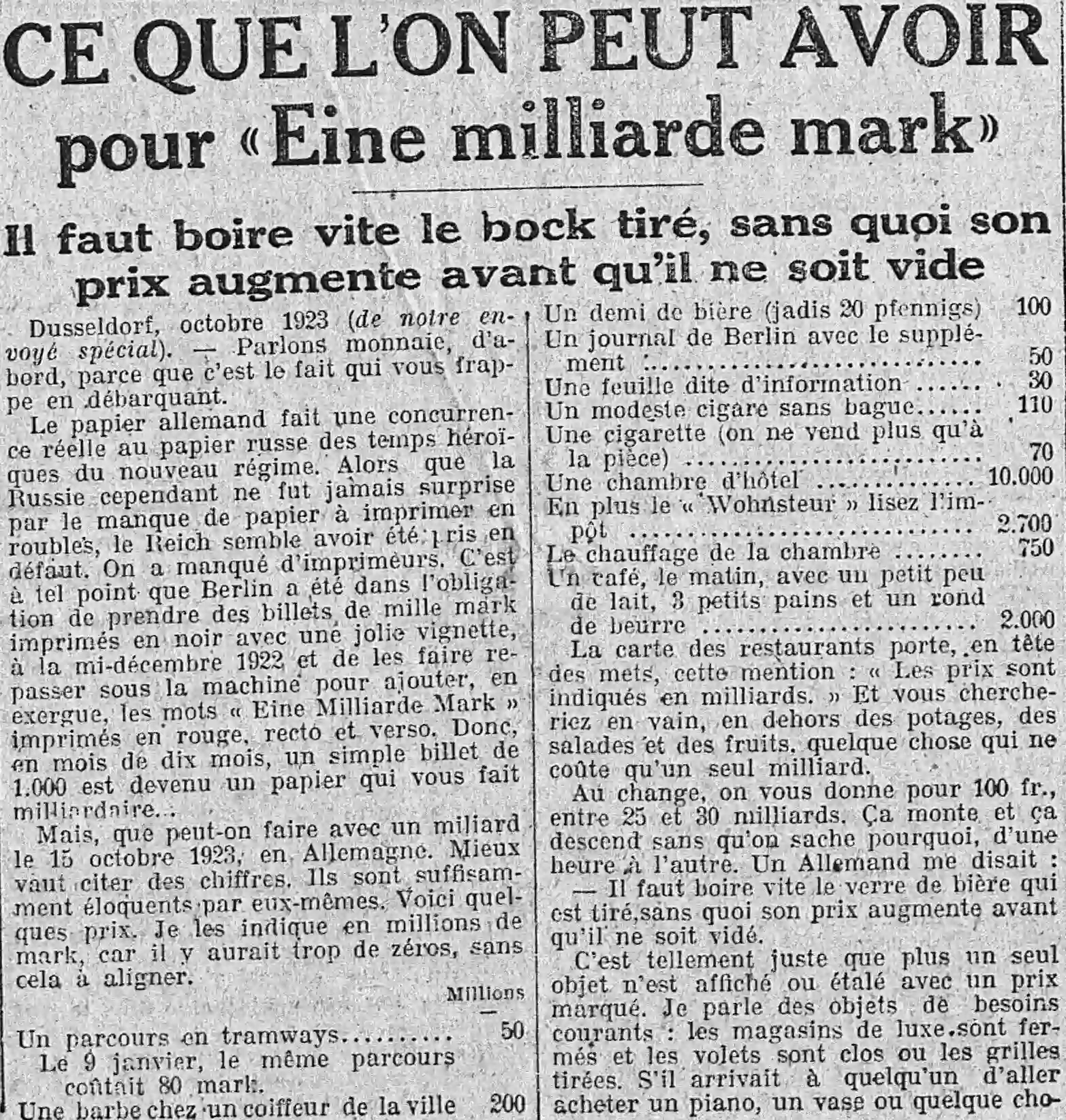
Dusseldorf, October 1923 (from our special correspondent).
Let's talk about money, first, because that's the fact that strikes you when you disembark.
German paper is in real competition with Russian paper from the heroic times of the new regime. While Russia, however, was never surprised by the lack of paper to print in rubles, the Reich seems to have been found wanting. We ran out of printers. It was so much so that Berlin was obliged to take thousand mark notes printed in black with a pretty sticker, in mid-December 1922 and put them under the machine again to add, in emphasis, the words “Eine Milliarde Mark” printed in red, front and back. So, in less than ten months, a simple 1,000 note became a paper that made you a billionaire...
But, what can you do with a billion on October 15, 1923, in Germany. Better to cite figures. They are eloquent enough on their own. Here are some prices. I indicate them in millions of marks, because there would be too many zeros to line up otherwise.
A tram route... 50 Million
On January 9, the same route cost... 80 marks.
A beard at a city hairdresser... 200 Million
Half a beer (formerly 20 pfennigs)... 100 Million
A Berlin newspaper with the supplement... 50 Million
A so-called information sheet... 30 Million
A modest cigar without a ring... 110 Million
A cigarette (we only sell it by the piece)... 70 Million
A hotel room... 10,000 Million
In addition the “Wohnsteur” read the tax... 2,700 Million
Heating the room... 750 Million
A coffee in the morning, with a little milk, 3 rolls and a round of butter... 2,000 Million
The restaurant menu carries, at the head of the dishes, this note: “Prices are indicated in billions. » And you would look in vain, apart from soups, salads and fruit, for something that only costs a billion.
In exchange, we give you 100 francs. between 25 and 30 billion. It goes up and down without knowing why, from one hour to the next. A German told me: You have to drink the glass of beer that is drawn quickly, otherwise its price increases before it is emptied. It’s so right that no longer a single item is displayed or displayed with a marked price. I'm talking about everyday items, luxury stores are closed and the shutters are closed or the gates drawn. If someone happened to go and buy a piano, a vase or something that was not essential, we would immediately sell it to them in dollars, not otherwise...
Here are now the prices of edibles from modest merchants who can only leave their shops open for a few hours in the afternoon, that is to say between the time the goods arrive and the time they are sold:
50 kilos of potatoes... 3,000 Million
A one pound loaf... 80 Million
A pound of meat (waste)... 1,000 Million
Quality meat... 3,500 Million
Half a pound of butter... 700 Million
Now, a worker, who is not a specialist, works six days and earns a billion a day. This allows you to understand why the current situation will be very short-lived. This also explains to you why, every day, there are looting of stores in the towns of the Ruhr, looting which is no longer even reported.
This, finally, shows that a change will be necessary very quickly in this part of Germany which, since January 9, 1923, has lived quite easily, quite largely even, without working, without saving and without thinking about tomorrow. . Today, nothing comes. You have to “find” work that provides the material to feed your loved ones.
Serious problem...
Everyone knows it, feels it. The faces are contracted, the faces worried. But in Düsseldorf, a temporarily dead city, German poetics still love flowers. And, on the Koenigsallee bridge, the merchant spreads out some odorless flowers. The lover gives 500 million, chooses one and offers it to the blonde young woman who appreciates this present for its powerful value.
A. DE GOBART.
|