|
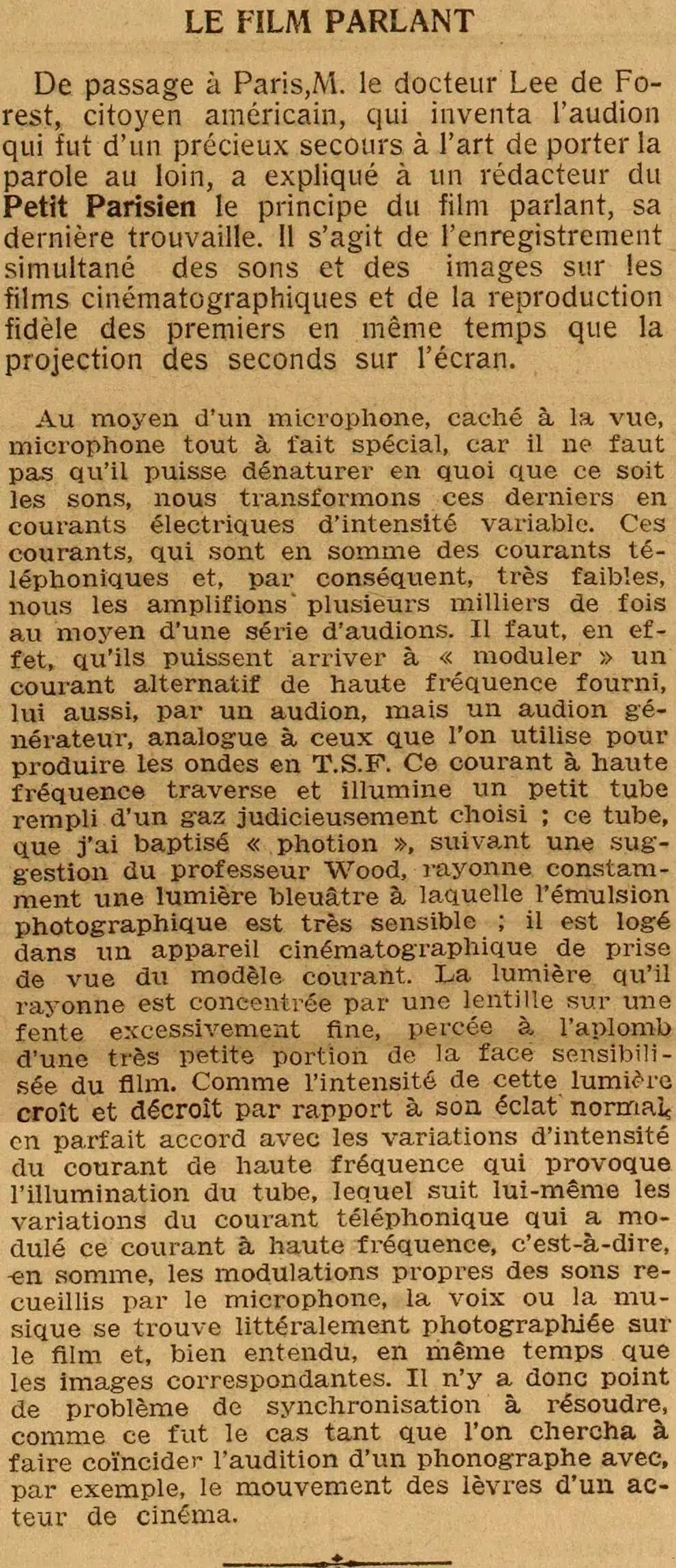
THE TALKING FILM
While passing through Paris, Dr. Lee de Forest, an American citizen, who invented hearing which was a valuable aid to the art of carrying the word far away, explained to an editor of Le Petit Parisien the principle of talking film, his latest discovery.
This involves the simultaneous recording of sounds and images on cinematographic films and the faithful reproduction of the former at the same time as the projection of the latter on the screen. By means of a microphone, hidden from view, a very special microphone, because it must not be able to distort the sounds in any way, we transform them into electric currents of variable intensity. These currents, which are in short telephone currents and, therefore, very weak, we amplify them several thousand times by means of a series of hearings. They must, in fact, be able to “modulate” a high frequency alternating current also supplied by an audion, but a generating audion, similar to those used to produce T.S.F. waves.
This high frequency current passes through and illuminates a small tube filled with a judiciously chosen gas; this tube, which I named "photion", following a suggestion from Professor Wood, constantly radiates a bluish light to which the photographic emulsion is very sensitive; it is housed in a current model cinematographic camera. The light it radiates is concentrated by a lens on an extremely fine slit, pierced directly above a very small portion of the sensitized side of the film. As the intensity of this light increases and decreases in relation to its normal brightness in perfect agreement with the variations in intensity of the high frequency current which causes the illumination of the tube, which itself follows the variations of the telephone current which has modulated this high frequency current, that is to say, in short, the specific modulations of the sounds collected by the microphone, the voice or the music is literally photographed on the film and, of course, at the same time as the corresponding images.
There is therefore no problem of synchronization to be solved, as was the case when we sought to make the hearing of a phonograph coincide with, for example, the movement of the lips of a film actor. .
|