

| Comoedia 19 juillet 1923 (art. page une) |
|
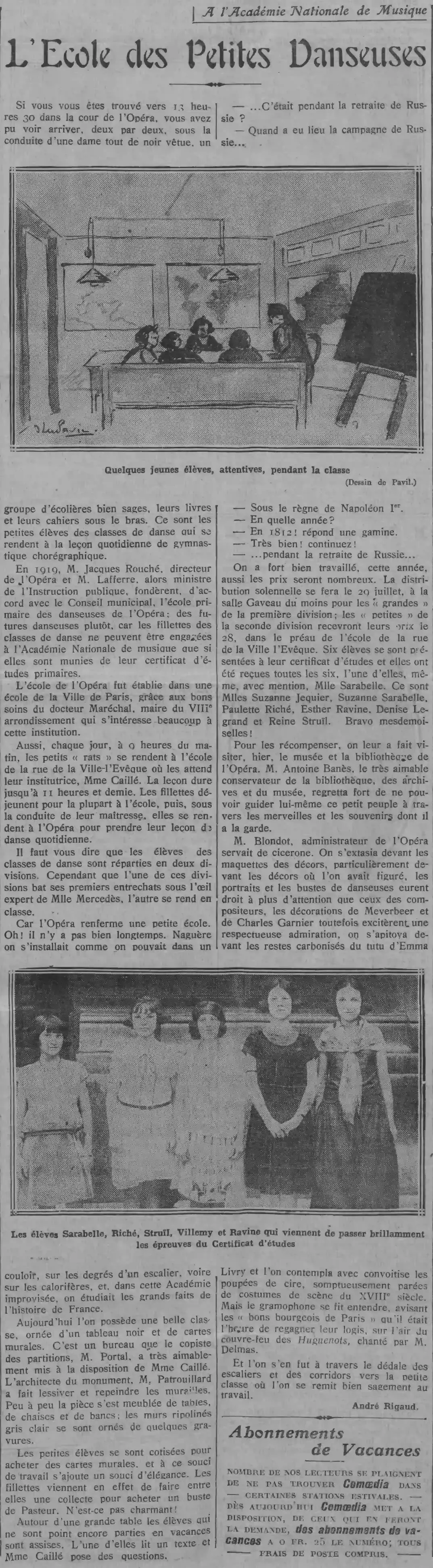
The school of little dancers If you found yourself around 1:30 p.m. in the courtyard of the Opera, you were able to see a group of well-behaved schoolgirls arriving, two by two under the leadership of a lady dressed all in black, with their books and their notebooks under my arm. These are the little students from the dance classes who go to the daily choreographic gymnastics lesson. In 1919, Mr. Jacques Rouche. director of the Opera and Mr. Lafferre, then Minister of Public Education, founded, in agreement with the Municipal Council, the primary school for Opera dancers, future dancers rather, because the girls in the dance classes can only be hired at the National Academy of Music if they have their primary education certificate. The Opera School was established in a school in the City of Paris, thanks to the good care of Doctor Maréchal, mayor of the 8th arrondissement who is very interested in this institution. Also, every day, at 9 a.m., the little “rats” go to the school on rue de la Ville-l’Evêque where their teacher, Ms. Caillé, awaits them. The lesson lasts until 11:30 a.m. Most of the girls have lunch at school, then, under the guidance of their teacher, they go to the Opera to take their daily dance lesson. I must tell you that the students in the dance classes are divided into two divisions. While one of these divisions is having its first entrechats under the expert eye of Miss Mercedès, the other is going to class. Because the Opera contains a small school. Oh, not too long ago. Previously we settled in as best we could in a corridor, on the steps of a staircase. hunched over the heaters, and in this improvised Academy, we studied the great facts of French history. Today we have a beautiful classroom, decorated with a blackboard and wall maps. It is a desk that the copyist of the scores, Mr. Portal. very kindly made available to Ms. Caillé. The architect of the monument. Mr. Patrouillard had the walls washed and repainted. Little by little the room was furnished with tables, chairs and benches: the light gray painted walls were decorated with some engravings. The little students chipped in to buy wall maps and to this concern for work is added a concern for elegance. The little girls have just collected money among themselves to buy a bust of Pasteur. Isn't that lovely. Around a large table the students who have not yet gone on vacation are seated. One of them reads a text and Ms. Caillé asks questions. Mr. Blondot, administrator of the Opera, served as cicerone. We were ecstatic in front of the models of the sets, particularly in front of the sets where we had appeared, the portraits and busts of dancers were entitled to more attention than those of the composers, the decorations of Meyerbeer and Charles Garnier however excited respectful admiration, we felt sorry for the charred remains of Emma Livry's tutu and we contemplated with covetousness the wax dolls, sumptuously adorned with 18th century stage costumes. But the gramophone was heard, warning the “good bourgeois of Paris” that it was time to return to their homes, to the tune of the Huguenot curfew, sung by Mr. Delmas. And we went through the maze of stairs and corridors towards the little classroom where we quietly got back to work. André Rigaud |
 |