|
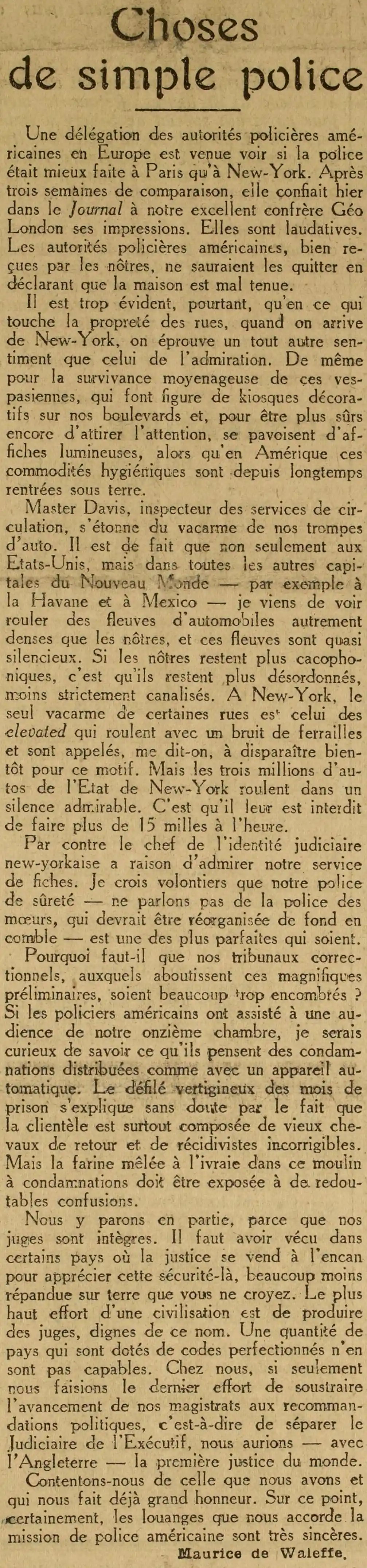
Simple Things Police
A delegation of American police authorities in Europe came to see if the police were better done in Paris than in New York. After three weeks of comparison, she confided her impressions yesterday in the Journal to our excellent colleague Géo London. They are laudatory. The American police authorities, well received by our people, cannot leave them by declaring the house is poorly kept. It is too obvious, however, that when it comes to the cleanliness of the streets, when one arrives from New York, one experiences a completely different feeling than that of admiration. The same goes for the medieval survival of these vespasiennes, which act as decorative kiosks on our boulevards and, to be even more certain of attracting attention, are adorned with bright posters, whereas in America these hygienic conveniences have since been long gone underground.
Master Davis, traffic inspector, is surprised by the noise of our car horns. It is a fact that not only in the United States, but in all the other capitals of the New World, for example in Havana and Mexico, I have just seen rivers of cars rolling by that are much more dense than ours, and these rivers are almost silent. If ours remain more cacophonous, it is because they remain more disordered, less strictly channeled. In New York, the only noise in certain streets is that of the people driving around with the sound of iron and are destined, I am told, to disappear soon for this reason. But the three million cars in New York State drive in admirable silence. This is because they are prohibited from doing more than 15 miles per hour. On the other hand, the head of New York's forensic identification is right to admire our file service. I readily believe that our security police - let's not talk about the morality police, which should be reorganized from top to bottom - is one of the most perfect there is. Why must our criminal courts, to which these magnificent preliminaries lead, be far too congested? If American police officers attended a hearing of our Eleventh Chamber, I would be curious to know what they think of sentences being distributed as if with an automatic device. The dizzying parade of months in prison is undoubtedly explained by the fact that the clientele is mainly made up of old returning horses and incorrigible repeat offenders. But the flour mixed with the tares in this condemnation mill must be exposed to formidable confusions. We manage this in part because our judges have integrity. You have to have lived in certain countries where justice is sold at auction to appreciate this security, much less widespread on earth than you think. The highest effort of a civilization is to produce judges worthy of the name. A number of countries that have sophisticated codes are not capable of doing so. At home, if only we made the last effort to shield the advancement of our magistrates from political recommendations, that is to say, to separate the Judiciary from the Executive, we would have, with England, the first justice of the world. Let us be content with the one we have and which already does us great honor. On this point, certainly, the praise given to us by the American police mission is very sincere.
Maurice de Waleffe
|