|
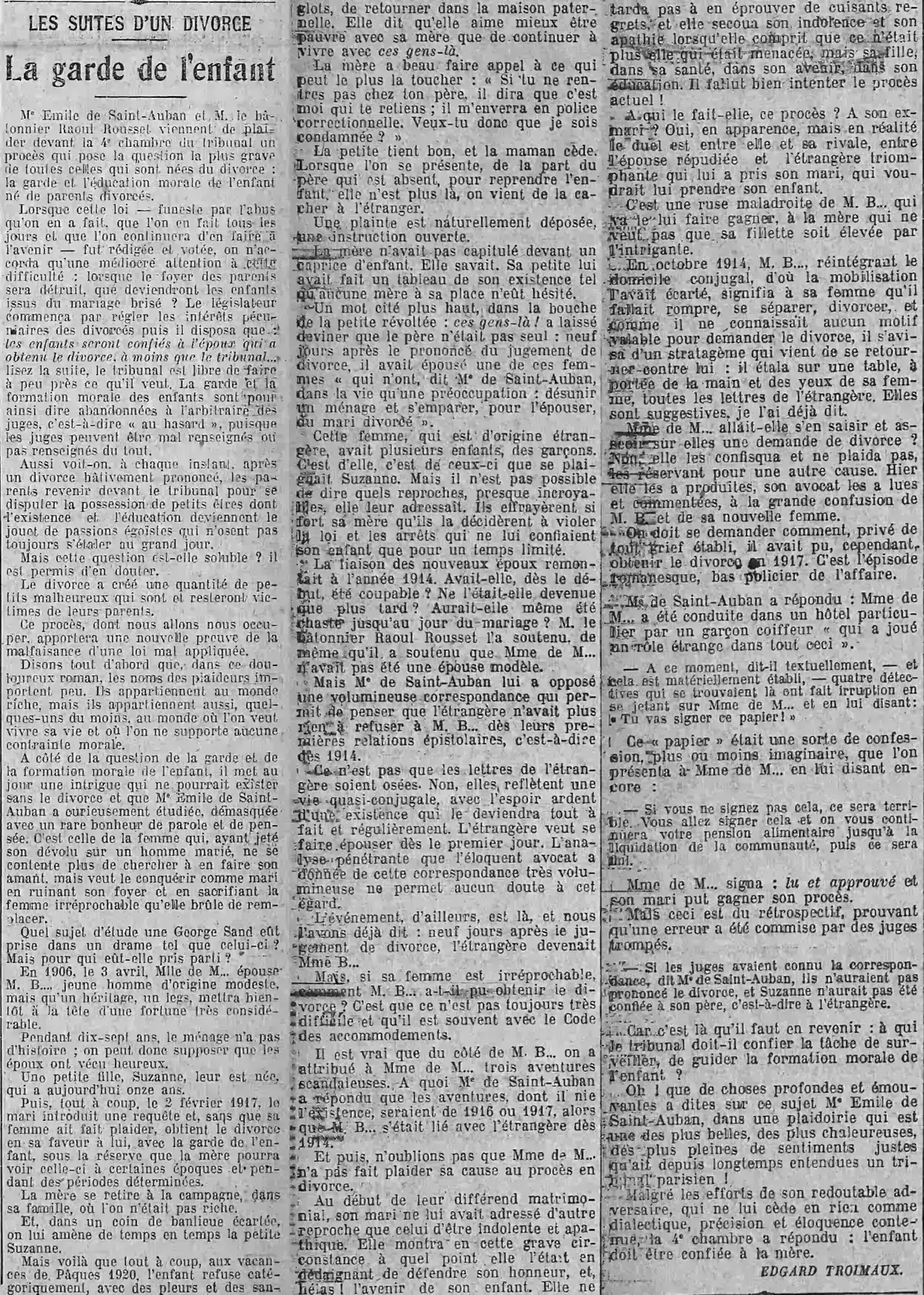
THE AFTERMATH OF A DIVORCE
Child custody
Me Tanile de Saint-Auban and Mr. President Raoul Roussel have just pleaded before the 4th chamber of the court a trial which poses the most serious question of all those which arose from the divorce: the custody and moral education of the child born to divorced parents.
When this law - disastrous by the abuse that is made of it. that we do it every day and that we will continue to do it in the future - was written and voted on, only mediocre attention was paid to this difficulty: when the parents' home will be destroyed , what will become of the children born from a broken marriage? The legislator began by regulating the pecuniary interests of the divorced and then provided that the children would be entrusted to the spouse who obtained the divorce. "unless the court..." read on, the court is free to do pretty much what it wants, The custody and moral training of children are, so to speak, abandoned to the arbitrary decisions of the judges, c that is to say "at random", since the judges may be poorly informed or not informed at all.
So we see at every moment, after a hastily declared divorce, parents return to court to argue over the possession of little beings whose existence and education become the playthings of selfish passions who do not always dare to express themselves. put out into the open.
But is this question solvable? it is permissible to doubt it. Divorce has created a number of unfortunate children who are and will remain victims of their parents. This trial, which we are going to deal with, will provide new proof of the evil of a poorly applied law. Let us say first of all that, in this painful novel, the names of the litigants do not matter. They belong to the rich world, but they also belong, at least some of them, to the world where we want to live our lives and where we cannot tolerate any moral constraints.
Alongside the question of custody and the moral training of the child, it brings to light an intrigue which could not exist without divorce and which M° Émile de Saint-Auban has curiously studied, unmasked with a rare joy of speech and thought. It is that of the woman who, having set her sights on a married man, is no longer content with seeking to make him her lover but wants to conquer him as a husband by ruining her home and sacrificing the irreproachable woman she longs for. replace.
What subject of study would a George Sand have taken up in a drama such as this? But who would she have sided with? In 1906, on April 3, Miss de M... married Mr. B... a young man of modest origins, but an inheritance, a legacy, would soon put him at the head of a very considerable fortune.
For seventeen years, the household has no history; we can therefore assume that the spouses lived happily. A little girl, Suzanne, was born to them, who is now eleven years old. Then, suddenly, on February 2, 1917, the husband filed a petition and, without his wife having filed a plea, obtained a divorce in his favor, with custody of the child, on the condition that the mother could see this at certain times and during specific periods.
The mother retired to the countryside, to her family, where they were not rich, and in a remote suburban corner, little Suzanne was brought to her from time to time. But suddenly, during the Easter holidays of 1920, the child categorically refused, with tears and sobs, to return to his father's house. She says she would rather be poor with her mother than continue to live with these people. The mother may appeal to what can affect her the most: “If you don't go home to your father, he will say that it's me who's holding you back; he will send me to the correctional police. So do you want me to be condemned? » The little one holds on, and the mother gives in.
When the absent father shows up to take the child back, she is no longer there, she has just been hidden abroad. A complaint is naturally filed, an investigation opened. The mother had not capitulated to a child's whim. She knew. Her little one had painted a picture of her existence such that no mother in her place would have hesitated. A word cited above, in the mouth of the little rebel "those people", suggested that the father was not alone: nine days after the divorce judgment was pronounced, he had married one of these women "who have, says Me de Saint-Auban, only one concern in life: to break up the household and take possession of the divorced husband in order to marry her.
This woman, who is of foreign origin, had several children, boys. It was about her, it was about them that Suzanne complained. But it is not possible to say what, almost incredible, reproaches she addressed to them. They frightened her mother so much that they made her decide to violate the law and the rulings which only entrusted her child to her for a limited time.
The new couple's affair dated back to 1914. Had she been guilty from the start? Did she only become one later? Would she even have been chaste until the wedding day? Mr. President Raoul Rousset supported this, just as he maintained that Madame de M... had not been a model wife. But Me de Saint-Auban sent her a voluminous correspondence which allowed us to believe that the foreigner no longer had anything to refuse to Mr. B.... from their first epistolary relations, that is to say from 1914.
It's not that the stranger's letters are daring. No, they reflect a quasi-marital life, with the ardent hope of an existence which will become completely and regularly. The foreigner wants to be married from day one.
The penetrating analysis that the eloquent lawyer gave of this very voluminous correspondence leaves no doubt in this regard. The event, moreover, is there, and we have already said it: nine days after the divorce judgment, the stranger became Mrs. B...
But, if his wife is blameless, how was Mr. B... able to obtain a divorce? This is because it is not always very difficult and it is often with the Accommodations Code. It is true that on Mr. B...'s side, Madame de M... has been attributed with three scandalous adventures. To which Mr. de Saint-Auban replied that the adventures, the existence of which he denies, were from 1916 or 1917, while Mr. B... had been involved with the foreigner since 1914... And then, let's not forget that Mme de M... did not plead her case at the divorce trial.
At the start of their marital dispute, her husband had made no other reproach towards her than that of being indolent and apathetic. She showed in this serious circumstance to what extent she was by disdaining to defend her honor, and the future of her child. It did not take long for her to feel burning regret, and she shook off her indolence and apathy when she understood that it was no longer her who was threatened but her daughter, in her health, in her future, in her education. It was necessary to bring the current lawsuit.
Who is she doing this trial to? To her ex-husband? Yes, in appearance, but in reality the duel is between her and her rival, between the divorced wife and the triumphant stranger who took her husband, who would like to take her child. It's a clumsy ruse on the part of Mr. B... that will win it for the mother who doesn't want her little girl to be raised by the intriguer.
In October 1914, M, B..., returning to the marital home, from which the mobilization had removed him, informed his wife that they had to break up, separate, divorce, and as he knew of no valid reason for ask for a divorce, he became aware of a stratagem which has just backfired on him. He spread out on a table, within reach of his wife's hand and eyes, all the letters from the stranger. They are suggestive, I have already said it. Was Madame de M… going to seize them and file a divorce petition on them? No, she confiscated them and did not plead, reserving them for another cause.
Yesterday she produced them, her lawyer read them and commented on them, to the great confusion of Mr. B...and his new wife. One must wonder how, deprived of an established grievance, he was nevertheless able to obtain a divorce in 1917.
This is the romantic, low-level detective episode of the case.
Me, from Saint-Auban replied: Mme de M... was taken to a private hotel by a hairdresser boy “who played a strange role in all this”. — At that moment, he said verbatim, — and this is materially established, — four detectives who were there burst in, throwing themselves on Madame de M... and telling her: “You are going to sign this paper!” . This “paper” was a sort of confession, more or less imaginary, which was presented to Madame de M... while still telling her: — If you do not sign this, it will be terrible. You will sign this and we will continue your alimony until the liquidation of the community, then it will be over. Madame de M... signed: read and approved and her husband was able to win his case.
But this is hindsight, proving that an error was made by deceived judges. If the judges had known the correspondence, says Mme de Saint-Auban, they would not have pronounced the divorce, and Suzanne would not have been entrusted to her father, that is to say to the stranger. Because this is where we have to come back: to whom should the court entrust the task of monitoring, of guiding the moral formation of the child? Oh, what profound and moving things M° Emile de Saint-Auban said on this subject, in a pleading which is one of the most beautiful, the warmest, the most full of just feelings that a Parisian court has heard for a long time
Despite the efforts of his formidable adversary, who yields nothing to him in terms of dialectic, precision and restrained eloquence, the 4th chamber responded: the child must be entrusted to the mother.
EDGARD TROIMAUX
|
|
 |