|
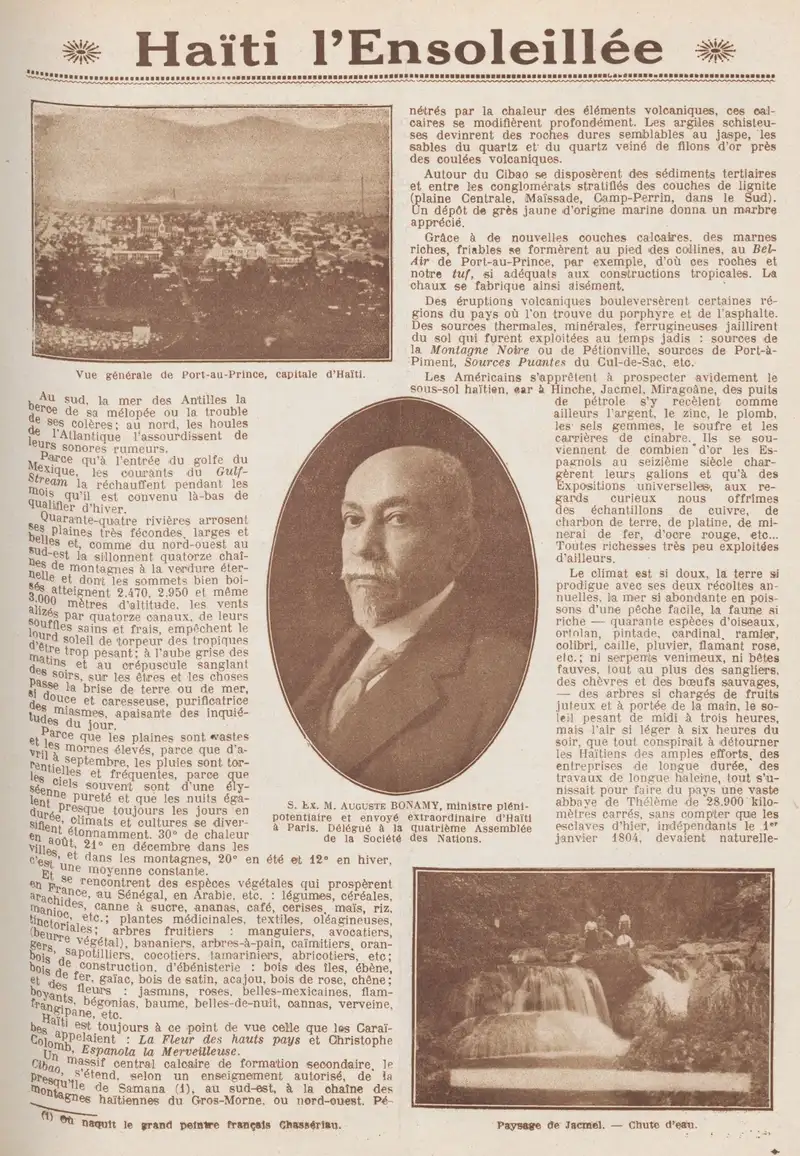
To the south, the Sea of the Antilles rocks it with its chant or disturbs it with its anger; to the north, the swells of the Atlantic deafen it with their sonorous rumors.
Because at the entrance to the Gulf of Mexico, the currents of the Gulf Stream warm it during the months that are commonly called winter there.
Forty-four rivers water its very fertile, wide and beautiful plains and, from the northwest to the southeast, fourteen mountain ranges with eternal greenery crisscross it and whose well-forested summits reach 2,470, 2,950 and even 3,000 meters above sea level. altitude, the trade winds through fourteen channels, with their healthy and fresh breaths, prevent the heavy torpor sun of the tropics from being too heavy; at the gray dawn of the mornings and the bloody twilight of the evenings, over beings and things passes the breeze of land or sea, so gentle and caressing, purifying from miasmas, soothing from the worries of the day.
Because the plains are vast from April to September, the rains are torrential and frequent, because the skies are often of Elysian purity and the nights almost always equal the days in length, climates and cultures are surprisingly diverse. 30° heat in August, 21° in December in the cities and in the mountains, 20° in summer and 12° in winter is a constant average.
And there are plant species that thrive in France, Senegal, Arabia, etc. vegetables, cereals, peanuts, sugar cane, pineapple, coffee, cherries, corn, rice, cassava, etc.; medicinal, textile, oilseed and dye plants; fruit trees: mango trees, avocado trees, (vegetable butter), banana trees, breadfruit trees, caimitia trees, orange trees, construction wood, cabinetmaking: island wood, ebony, gers, sapodilla trees, coconut trees, tamarind trees, apricot trees, etc.; ironwood, guaiac, satinwood, mahogany, rosewood, oak; and flowers jasmines, roses, Mexican flowers, flamboyants, begonias, balsam, night roses, cannas, verbena, frangipane, etc. From this point of view, Haiti is still the one that the Caribbean called: The Flower of the High Countries and Christopher Columbus, Espanola the Wonderful.
A central limestone massif of secondary formation, the Cibao, extends, according to an authorized teaching, from the Samana peninsula (1), in the southeast, to the Haitian mountain range of Gros-Morne, in the northwest. . Penetrated by the heat of the volcanic elements, these limestones changed profoundly. The shale clays became hard rocks similar to jasper, the sands became quartz and quartz veined with gold veins near the volcanic flows.
Around the Cibao there were tertiary sediments and between the stratified conglomerates layers of lignite (Central plain, Maïssade, Camp-Perrin, in the South). A deposit of yellow sandstone of marine origin produced a popular marble.
Thanks to new limestone layers, rich, friable marls were formed at the foot of the hills, at Bel-Air in Port-au-Prince, for example, hence these rocks and our tuff, so suitable for tropical constructions. Lime is thus easily made.
Volcanic eruptions disrupted certain regions of the country where porphyry and asphalt are found. Thermal, mineral and ferruginous springs sprang from the ground which were exploited in the old days, sources of Montagne Noire or Pétionville, sources of Port-à-Piment, Sources Puantes du Cul-de-Sac, etc.
The Americans are preparing to eagerly explore the Haitian subsoil, because in Hinche, Jacmel, Miragoâne, oil wells are hidden there, as elsewhere, silver, zinc, lead, rock salts, sulfur and minerals. cinnabar quarries. They remember how much gold the Spaniards loaded their galleons in the sixteenth century and that at Universal Exhibitions, to curious looks they offered us samples of copper, earth coal, platinum, iron ore, ocher red, etc... All very little exploited resources elsewhere.
The climate is so mild, the land so prodigal with its two annual harvests, the sea so abundant in easily caught fish, the fauna so rich forty species of birds, ortolan, guinea fowl, cardinal, woodpigeon, hummingbird, quail, plover, flamingo, etc.; neither venomous snakes nor wild beasts, at most wild boars. wild goats and oxen, trees so laden with juicy fruits within reach, the sun heavy from noon to three o'clock, but the air so light at six o'clock in the evening, that everything conspired to distract the Haitians from the extensive efforts, long-term undertakings, long-term work, everything combined to make the country a vast abbey of Thélème of 28,900 square kilometers, not to mention that the slaves of yesterday, independent on January 1, 1804, naturally had to imagine that freedom was first and foremost the right to do nothing. But new times have come.
Because the 2,500,000 souls who populated the island in 1923 and who range from dark ebony to almost immaculate snow via gleaming gold, descend from the 40,000 whites, the 40,000 mulattoes or freedmen and the 500,000 slaves that the French colony of Saint-Domingue counted in 1789. This particularity explains many things.
On this American land, in this despotic, elegant, sensitive and cruel eighteenth century, three castes were juxtaposed, the first two of which owned the last, the black, in the same way as tiles or hectares of land, mules or horses.
The whites of 1492, the Spaniards, had exterminated the million aborigines, the sweet Caribbean of Ahiti (Quisqueya, the Mother of the Lands (Bohio the great mountainous land), then to replace them had imported from all areas of the immense Africa with thousands of black people.
They in turn disappeared from the western part of Saint-Domingue since, stronger than them, the French buccaneers and buccaneers had raised the fleurdelysé flag there in 1625, on Tortue Island. French domination extended on the coasts first, on the surface, because if the entire island measures 77,250 square kilometers it has three thousand (3,000) kilometers around, and if in 1923, the Haitian Republic alone opened twelve (12 ) ports for foreign trade, coves, landing stages, bays are really teeming - hence the development of coastal shipping and sailing.
In 1665, the good Angevin Bertrand d'Ogeron, tried to transform the two to three thousand pirates and wild ox hunters of 1625 into "inhabitants", and for their benefit imported into the colony a few dozen Manon Lescaut avant la lettre.
French penetration was resolutely directed towards the interior. The Treaty of Ryswick of 1697 legitimized the fait accompli; Spain resigned itself to possessing only the Eastern Audience, present-day Dominicania, and the sovereignty of the Bourbons over the magnificent island of sunshine and eternal greenery, soon in full bloom, seemed to take on a character of eternity.
But whites and blacks had given birth to a new species of men, the mulattoes. Mulattoes sometimes freed on the same day of their birth. slaves freed by their savings, the vanity or the goodness of their masters constituted a well-defined social order, the class of freedmen who became rich, studied as best they could on the spot, sent their sons to metropolitan schools and distinguished themselves in the royal marshal.
New ideas shook the motherland to its depths and across the Atlantic resounded through Santo Domingo. 1789 broke out and the three colonial castes in pure social juxtaposition moved to achieve different goals.
The great whites, the great planters attempted a Secession; the little whites, the white manants tended to fraternize with them; the freedmen demanded civil and political equality, and the slaves freedom, fire torch in hand.
A drama unfolded from 1789 to 1804, where the human beast, white and black, was unleashed and epic thrills took place.
Famous struggles where the beautiful blood of France and the heavy blood of Africa flowed in waves, where Captain-General Donatien de Rochambeau, future marshal of Napoleon I and the former slave with a legendary destiny, Dessalines-le-Grand, division general of the consular armies and future emperor, equaled each other in bravery and cruelty, in lust for destruction and tenacity, in pleasure of torture and in energy, famous struggles where, prey to a mystical hysteria since, they believed , the old gods of Africa themselves guided them in battle, blacks and mulattoes, soldiers of Christophe and Gabart, freed from Pétion and Geffrard, fell with joy since they were going to be reborn there, in the land of the ancestors, to be reborn and relive the free primitive life, under the munificent sun and in the thousand-year-old forests, famous struggles where, for the first time, 35,000 of the splendid legionaries of Jemmapes and Arcole of Marengo and of Egypt experienced the agonies of capitulation.
Saint-Domingue-Haiti trembled to have seen the flight of the giants, the giants of Year II who had received the mission of re-establishing slavery there.
On January 1, 1804, therefore, here we are, independent and free, but masters of a land where black hands and white hands had spread fire everywhere, where ruins and rubble accumulated, masters of a land surrounded by on all sides, suspicious and clearly hostile, the Spanish, English and French slave bastilles, masters of a land finally located a few days from these United States of North America where millions of blacks will only be freed in 1863 or 1865.
The task ahead was enormous. It was necessary to organize the new State, to educate the completely illiterate people who were almost completely the heroes of yesterday, to remove their faith in ancient cults dating back thousands of years. from Africa, to give them back the taste for work, for a homeland to make a nation.
From the beginning, King Christophe and President Pétion understood the problem, one in the manner of Pierre-le-Grand, the other as a disciple of Jean-Jacques Rousseau, who would have been, in 1802, colonel of artillery in the consular army. The work was undertaken and continued with courage and tenacity, despite inexperiences, regressions and inevitable falls. In 1822, Jean-Pierre Boyer (1818-1843) achieved the territorial unity of the island (Haiti and Dominicania), which, in 1825, took on the rank of nation, since the former metropolis itself recognized its independence. As early as 1816, Bolivar had freed the slaves of Venezuela because President Pétion had made it the sine qua non condition of his powerful and effective aid. In 1822, Boyer freed the Dominican slaves. In 1842, it even led him to carry out a landing in Cuba, a Spanish colony, to abolish slavery there and annex it to us.
We were truly the eldest sons of the black race, and to rehabilitate it, it was only necessary to give the Haitian nation the image of a peaceful, hardworking State, knowing how to keep its dignity.
Beautiful dreams that almost became realities! Our epic destinies proved fragile and the sense of the goals to be achieved seemed to be lost.
Around 1860, our Second Republic, with Fabre Geffrard (1858-1867), went back to work, resumed the march to the star, the march to moral, material, intellectual progress and the country experienced very sweet, very beautiful times. comforting moments that were to follow by distressing and dark hours since we were already marked by “bovaryism” and cosmopolitanism and the revolutionary and joyful spirit seemed no longer able to be exorcised. While buffoons stupidly persisted in spoiling public affairs and "the multitudes" paraded
of nothingness", the peasant and his wife, very hospitable, very sober, very obliging, toiled in the fertile fields and in no way danced voodoo and martinique all day long, these exasperated shimmys, good people continued to work from brain, to withdraw into themselves, to meditate, to face the study of the most serious problems, the greatest questions and to constitute, so to speak, a reservoir of energies.
And so each time the country found itself in bad position, men appeared who, as best they could, often even with infinite happiness, got it out of its difficulties, completed its political, administrative, judicial unity, constituted a military framework, imperfect and open to criticism, certainly, which the bayonets of Mr. Woodrow Wilson very foolishly broke in 1915, only to then try to reforge it for their benefit with truly lamentable clumsiness and failure.
When political life exists, but too little, through unintelligent and unbearable despotism, the inhabitants of the country, unable to say their word, to shout daredevil to those who imagine themselves to be the only ones capable of leading them, come to no longer understand the feeling of homeland. When political life exists, but too much. through continuous revolutions and uncontrolled economic upheavals, whirlwinds arise, all social fixity disappears and minds, not knowing what to cling to, sink into indifference. And it is the class of “emigrants within” that is being formed, growing, increasing in formidable proportions.
We saw this clearly when, on the night of July 28, 1915, Mr. Wilson's Marines unexpectedly landed on our shores, trailing with them it quickly became incontestable - anarchy, violence, desolation and misery, but we brought a benefit, that of provoking a revival of the idea of the Fatherland, of forcing us to understand how much and how we had sinned towards the country and towards the race, and how much our Gallo-black heredities, our Afro-Latin affinities, our French culture were the opposite of crude pragmatism, of harsh North American neo-Saxonism disdainful of nuances, ignorant of finesse and convinced that all civilization is first and foremost material.
Because, from 1625 to 1803, the Fleurdelysé flag and then the tricolor flag flew in the large island of Central America, because from 1804 to this time, our official and literary language is French, because our archbishopric and our five bishoprics are served by 200 French priests, because in our 1,000 higher, secondary, professional and primary schools meet French academics, Fathers of the Holy Spirit, Religious Sisters of Saint-Joseph-de-Cluny, Brothers of Christian Instruction, Daughters of Wisdom, Belgian Daughters of Mary, that in our hospitals there are dedicated Daughters of Wisdom and that our 100,000 students and schoolchildren have learned that Paris is the Mecca of the world, because the blood of the two races has often and happily united, it turns out that against Latin intelligence the Yankee Marines will not prevail, and that only its influence will remain sovereign among us if France no longer forgets its Antillean intellectual Dominion.
And besides, we work almost remarkably. In 1918-1919, our exports were worth $21,403,668 (coffee, cotton, logwood, sugar, mahogany, corn, cocoa, guaiac, etc., etc.); in 1919-1920, our imports amounted to 27,398,411 dollars (wines from France, articles from Paris, books, machines, agricultural implements, fabrics, oils, edibles, etc.). After submarine cables (1887), land telegraphs and the telephone (1893), tramways and railways (1901), the automobile was introduced into the country as well as electricity (1911). Alongside vast power plants, large sugar mills, industries with smaller capital were established and prospered: distilleries (rum, tafla, clairin, liqueurs), ice houses, tanneries, shoemaking, mechanical sawmills, cabinetmaking, pottery, brickworks, etc. ., factories of cigars and cigarettes, matches, Kola-Champagne, jams, etc.; workshops for making ropes, latanier works, factories for hulling coffee, preparing chocolate, starch, candles, castor and cotton oils, hat makers, goldsmiths, etc. Beekeeping flourished rapidly.
New cinema-theaters, from 1914, were built in Port-au-Prince the capital (150,000 inhabitants and 7 square kilometers in area) in Cayes, Cap-Haitien, Gonaïves, etc., towns with clean and wide streets , cemented or macadamized, where newspapers and magazines appear regularly and written in good language, where libraries and bookstores provide successful French magazines, newspapers and novels twenty days after their appearance, etc.
A whole varied, fresh, picturesque literature of Haitianness flourishes there in its “continuous creation” and finally attempts, with many chances, to enter French literature. The best proof that if France is willing, its influence will never disappear from this good breeding ground of Latin culture, is that the battalions and the strange civilizers that, since 1915, Mr. Wilson, Mr. Harding and M. .Calvin Coolidge, could not force anyone to learn English or more precisely American. On the contrary, the officers of the occupation corps had to hire tutors to learn the incomparable beauties of Racine's language, while the common riflemen created relationships among the plebs to... learn Creole.
When Mr. Wilson finally sided with the Allies, he shipped most of the Navy and Marine Corps men who had fought in the Haitian campaign to Europe, and history records that many of them escaped. business in Bordeaux or Le Havre while jabbering as best we could in our gentle dialect. Also an American officer recently published a manual of Creole conversations, no doubt out of gratitude...
We resist as best we can. Haitian families now demand that their servants speak French when carrying out their tasks!
Mr. Raymond Poincaré should have doubled the 60,000 francs annual subsidy that his government grants to French works in Haiti. Doubled capital would never have been better placed.
By the odious American-Haitian convention of 1915, the Haitian state became half-sovereign, but the nation. Haitian style continues, intact.
I therefore keep intact my faith in the future of an integral, Gallo-black, hardworking, peaceful, educated and respected Haiti.
LOUIS MORPEAU.
|