

| Le Matin 21 juillet 1923 (art. page deux) |
 |
|
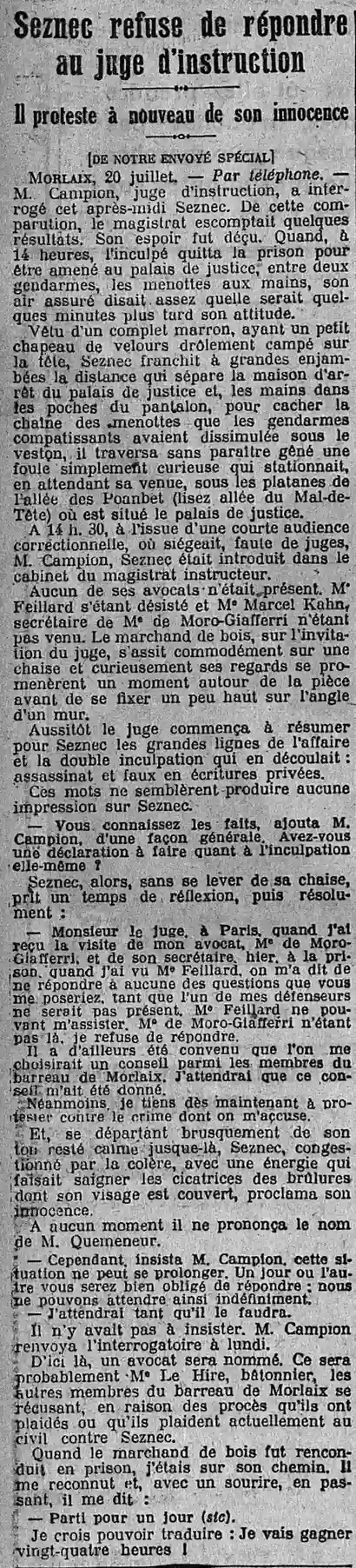
Seznec refuses to answer the investigating judge He again protests his innocence From our special correspondent Morlaix, July 20, — By telephone. — Mr. Campion, examining magistrate, questioned Seznec this afternoon. From this appearance, the magistrate expected a result, his hope was disappointed. When, at 2 p.m., the accused left the prison to be brought to the courthouse between two gendarmes, handcuffs in his hands, his assured air was enough to say what his attitude would be a few minutes later. Dressed in a brown suit, with a small velvet hat amusingly planted on his head, Seznec crosses with great strides the distance which separates the remand center from the courthouse and, his hands in the pockets of his trousers, to hide the wearing the handcuffs that the sympathetic gendarmes had hidden under his jacket, he crossed without appearing embarrassed a simply curious crowd which was stationed, waiting for his arrival, under the plane trees of the alley of Poanbet (read alley of Mal-de-Tête) where the courthouse is located. At 2:30 p.m., after a short correctional hearing, where Mr. Campion sat, for lack of judges, Seznec was introduced into the office of the investigating magistrate. None of his lawyers were present. Me Feillard having withdrawn and Me Marcel Kahn, secretary of Me de Moro-Giafferri not having come, the timber merchant, at the invitation of the judge, sat down comfortably on a chair and curiously his eyes wandered a moment around the room before fixing itself a little high on the angle of a wall. Immediately the judge began to summarize for Seznec the broad lines of the case and the double indictment which resulted from it: assassination and forgery in private writings. Those words didn't seem to make any impression on Seznec. You know the facts, Mr. Campion added, generally speaking, do you have a statement to make as to the indictment itself? Seznec, without getting up from his chair, took a moment to reflect, then resolutely: "Mr. Judge, in Paris, when I received a visit from my lawyer, M° de Moro-Giafferri, and his secretary yesterday, in prison, when I saw Ms. Feillard, I was told not to answer any questions you put to me until one of my defenders is present. Me Feillard not being able to assist me, Me de Moro-Giafferri not being there, I refuse to answer. It was also agreed that I would be chosen as counsel from among the members of the bar of Morlaix. I will wait until this advice has been given to me. Nevertheless, I want to protest now against the crime of which I am accused. And abruptly departing from his hitherto calm tone, Seznec, congested with anger, with an energy that made the burn scars covering his face bleed, proclaimed his innocence. At no time did he mention M. Quemeneur's name. "However," insisted M. Campion, "this situation cannot be prolonged." One day or another you will be obliged to answer; we cannot wait like this forever. “I will wait as long as necessary. There was no need to insist. Mr. Campion adjourned the questioning to Monday. Until then, a lawyer will be appointed. It will probably be Me Le Hire, chairman, the other members of the Bar of Morlaix recused themselves, because of the lawsuits they have pleaded or are currently pleading in civil proceedings against Seznec. When the timber merchant was taken back to prison, I was on his way. He recognized me and, with a smile, in passing, he said to me: Gone for a day (sic). I think I can translate: I will win twenty-four hours |