

| Le Monde Illustré 24 juin 1923 (pages 03 et 04) |
  |
|
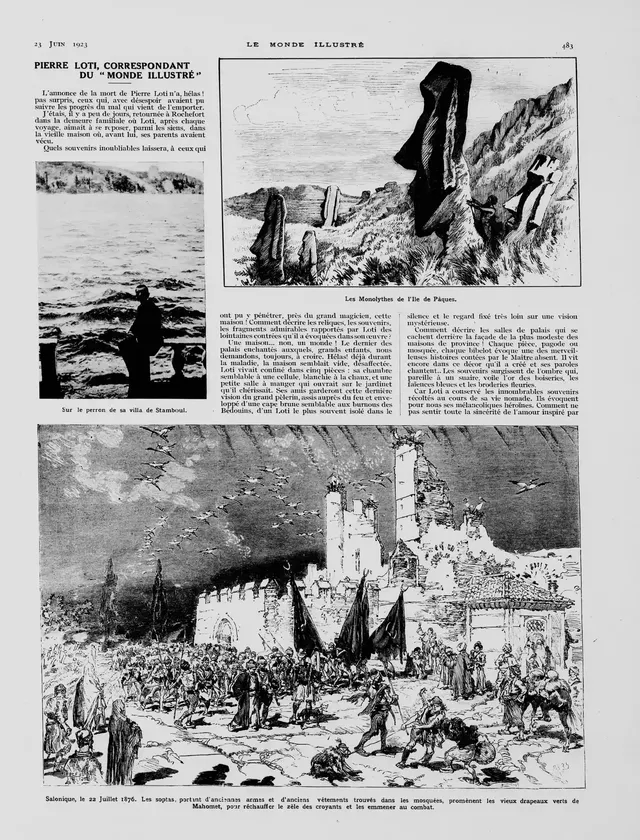
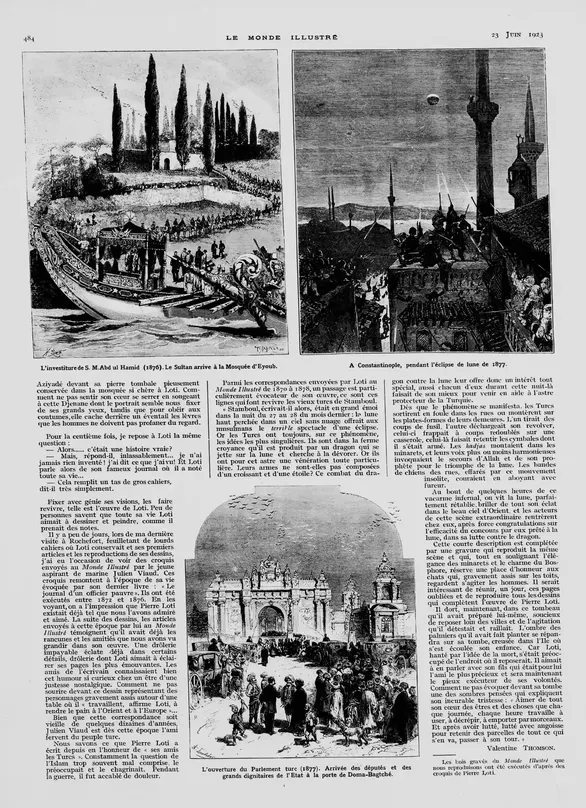
PIERRE LOTI Correspondent from the “Illustrated World” The announcement of the death of Pierre Loti has, alas! not surprised, those who in despair had been able to follow the progress of the evil which had just prevailed. I had, a few days ago, returned to Rochefort to the family home where Loti, after each trip, liked to rest, among his family, in the old house where, before him, his parents had lived. What unforgettable memories will leave, to those who have been able to enter, near the great magician, this house! How to describe the relics, the memories, the admirable fragments brought back by Loti from the distant lands that he evoked in his work? A house... no, a world! The last of the enchanted palaces in which, grown-up children, we always ask to believe. Alas! already during the illness, the house seemed empty, disused. Loti lived confined to five rooms: his whitewashed, cell-like bedroom and a small dining room that opened onto the garden he cherished. His friends will keep this last vision of the great pilgrim, seated by the fire and wrapped in a brown cape similar to the Bedouin burnous, of a Loti most often isolated in silence and staring far away at a mysterious vision. How to describe the palace rooms that hide behind the facade of the most modest of provincial houses! Each room, pagoda or Because Loti has preserved the countless memories collected during his nomadic life. They evoke for us his melancholic heroines. How not to feel all the sincerity of the love inspired by Aziyadé in front of his tombstone piously preserved in the mosque so dear to Loti. How not to feel his heart Tighten when thinking of this Djenane whose portrait seems to stare at us with her big eyes, while to obey customs, she hides behind a fan the lips that men must not profane with their gaze. For the hundredth time, I put the same question to Loti: "So... was it a true story?" Fixing his visions with genius, bringing them to life, such is Loti's work. Few people know that all his life Loti loved to draw and paint, as he took notes. A few days ago, during my last visit to Rochefort, leafing through the heavy notebooks in which Loti kept both his first articles and the reproductions of his drawings, I had the opportunity to see sketches sent to Le Monde Illustré by the young naval cadet Julien Viaud. These sketches go back to the period of his life evoked by his last book: “The diary of a poor officer”. They were executed between 1872 and 1876. Seeing them, one has the impression that Pierre Loti already existed as we admired and loved him. The continuation of the drawings, the articles sent by him at this time to the Illustrated World testify that he already had the grudges and the friendships that we have seen grow in his work. A priceless drollery already bursts out in certain details, drollery with which Loti liked to illuminate his most moving pages. The writer's friends knew well this curious humor in a being of nostalgic accuracy. How not to smile in front of this drawing representing characters gravely seated around a table where they "work, says Loti, to return bread to the East and to Europe".... Although this correspondence is several decades old, Julien Viaud is from this time the fervent friend of the Turkish people. We know what Pierre Loti has since written in honor of “his friends the Turks”. Constantly the question of Islam, too often misunderstood, preoccupied and saddened him. During the war, he was overwhelmed with grief. Among the correspondence sent by Loti to the Illustrated World from 1870 to 1878, a passage is particularly evocative of his work, it is these lines that bring the old Turks of Stamboul back to life. “Stamboul, he wrote then, was in great turmoil on the night of the 27th to the 28th of last month: the moon perched high in a cloudless sky offered Muslims the terrible spectacle of an eclipse. Now the Turks always have the most singular ideas about this phenomenon. They are in the firm belief that it is produced by a dragon which throws itself on the moon and seeks to devour it. Yet they have a very special veneration for this star. Are not their arms composed of a crescent and a star? This fight of the dragon against the moon therefore offers them a very special interest, so each of them during that night did their best to come to the aid of the protective star of Turkey. As soon as the phenomenon occurs. the Turks came out in droves into the streets and climbed onto the platforms of their dwellings. One was firing gunshots. the other unloaded his revolver, this one struck with redoubled blows on a saucepan, that one sounded the cymbals with which he had armed himself. The hadjas rose in the minarets, and their more or less harmonious voices invoked the help of Allah and his prophet, for the triumph of the moon. Gangs of street dogs, terrified by this unusual movement, ran around barking furiously. After a few hours of this infernal din, the moon was seen, perfectly restored. shine with all its brilliance in the beautiful sky of the East, and the actors of this extraordinary scene returned home, after many congratulations on the effectiveness of the assistance by them lent to the moon, in its fight against the dragon. This short description is completed by an engraving which reproduces the same scene and which, while emphasizing the elegance of the minarets and the charm of the Bosphorus, reserves a place of honor for the cats which, gravely seated on the roofs, watch men. It would be interesting to bring together, one day, these forgotten pages and to reproduce all the drawings that complete the work of Pierre Loti. He sleeps, now, in this tomb which he had prepared himself, anxious to rest far from the cities and the agitation which he hated and mocked. The shadow of the palm trees he had planted will spread over his grave, dug in the island where his childhood passed. For Loti, haunted by the idea of death, was preoccupied with the place where he would rest. He liked to talk about it with his son who was his most precious friend and will now be the pious executor of his wishes. How not to evoke in front of his grave one of the dark thoughts which explain his incurable sadness: “To love with all his heart beings and things that every day, every hour works to wear out, to decrepit, to take away in pieces. And after having struggled, struggled with anguish to retain fragments of all that is going away, to pass in turn. » Valentine THOMSON |