

| Le Monde Illustré |
 |
|
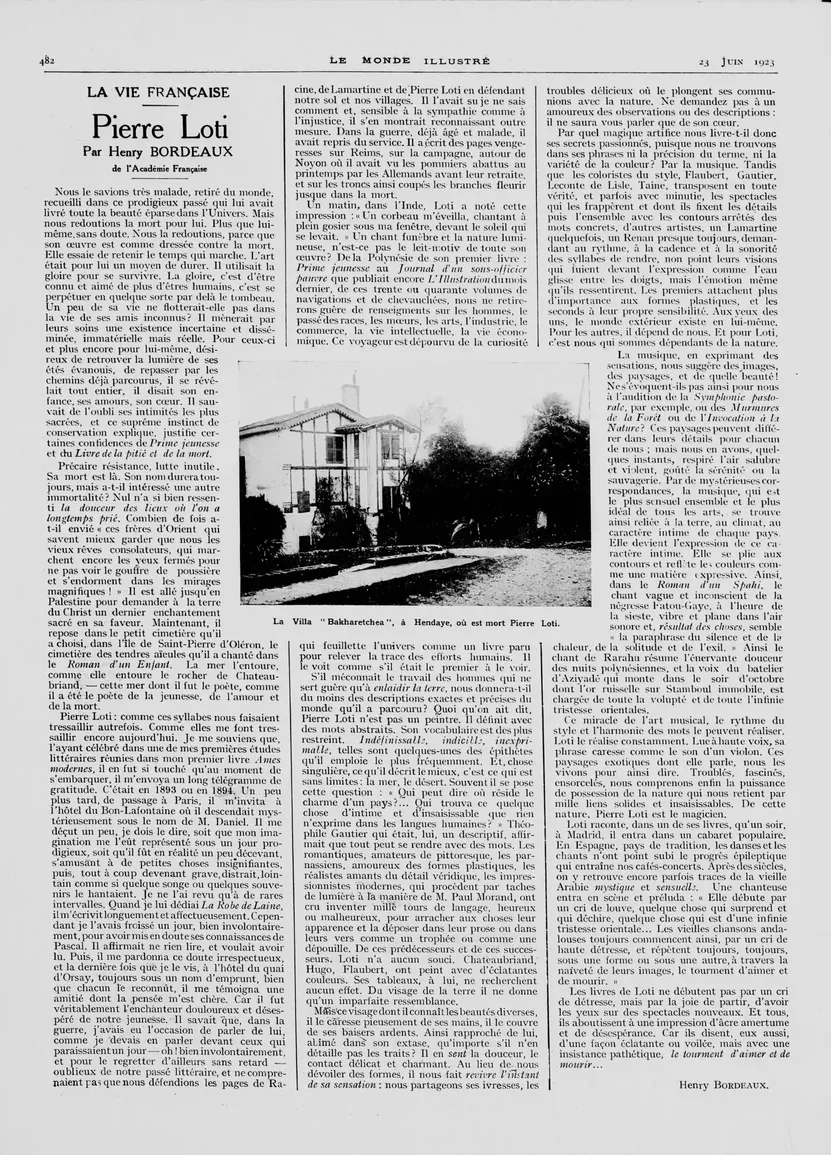
PIERRE LOTI By Henry BORDEAUX of the French Academy We knew him to be very ill, withdrawn from the world, collected in this prodigious past which had given him all the beauty scattered in the Universe. But we feared death for him. More than himself no doubt. We feared her, because her work is as if set up against death, She tries to hold back the passing time. Art was for him a way to last. He used fame to survive. Glory is to be known and loved by more human beings, it is to perpetuate itself somehow beyond the grave. Wouldn't a bit of his life float in the lives of his unknown friends? Through their care, he would lead an uncertain and scattered existence, immaterial but real. For them and even more for himself, eager to rediscover the light of his vanished summers, to retrace the paths he had already traveled, he revealed himself completely, he spoke of his childhood, his loves, his heart. He rescued his most sacred intimacies from oblivion, and this supreme instinct of self-preservation explains, justifies certain confidences in "Prime jeunesse" and "Livre de la pitié et de la mort". Precarious resistance, useless struggle. His death is there. His name will last forever, but did he interest another immortality? No one has felt so well the sweetness of the places where we have long prayed. How many times did he envy “those brothers from the Orient who know better how to keep the old consoling dreams than we do, who still walk with their eyes closed so as not to see the abyss of dust and fall asleep in magnificent mirages! “He went as far as Palestine to ask the land of Christ for a last sacred enchantment in its favor. Now he rests in the little cemetery he chose, on the island of Saint-Pierre d'Oléron, the cemetery of the tender ancestors he sang about in the Roman d'un Enfant. The sea surrounds him, as it surrounds the rock of Chateaubriand—this sea of which he was the poet, as he was the poet of youth, of love, and of death. Pierre Loti how these syllables made us quiver in the past. How they thrill me to this day. I remember that, having celebrated it in one of my first literary studies collected in my first book "Modern Souls", he was so touched by it that on boarding he sent me a long telegram of gratitude. It was in 1893 or 1894. A little later, passing through Paris, he invited me to the Hotel du Bon-Lafontaine where he mysteriously stayed under the name of M. Daniel. He disappointed me a little, I must say, either because my imagination had represented him to me in a prodigious light, or because he was in reality a little disappointing, amusing himself with little insignificant things, then, suddenly becoming serious, distracted, distant as if some dream or some memory were haunting him. I saw him only at rare intervals. When I dedicated "La Robe de Laine" to him, he wrote to me at length and affection. However, I had offended him one day, very involuntarily, for having questioned his knowledge of Pascal. He claimed not to read anything, and wanted to have read. Then he forgave me this disrespectful doubt, and the last time I saw him, at the hotel on the Quai d'Orsay, still under an assumed name, although everyone recognized him, he showed me a friendship whose thought is dear to me. For he was truly the painful and desperate enchanter of our youth. He knew that, in the war, I had had the opportunity to speak of him, as I had to speak of him in front of those who appeared one day — oh! very involuntarily, and moreover to regret it without delay — forgetful of our literary past, and did not understand that we were defending the pages of Racine, Lamartine and Pierre Loti by defending our soil and our villages. He had known about it I don't know how and, sensitive to sympathy as well as to injustice, he showed himself grateful for it measure. In the war, already old and ill, he had returned to service. He wrote vengeful pages on Rheims, on the countryside, around Noyon where he had seen the apple trees felled in the spring by the Germans before their retreat, and on the trunks thus cut the branches bloom even in death. One morning in India, Loti noted this impression: “A crow woke me, singing at the top of my voice under my window, in front of the rising sun. A funeral song and luminous nature, isn't this the leitmotif of all his work? From Polynesia in his first book, "Prime jeunesse" to the poor "Journal d'un non-commissioned officer" still published in L'Illustration last month, from these thirty or forty volumes of navigations and rides, we will hardly get information on men, the past of races, manners, arts, industry, commerce, intellectual life, economic life. This traveler is devoid of the curiosity that leafs through the universe like a book published to find traces of human efforts. He sees it as if he were the first to see it. If he misunderstands the work of men, which only serves to make the earth ugly, will he at least give us exact and precise descriptions of the world he has traveled through? Whatever has been said, Pierre Loti is not a painter. It defines with abstract words. Its vocabulary is very limited. Indefinable, unspeakable, inexpressible, these are some of the epithets he uses most frequently. And, singular thing, what he best describes is what is limitless: the sea, the desert. Often he asks himself this question: “Who can say where the charm of a country lies? Who found this intimate and elusive something that nothing expresses in human languages? Théophile Gautier, who was himself a descriptive, affirmed that everything can be rendered with words. The romantics, lovers of the picturesque, the Parnassians, lovers of plastic forms, the realists, lovers of truthful detail, the modern impressionists, who proceed by spots of light in the manner of M. Paul Morand, thought they had invented a thousand tricks of language, happy or unhappy, to tear things out of their appearance and deposit them in their prose or in their verses like a trophy or like a spoil. Of these predecessors and successors, Loti has no worries. Chateaubriand, Hugo, Flaubert, painted with brilliant colors. His paintings, to him, do not seek any effect. Of the face of the earth it only gives an imperfect resemblance. But this face of which he knows the various beauties, he piously caresses it with his hands, he covers it with his ardent kisses. Thus brought closer to him, loved in his ecstasy, what does it matter if he does not detail his features? He feels its softness, the delicate and charming touch. Instead of revealing forms to us, he makes us relive the moment of his sensation, we share his intoxication, the delicious troubles in which his communion with nature plunges him. Do not ask a lover for observations or descriptions: he will only be able to speak to you from his heart. By what magical artifice does he reveal his impassioned secrets to us, since we find in his sentences neither the precision of the term, nor the variety of the color? By music. While the colorists of style, Flaubert, Gautier, Leconte de Lisle, Taine, transpose in all truth, and sometimes with meticulousness, the spectacles which struck them and of which they fix the details then the whole with the fixed contours of the concrete words, other artists, a Lamartine sometimes, a Renan almost always, asking the rhythm, the cadence and the sonority of the syllables to render, not their visions which flee before expression like water slipping between the fingers, but the very emotion they felt. The former attach more importance to plastic forms, and the latter to their own sensibility. In the eyes of some, the outside world exists in itself. For others, it depends on us. And for Loti, it is we who are dependent on nature. Music, by expressing feelings, suggests images, landscapes, and what beauty! Are they not evoked in this way for us when hearing the "Pastoral Symphony", for example, or the "Murmurs of the Forest" or the "Invocation to Nature"? These landscapes may differ in their detail for each of us; but we have, for a few moments, breathed the salubrious and violent air, tasted the serenity where the savagery. By mysterious correspondences, music, which is the most sensual ensemble and the most ideal of all the arts, is thus linked to the earth, to the climate, to the intimate character of each country. It becomes the expression of this intimate character. It bends to contours and reflects colors like an expressive material. Thus, in the "Roman d'un Spahi", the vague and unconscious song of the negress Fatou-Gaye, at siesta time, vibrates and hovers in the sonorous air and, as a result of things, seems "the paraphrase silence and warmth, loneliness and exile”. Thus Rarahu's song sums up the enervating sweetness of Polynesian nights, and the voice of the Aziyade boatman rising in the October evening, whose gold streams over the motionless Stamboul, is charged with all the voluptuousness and all the infinite oriental sadness. This miracle of musical art, the rhythm of style and the harmony of words can achieve it, Loti constantly achieves it. Read aloud, his phrase caresses like the sound of a violin. These exotic landscapes of which she speaks, we live them so to speak. Troubled, fascinated, bewitched, we finally understand the power of possession of nature which holds us back by a thousand solid and elusive bonds. Of this nature, Pierre Loti is the magician. Loti recounts in one of his books that one evening in Madrid he entered a popular cabaret. In Spain, a country of tradition, dances and songs have not undergone the epileptic progress which leads to our café-concerts. After centuries, we still sometimes find traces of the old mystical and sensual Arabia. A singer entered the stage and preluded: “It begins with a cry of a wolf, something that surprises and tears, something that is of an infinite oriental sadness. The old Andalusian songs always begin like this, with a cry of high distress, and repeat always, always, in one form or another, through the naivety of their images, the torment of loving and dying”. Loti's books do not begin with a cry of distress, but with the joy of leaving, of having our eyes on new sights. And all of them lead to an impression of acrid bitterness and despair. Because they too say, in a brilliant or veiled way, but with pathetic insistence, the torment of loving and dying... Henry Bordeaux. |