|
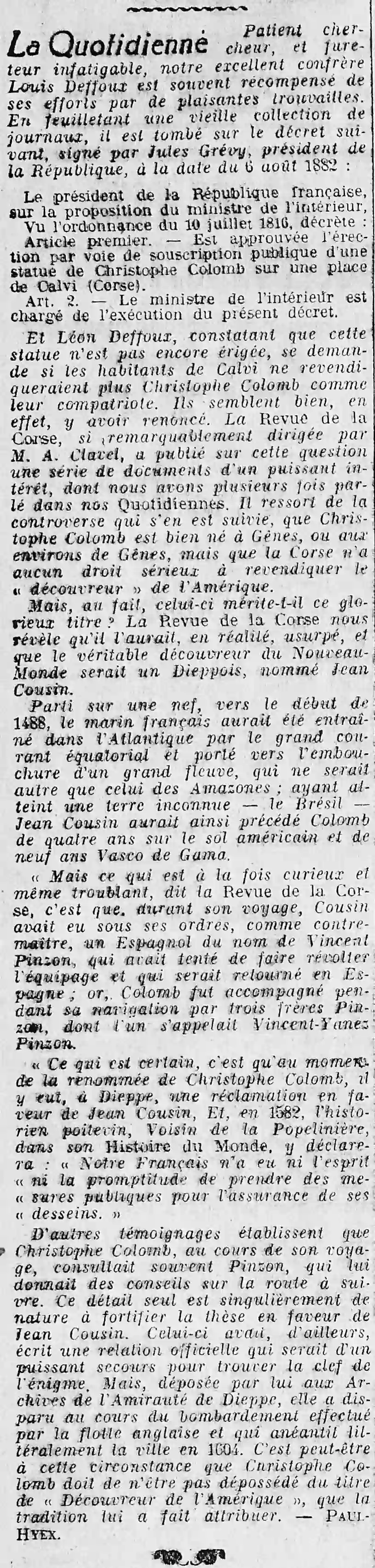
Jean Cousin and Christophe Colombus Patient researcher, and tireless browser, our excellent colleague Louis Deffoux is often rewarded for his efforts with pleasant finds. Leafing through an old collection of The President of the French Republic, on the proposal of the Minister of the Interior, Having regard to the ordinance of July 19, 1816, decrees: First article. — Is approved the erection by way of public subscription of a statue of Christopher Columbus on a square in Calvi {Corsica}. Art. 2 — The Minister of the Interior is charged with the execution of this decree. And Léon Deffour, noting that this statue has not yet been erected, wonders if the inhabitants of Calvi would no longer claim Christophe Colomb as their compatriot. They do indeed seem to have given up on it. The Revue de la Corse, so remarkably edited by M. A. Clavel, has published on this question a series of documents of great interest, of which we have spoken several times in our Quotidiennes. It emerges from the controversy that ensued that Christopher Columbus was indeed born in Genoa, or around Genoa, but that Corsica has no serious right to claim the "discoverer" of America. But, by the way, does this one deserve this glorious title? The Revue de la Corse reveals to us that he would have, in fact, usurped it, and that the real discoverer of the New World would be a Dieppe, named Jean Cousin. Leaving on a ship, towards the beginning of 1488, the French sailor would have been swept into the Atlantic by the great eguatorial current and carried towards the mouth of a great river, which would only be that of the Amazons; having reached an unknown land - Brazil - Jean Cousin would thus have preceded Columbus by four years on American soil and Vasco da Gama by nine years. "But what is both curious and even disturbing, says La Revue de la Corse, is that, during his trip, Cousin had had under his orders, as foreman, a Spaniard named Vincent Pinson, who would have tried to revolt the crew and who would have returned to Spain; however, Columbus was accompanied during his navigation by three Pinzo brothers, one of whom was called Vincent-Yanes Pinzon. "What is certain is that at the time of the fame of Christopher Columbus, there was, in Dieppe, a claim in favor of Jean Cousin, And, in 1582, the Poitevin historian, Voisin de la Popelinière, in his History of the World, declared: "Our Frenchman had neither the spirit nor the promptness to take public measures for the assurance of his "designs." » Other testimonies establish that Christopher Columbus, during his journey, often consulted Pinzon, who gave him advice on the route to follow. This detail alone is singularly likely to strengthen the thesis in favor of Jean Cousin. He had also written an official report which would be of powerful help in finding the key to the enigma. But, deposited by him in the Archives of the Admiralty of Dieppe, it disappeared during the bombardment carried out by the English fleet and which literally annihilated the city in 1604. It is perhaps PAUL-HYEX |
- Détails