

| La Presse 21 juillet 1923 (art. page trois) |
 |
|
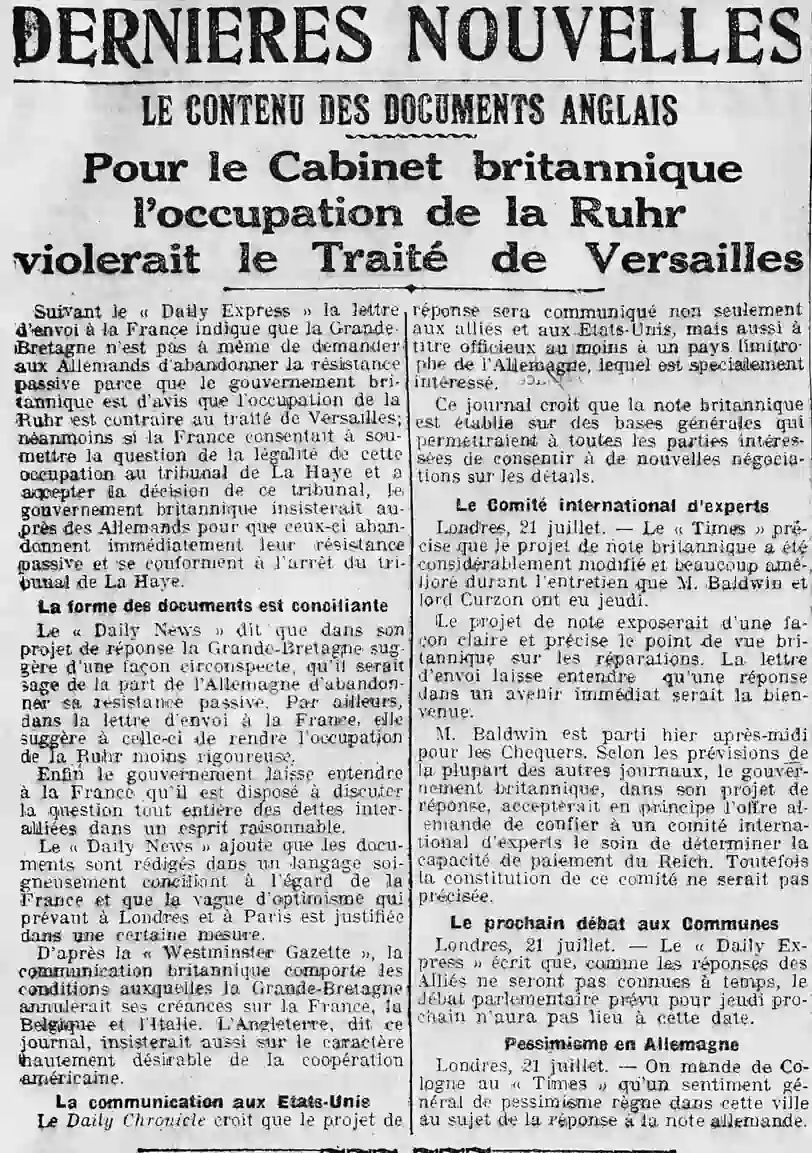
English Document Content For the British Cabinet the occupation of the Ruhr would violate the Treaty of Versailles According to the "Daily Express" the letter of dispatch to France indicates that Britain is unable to ask the Germans to give up passive resistance because the British government is of the opinion that the occupation of the Rubr is contrary to the Treaty of Versailles; nevertheless, if France consented to submit the question of the legality of this occupation to the tribunal of The Hague and to accept the decision of this tribunal, the British government would insist that the Germans immediately abandon their passive resistance and conform to The judgment of the court of The Hague. The form of the documents is accommodating: The "Daily News" says that Britain's draft reply cautiously suggests that it would be wise for Germany to abandon passive resistance. Moreover, in her letter of dispatch to France, she suggests that the latter "make the occupation of the Ruhr less rigorous" Finally, the government gives France to understand that it is disposed to discuss the whole question of inter-allied debts in a reasonable spirit. The "Daily News" adds that documents are written in carefully conciliatory language towards France and that the wave of optimism prevailing in London and Paris is to some extent justified. According to the "Westminster Gazette", the British communication includes the conditions under which Great Britain would cancel its claims on France, Belgium and Italy. England, says this newspaper, would also insist on the highly desirable character of American cooperation. Communication in the United States: The Daily Chronicle believes that the draft reply will be communicated not only to the allies and to the United States, but also informally at least to one country bordering on Germany, which is specially interested. This newspaper believes that the British note is established on a general basis which would allow all interested parties to agree to further negotiations on the details. The International Expert Committee: London, July 21. — The "Times" states that the draft British note was considerably modified and much improved during the interview which Mr. Baldwin and Lord Curzon had on Thursday: The draft note would set out in a clear and precise manner the British point of view on reparations. The letter Mr. Baldwin left for Checkers yesterday afternoon. According to the forecasts of most of the other newspapers, the British government, in its draft reply, would accept in principle the German offer to entrust an international committee of experts with the task of determining the Reich's ability to pay. However, the composition of this committee would not be specified. The next debate in the Commons: London, July 21 — The "Daily Express" writes that, as the answers of the Allies will not be known in time, the parliamentary debate scheduled for next Thursday will not take place on that date. Pessimism in Germany: London, July 21. — The Times reports from Cologne that there is a general feeling of pessimism in that city about the response to the German note. |