|
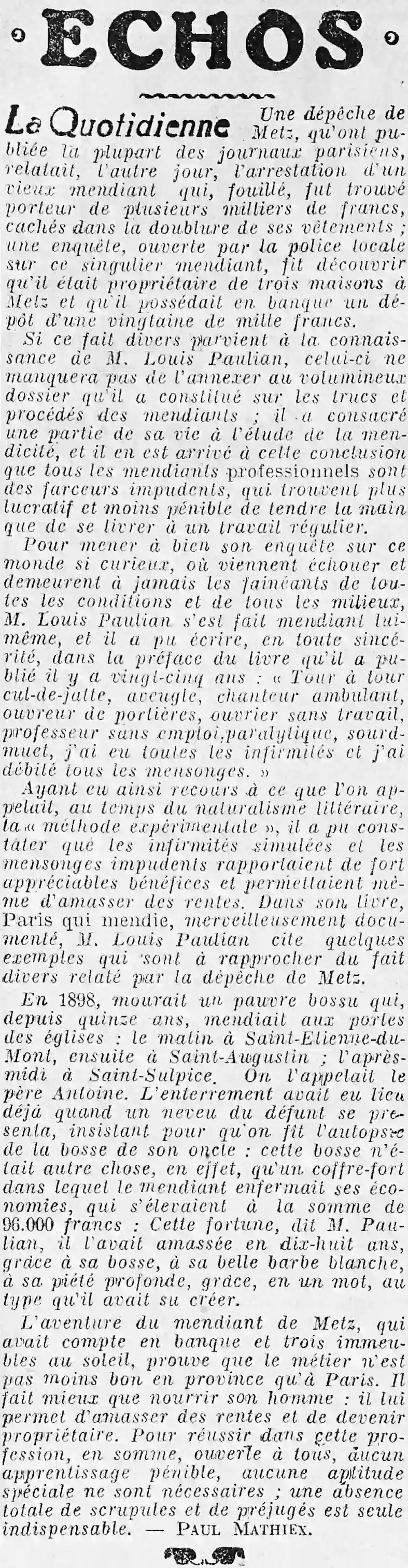
ECHOES
A dispatch from Metz, published by most Parisian newspapers, reported the other day the arrest of an old beggar who, when searched, was found carrying several thousand francs, hidden in the lining of his clothes. an investigation, opened by the local police into this singular beggar, revealed that he was the owner of three houses in Metz and that he had a bank deposit of around twenty thousand francs.
If this news item comes to the attention of Mr. Louis Paulian, he will not fail to append it to the voluminous file he has compiled on the tricks and practices of beggars; he has devoted part of his life to study of begging, and he came to the conclusion that all professional beggars are impudent pranksters, who find it more lucrative and less laborious to extend a hand than to engage in regular work.
To carry out his investigation into this very curious world, where lazy people of all conditions and from all walks of life end up and remain forever, Mr. Louis Paulian became a beggar himself, and he was able to write, in all sincerity, in the preface to the book he published twenty-five years ago: “In turn deadbeat, blind, itinerant singer, door opener, unemployed worker, unemployed teacher, paralytic , deaf and dumb, I had all the infirmities and I stupid all the lies. »
Having thus resorted to what was called, in the days of literary naturalism, "the experimental method", he was able to observe that simulated infirmities and impudent lies brought in very appreciable profits and even made it possible to amass income. In his book, “Paris qui mendie”, wonderfully documented, Mr. Louis Paulian cites some examples which can be compared to the news item reported by the Metz dispatch.
In 1898, a poor hunchback died who, for fifteen years, had been begging at the doors of churches: in the morning at Saint-Elienne-du-Mont, then at Saint-Augustin; in the afternoon in Saint-Sulpice. They called him Father Antoine. The burial had already taken place when a nephew of the deceased presented himself, insisting that an autopsy be carried out on his uncle's bump: this bump was nothing other, in fact, than a safe in which the beggar locked up his savings, which amounted to the sum of 96,000 francs. This fortune, says Mr. Paulian, he had amassed in eighteen years, thanks to his hump, his beautiful white beard, his deep piety , thanks, in a word, to the type he had been able to create.
The adventure of the beggar from Metz, who had a bank account and three buildings in the sun, proves that the profession is no less good in the provinces than in Paris. He does more than feed his man; he allows him to amass income and become an owner. To succeed in this profession, in short, open to all, no arduous apprenticeship, no special skills are necessary; a total absence of scruples and prejudices is all that is essential.
PAUL MATHIEX.
|