|
The ambassadors, meeting yesterday morning, dealt with two distinct questions: 1° the return of the Crown Prince to Germany and the possible return of the Kaser; 2° the resumption of military control interrupted for a year.
On the first point, a new development occurred on Sunday. The German charge d'affaires went to the Ministry of Foreign Affairs to correct his communication from Thursday. He declared that the Crown Prince had formally relinquished all his rights to the crown of Prussia, and to the imperial crown of Germany, on December 1, 1918. He added that the Berlin cabinet had resolved to oppose, if necessary , upon the return of William II to German territory. So these are complications that we are free of, at least for the moment.
The second point, as might be expected, proved much more difficult. England, as we know, rejected a first compromise formula drawn up on Saturday and which was transmitted to London in the middle of the night. Yesterday morning, his spokesperson developed the thesis indicated in our last article. The London cabinet accepts that an injunction be sent to the Berlin government to put it on notice to resume military control to the extent of its authority, General Nollet and his colleagues on the inter-allied military commission receiving the mission of assessing the good or the bad will of Germany in each particular case. But Downing Street leaders refuse to include any sanctions in such an injunction. Any inter-allied sanctions, in their judgment, would only add to German disorder. On the other hand, claiming both the Treaty of Versailles and the commitment made by the Paris ministry in April 1920, they deny France the right to proceed with the implementation of separate sanctions.
Such being the state of affairs, the French delegates, led by Mr. Jules Cambon, were of the opinion that a new effort must be made to prevent the rupture. The French government, in any case, has never considered applying, in the current situation, new military and territorial sanctions. The territories currently occupied, as we have said, are sufficient in themselves, with a few changes, and as an instrument of reparation and, if necessary, as a. security instrument. As for the economic and financial sanctions, which we would have liked to have applied by all the Allies, we are taking them every day, without noise or storm, in application of the policy of January 11. It goes without saying that we would have preferred to succeed in persuading our allies: thus, their assent would have been won for the Ruhr policy. But there is no point in persisting in an effort which, far from bringing the Allies closer to the work we have begun, would tend to further distance them from it.
It is in this spirit that a new formula was drawn up. An injunction will be sent to Berlin. The Reich will be ordered to regain military control at a relatively early date (probably the end of the month) under the conditions explained above. In the document no sanctions will be mentioned.
It goes without saying that, if necessary, the French government will assert its right to take any measure that may be important for the defense and protection of our army of occupation and the regime that we are establishing in an occupied country, in the event that the The failure of military control would threaten us in some way, whether the German government had anything to do with it or whether it had nothing to do with it. By taking such safeguards, France would not have to invoke this or that clause of the Treaty. It would simply make use of the right which belongs to every sovereign State to ensure its own security. There is no need for this right to be confirmed by anyone.
This is the draft agreement on which the French council of ministers deliberated for almost two hours, at the beginning of the afternoon, and which it eventually agreed to. It leaves us free to work, in an occupied country, on developing our system. And if it does not give us satisfaction regarding the rallying of the Allies around this system, at least it does not take away anything from what we have in hand, which is the essential thing. On Sunday, we recommended a solution of this order.
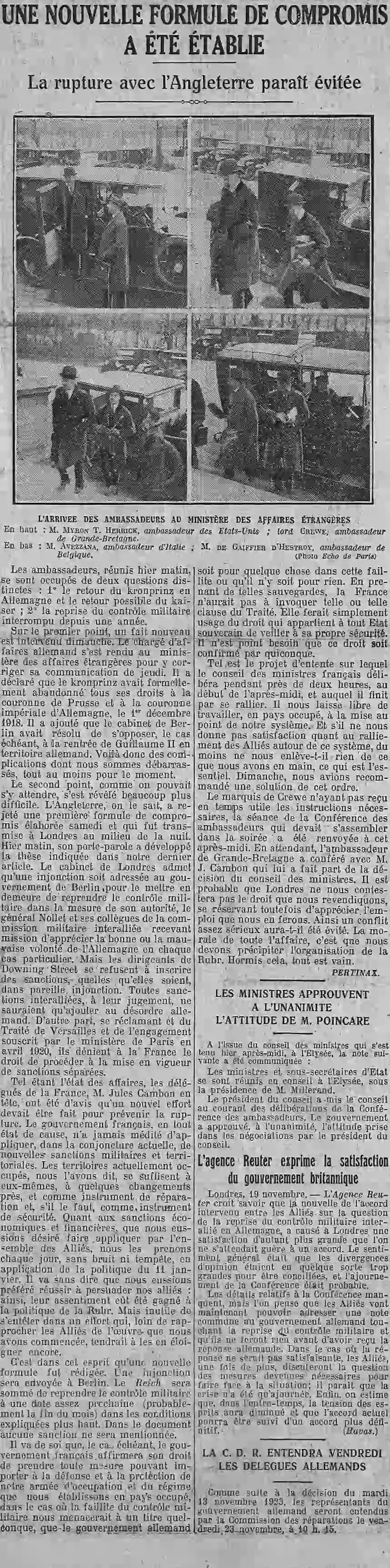
The Marquis of Crewe not having received the necessary instructions in good time, the session of the Conference of Ambassadors which was to have assembled in the evening was postponed until this afternoon. In the meantime, the British Ambassador spoke with Mr. J. Cambon who informed him of the decision of the Council of Ministers. It is likely that London will not contest the right we claim, reserving however to assess the use we make of it.Thus a fairly serious conflict will have been avoided. The moral of the whole affair is that we must hasten the organization of the Ruhr. Apart from that, everything is in vain.
PERTINAX.
London, November 19. The Reuters Agency understands that the news of the agreement reached between the Allies on the question of the resumption of inter-Allied military control in Germany caused London all the greater satisfaction as it was not hardly expected an agreement. The general feeling was that the differences of opinion were somehow too great to be reconciled, and adjournment of the Conference was likely. Details of the Conference are lacking, but it is believed that the Allies will now be able to send a joint note to the German government regarding the resumption of military control and will take no action until they receive the German response. In the event that the response is not satisfactory, the Allies will once again discuss the question of the measures that have become necessary to deal with the situation; it seems that the crisis has only been postponed. Finally, it is estimated that, in the meantime, the tension of minds will have diminished and that the current agreement could be followed by a more definitive agreement. (Havas.)
THE C. D. R. WILL HEAR THE GERMAN DELEGATES ON FRIDAY
Following the decision of Tuesday, November 13, 1923, the representatives of the German government will be heard by the Reparations Commission on Friday, November 23, at 10 a.m. 15. ARA
|