|
Trouville beach has just celebrated the centenary of what the initiative committee calls "its consecration as an elegant and fashionable beach." An approximate centenary, to be sure, and perhaps a little premature, because a hundred years ago, Trouville was known and frequented only by a few painters, and had not yet considered becoming a fashionable beach. Alexandre Dumas himself had not yet discovered it.
At that time, the one and only beach that could be described as "elegant and fashionable" was Dieppe. And this was because a Royal Highness had launched it. However, around 1812, Dieppe had a small establishment frequented by the sick, where one could take seawater baths in bathtubs at all temperatures. But it wasn't until 1822 that a company was formed to operate the beach.
It didn't truly become a fashionable beach until two years later. In August 1824, the Duchess of Berry went there, accompanied by a young and cheerful court. From then on, it became fashionable to follow her example; and for Dieppe, this marked the beginning of a fashion that has continued ever since.
At the same time, other Channel regions were becoming known. People went to Le Havre, Le Tréport, and Boulogne. However, Trouville, in 1825, was still only a modest fishing village.
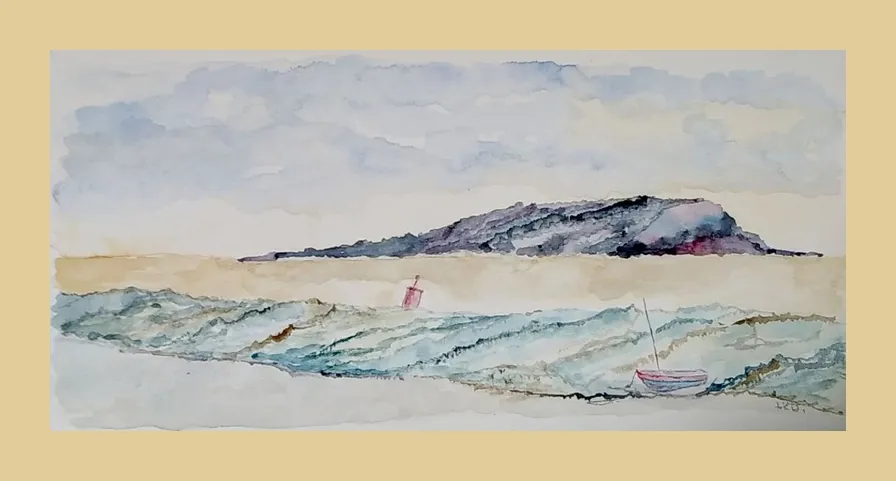
The first Parisian to settle there was a landscape painter named Charles Mozin. This artist lived on the Normandy coast for over twenty years, painting its most picturesque aspects. There is a landscape painting by him at the Trouville town hall that gives an accurate idea of what the town was like when he discovered it, around 1825 or 1826.
Other painters, his friends: Decamps, Jadin, Isabey, Paul Huet, soon joined him there and, like him, settled in the only inn in the area, run by a good woman who cooked wonderfully, Mother Oseraie.
On certain days, the group was joined by a Rouen poet, Ulric Guttinguer, owner of a chalet that stood nearby, on the road to Honfleur.
However, the Trouville painters had praised the charms of the beach and Mother Oseraie's excellent cooking in Paris. Alexandre Dumas, who knew Paul Huet intimately and who regularly visited Jadin and Decamps, having heard Trouville's praises sung so often, was seized by the desire to spend time there himself.
Found in Le Havre in the summer of 1831, he rented a boat and set sail for Trouville. Evening was falling when he arrived at the mouth of the Touques. The village, a few fishermen's houses nestled on the right side of the river, lay before him, but the tide was out. The sailors took Dumas and a gracious friend who was accompanying him onto their shoulders and set them ashore.
The couple went to stay with Mère Oseraie.
If we are to believe what Dumas recounts in his Memoirs, she had none of the exquisite urbanity of today's hoteliers. Dumas asked her for two rooms. Mother Oseraie exclaimed: "You want two rooms?
- Perfectly!
- Well, you'll have them, but I would have preferred it if you'd only taken one." "I wouldn't say," added Dumas, "that she said 'prissiez,' but the reader will forgive me for this embellishment.
- Good! I see where you're going," he replied. "You would have charged me for two and you would have had one more to rent to travelers.
- Exactly!... Well, you're not too stupid for a Parisian yet, are you!...
Anyway, our man sends the maid to lead his friend to the room allocated for him, and he declares that he wants to chat with the landlady again.
- Why?...
- Because I find your conversation pleasant.
- You joker!
- And then, I'd like to know what you'll charge me per day?"
- There are two prices: when it's the painters, it's forty sous.
- What, forty sous?... Forty sous for what?...
- For food and lodging, then.
- And when it's not the painters?
- Fifty sous.
So Dumas got by on one hundred sous a day for his companion and himself. Prices have increased somewhat since then, but so have the comforts. Yet Dumas had a beautiful whitewashed room, furnished with a wardrobe, a table, and a walnut bed, with crisp white sheets that smelled of verbena. At the window, calico curtains, and on the mantelpiece, Mother Oseraie's orange blossom wreath, piously preserved under a globe.
It was there, in this modest inn room, that he wrote his famous verse drama: Charles VII chez ses grands vassaux.
The great storyteller began Trouville's fortune. He brought all his friends there... And God knows he had some! So much so that Mother Oseraie's house soon found itself too small. So they began to open streets, build hotels and villas. In ten years, the humble fishing village had become an elegant bathing town.
The memory of Alexandre Dumas would live on for a long time in the minds of the elderly inhabitants of the village of Trouville. Some twenty years ago, the ferryman who ran the Touques ferry, a very gray-haired old man, still recounted that in his youth he had often passed "a tall, devilish Parisian with frizzy black hair," who would go hunting, rifle slung over his shoulder, in the marshes where the Deauville resort now stands, and who, the old man added, "often paid the price." You've recognized the silhouette of the good giant, a great hunter before the Lord.
It was a local landowner named Desseaux who completed the transformation of the village into a seaside resort. He bought land, divided it up, and had streets built. Soon, Trouville had a double row of cabins on its beach. In 1843, the town was already large enough for consideration to be given to building a performance hall there.
This news scandalized Alphonse Karr. He wrote in his Wasps: "The newspapers announce that Trouville is building a theater. I don't think Trouville is right. What people are going to see in Trouville is the sea. But what do you expect Parisians to do with the eighth-rate actors you can muster with great difficulty? Do you know what has made Trouville so successful over the past ten years? It's its isolation, its peaceful atmosphere, everything you're trying to make it lose!..."
Alphonse Karr, for once, was wrong. He didn't foresee that, far from harming the prosperity of these coastal towns, the pleasures of the Casino would, on the contrary, be its essential element. He did not foresee that the day would come when Parisians—or at least those who made up what is commonly called "All of Paris"—would go to Trouville, no longer like Dumas and his friends, to savor the joys of solitude and tranquility, but, on the contrary, to find themselves immersed in the whirlwind of their pleasures and worldly gossip. What a surprise the pamphleteer would have been if a vision of the future had shown him what the stage and open-air club on Rue Gontaut-Biron would be like sixty years from now!
Little by little, like Trouville, the fishing villages of the Normandy coast were transformed into elegant beaches, towns of pleasure. Writers, artists, and prominent figures in literature, politics, and the aristocracy played a major role in these metamorphoses. Alphonse Karr, who so amusingly protested against the social events of Trouville, created Etretat shortly after. The musician Offenbach, having chosen this beach as a vacation spot, was completing its launch.
Deauville, in 1853, was nothing more than a farm, belonging to Gustave Flaubert's mother, and lost among the marshy land where Alexandre Dumas hunted. The Duke of Morny arrived there a few years later, had the land reclaimed, streets laid out, villas built, and began the fortune of this beach destined to become the most fashionable on the coast.
The Princes of Orléans had founded Le Tréport; the Empress of Austria launched Les Petites Dalles; the Messrs. de Rothschild founded Berck; Queen Christine was the godmother of Sainte-Adresse; the Dukes of Mortemart and Audiffred-Pasquier were the true creators of Dinard. Guys, near Dieppe, owed its birth to Alexandre Dumas Jr.... And so on. For almost all our beaches in Normandy and Brittany, as well as most of our spa towns, were made fashionable by some illustrious figure.
Trouville, in a centenary, perhaps a little premature, celebrates its birth into high society. Let us hope that all our beaches follow his example and commemorate the memory of those who began their fortunes. Gratitude is a virtue that cities can practice as well as individuals.
Jean LECOQ.

|