|
The Five Detectives
by GABRIEL BERNARD
CHAPTER II
The Bride's Cablegram
SUMMARY OF THE PREVIOUS SERIES Constance Phips, the daughter of the American billionaire, marries Baron Gontran de Champval at the Madeleine. An unforeseen circumstance means that no cameraman can photograph the newlyweds as they leave the church. They nevertheless make their way to the "Mundial Palace," which has been rented out entirely for the wedding feast.
From this, one can imagine what the feast awaiting Reginald Phips's guests must have been like upon their return from the Madeleine, in the immense Venetian hall of the Mundial Palace: the fantastic profusion of flowers, silverware, and crystals, the succulent menu, the splendor and taste of the decoration, the work of a justly renowned galaxy of artists. All the guests were ecstatic, both those the King of Dynamos had brought from the United States, and the elite of Parisian society, invited by Baron Gontran de Champval.
While waiting to sit down to eat, most of this glittering gathering spread out into the circular gallery surrounding the hall and the surrounding salons, while a number of guests, mostly ladies, went to the apartments where everything had been arranged so that everyone could tidy up their attire. Accompanied by her maids of honor, the bride went to her own apartment, furnished, as one might imagine, with incredible splendor.
The new Baroness de Champval seemed moved, but it was a joyful emotion that the expression on her face revealed. The opposite would have surprised everyone, for despite her fabulous dowry, hers was a marriage of love, a marriage that began with a romantic encounter in the American West, where, the previous year, Baron Gontran de Champval had gone bison hunting.
Wounded during one of his hunting expeditions, the baron had been transported aboard Reginald Phips's special train, parked at just the right moment in a lonely station in the Far West, near a mine belonging to the billionaire. And, on this "superluxury" train, Gontran had as his nurse the woman who now bore his name...
It's not only in American films that things start like this! Once her marvelous attire had been adjusted by the bridesmaids, who had refused to abandon the bride to the mercenary care of her maids, Constance thanked them and said kindly: My dear friends, I have a request to ask of you... I wish to be alone for a few minutes...
"I promised my childhood friend, Edith Sprongfield, who is getting married today in Chicago, that the first lines I would write in my own hand after the wedding ceremony would be for her... She promised me to do the same in Chicago... So you understand?"
The bridesmaids, Miss Arabella Hitchwick, daughter of the Attorney General of the State of Ohio, and Miss Adélaïde de Saint-Enguerrand, daughter of the Duke of Saint-Enguerrand, Baron de Champval's first witness, hastened to grant Constance's request, who withdrew to her room, throwing them graciously these words: I ask you for ten minutes at the most...
It had already been more than a quarter of an hour since the new baroness had disappeared behind a heavy doorway when Reginald Phips and Gontran entered the boudoir where Miss Hitchwick and Mademoiselle de Saint-Enguerrand were. The bridesmaids informed them of Constance's expressed wish.
Ah yes, I know, said the billionaire. And, approaching the doorway that concealed the entrance to his daughter's room, he called out: Hello! Constance... Be as quick as possible... We're all waiting at the table... I'll hurry, replied the fresh voice of the pretty bride.
A few minutes passed. A woman entered the boudoir where, while chatting, Phips, his son-in-law, and the two maids of honor awaited Constance's return.
Quite tall, slender, wearing with haughty grace a gown that was a masterpiece, Countess Flora Zitti, widow of Count Antonio Zitti, was a celebrated beauty. Her Italian name suited her admirably, for her dark complexion, her medal-like profile, the velvety sparkle of her large black eyes, her overall appearance, and the quality of her charm, evoked at first glance the idea we have of the great ladies of the Florentine Renaissance. Yet Countess Flora Zitti was French, even Parisian. One only had to see her once to understand that her husband had married her for love and had happily married her. Well-informed people indeed whispered that Countess Zitti was of rather obscure origins and that she had brought nothing but her prestigious beauty as a dowry to her husband.
But it was not difficult for a man like Count Zitti, the last descendant of a family that had played a leading role in the history of his country, having himself held high offices of state, to impose on the world a woman as extraordinarily beautiful as his own.
And this was all the more so since Countess Flora Zitti was intelligent, and her reputation was unassailable.
Irreproachable during the Count's lifetime, she remained so after his death. Flora Zitti had taken a great liking to Constance Phips. It was known that she had guided the young girl's steps through the labyrinth of Parisian society when, two years before the beginning of this story, Reginald Phips had brought his daughter to Europe for the first time. During this trip, there was no question yet of Constance's marriage to Baron de Champval, for the excellent reason that Constance and Gontran, at that time, did not know each other, had never even seen each other.
Well, Mr. Phips, said the Countess, what's going on?... I come here as an ambassador... Your guests are beginning to wonder anxiously if the newlyweds have forgotten them... Several of them have asked me to come and find out... Since the Baron is here, it means that our lovebirds have not yet left for their honeymoon... But where is dear Constance?...
She's writing a cablegram, explained Baron de Champval. Despite his customary impassiveness, Reginald Phips made a gesture of impatience. Come now, Constance, he said loudly, walking towards his daughter's room, you're losing track of time... Come right away...
But this time, the bride didn't answer. Constance, repeated the billionaire with a hint of irritation, I beg you not to keep our guests waiting any longer... And, abruptly pushing the door open, he entered his daughter's room. Constance was not there.
CHAPTER III
Anguish and Mystery
The people gathered in the adjoining boudoir heard Reginald Phips's voice calling out in a tone of displeasure: Constance!... Where are you?... Constance...
But no answer came. Reginald Phips repeated his calls with no more success. Yet Constance couldn't be far from her room. On the writing desk where she had written was the dispatch form bearing the text of her cablegram addressed to Mrs. Edith Ripsland, née Sprongfield, her childhood friend, who was to be married that same day in Chicago.
The ink was not yet completely dry, which proved that Constance had still been in the room a few moments before.
Since she had not entered the boudoir where she was expected, she could only have gone to one of the two other adjoining rooms: the dressing room and a small sitting room, which was, in reality, an annex of the bedroom. There was no one in either the dressing room or the sitting room. It is true that this sitting room had an exit opening onto a secondary corridor upstairs. A broad smile suddenly spread across the usually impenetrable face of the King of the Dynamos. That mischievous Constance, he murmured, knowing that we were waiting for her in the boudoir, will have slipped through the small drawing room and reached the hall... When we arrive there in turn, it will be she who reproaches us for being late... That joke is completely in her character... I should have thought of it sooner... Returning to the boudoir, Reginald Phips bravely announced to his son-in-law, the countess and the maids of honor that Constance must already be in the hall. And as everyone cried out, expressing their surprise and disbelief, the billionaire repeated to them what he had just said to himself: - That joke is completely in my daughter's character... She takes after me... She cultivates humor...
The audience smiled deferentially, as is fitting when an important and wealthy man honors you with a remark he finds humorous and witty. But it was clear that everyone considered Constance's joke at least ill-timed. There was a slight awkwardness, which Reginald Phips cut short by leading everyone toward the banqueting hall.
Each of the numerous guests had recognized their assigned seat and was waiting to be seated until the masters of the house arrived. A friendly murmur greeted the appearance of Reginald Phips, who had offered his arm to Countess Flora Zitti. Miss Arabella Hitchwick and Miss Adélaïde de Saint-Enguerrand followed, gracefully flanking Baron Gontran de Champval. Reginald Phips swept the Venetian hall with a sharp gaze. He didn't see his daughter... At the same time, he had the distinct impression that the audience was just as surprised not to see Constance in the small group of arrivals as they were surprised not to see the bride among them.
Reginald Phips felt a dull anger simmering within him against his daughter, whom he adored, who was indeed the sole affection of his heart, armored by a lifetime devoted to making money, against the temptations of sentimentality.
The great businessman that he was abhorred being late for anything. He was ready to forgive Constance for having beaten him to the entrance. That, as he had said, was just humor. But that Constance would deliberately arrive after everyone else, he wouldn't accept. Deep down, he suffered because he thought he looked ridiculous. He was like an actor who had missed his entrance. In truth, no one thought of laughing at the bride's absence; but, as the minutes ticked by, this absence seemed stranger to everyone.
Miss Adélaïde de Saint-Enguerrand volunteered. I'll get her, she whispered in the billionaire's ear. The groom was likely beginning to feel as nervous as his father-in-law, but his familiarity with society allowed him to keep up appearances.
To gain time, he quietly approached a prominent man with a well-established reputation as an incorrigible chatterbox, and discreetly engaged him on a subject that had the virtue of making the man's verbosity seem inexhaustible. However, this could only be a very precarious expedient.
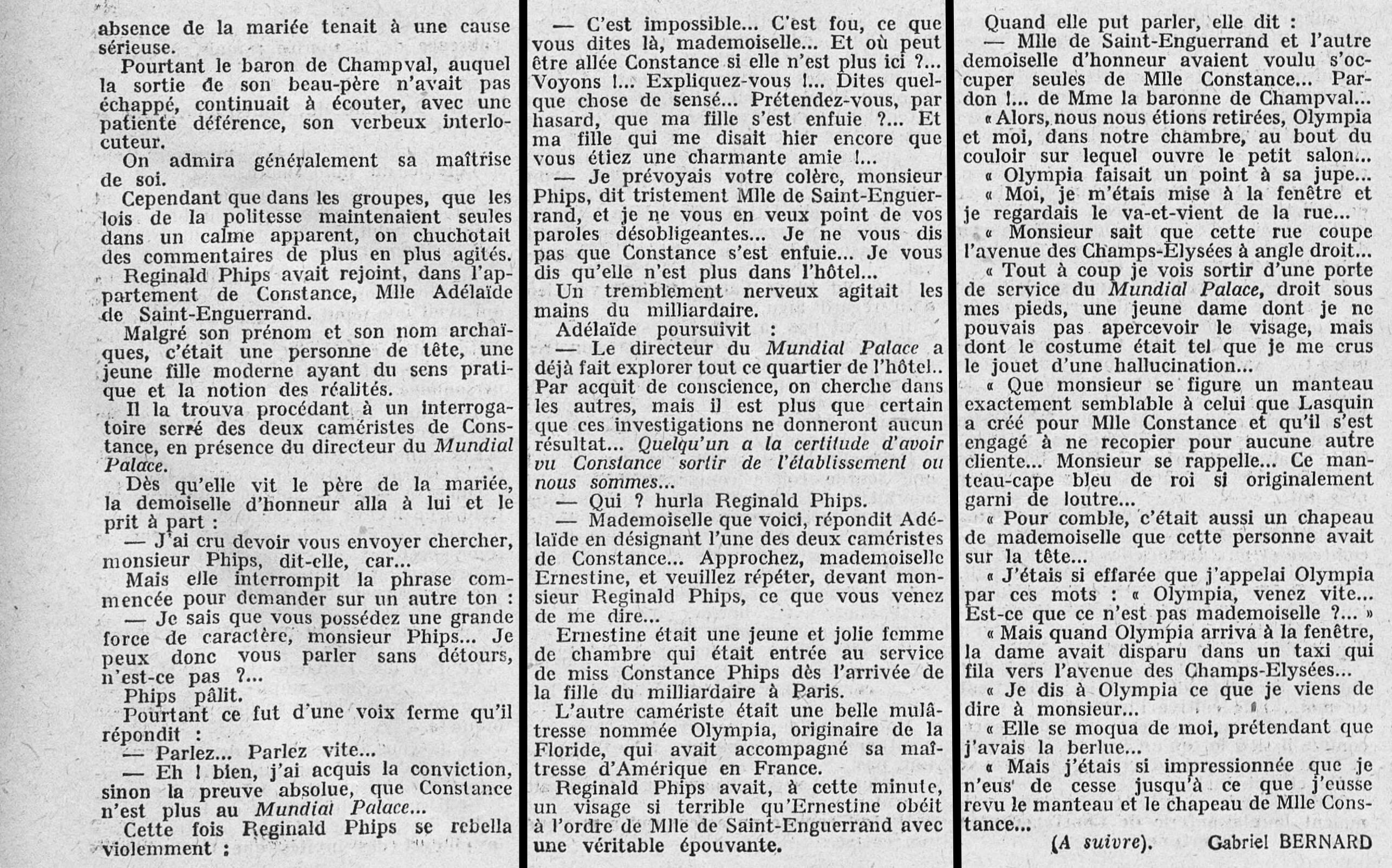
Minutes passed, and still the bride hadn't arrived... As for Miss Adélaïde de Saint-Enguerrand, she hadn't returned. Finally, as the time set for the beginning of the meal was thirty-five minutes past, a servant was seen discreetly approaching Reginald Phips. This man said a few words to the billionaire in a low voice. The King of the Dynamos flinched slightly, and, however much control he had over himself, his face betrayed a look of anxious surprise. "I beg your pardon," he murmured, addressing the people who had been chatting with him before the valet's arrival. And he followed the latter out of the hall. From then on, most of the guests no longer doubted that the bride's inexplicable absence was due to a serious cause. Yet Baron de Champval, whose father-in-law's departure had not escaped notice, continued to listen with patient deference to his verbose interlocutor. His self-control was generally admired. Meanwhile, in the groups, which only the laws of politeness maintained in apparent calm, increasingly agitated comments were being whispered. Reginald Phips had joined Miss Adélaïde de Saint-Enguerrand in Constance's apartment.
Despite her archaic first and last name, she was a strong-willed person, a modern young woman with practical sense and a grasp of reality. He found her conducting a rigorous interrogation of Constance's two chambermaids, in the presence of the director of the Mundial Palace. As soon as she saw the bride's father, the maid of honor went to him and took him aside:
"I thought I should send for you, Mr. Phips," she said, "because..." But she interrupted the sentence to ask in a different tone: "I know you possess great strength of character, Mr. Phips... So I can speak to you directly, can't I?" Phips paled. Yet it was in a firm voice that he replied: Speak... Speak quickly... Well, I have become convinced, if not absolutely certain, that Constance is no longer at the Mundiai Palace...
This time Reginald Phips rebelled violently: It's impossible... What you're saying is crazy, miss... And where could Constance have gone if she's no longer here?... Come on!... Explain yourself!... Say something sensible... Are you claiming, by any chance, that my daughter has run away?... And my daughter, who was telling me only yesterday that you were a charming friend!...
I anticipated your anger, Mr. Phips, said Miss de Saint-Enguerrand sadly, and I don't hold your disparaging words against you... I'm not telling you that Constance has run away... I'm telling you that she's no longer in the hotel... A nervous tremor shook the billionaire's hands. Adelaide continued, "The director of the Mundial Palace has already had this entire area of the hotel explored. For the sake of certainty, we're searching the others, but it's more than certain that these investigations won't yield any results... Is anyone certain they saw Constance leaving the establishment where we are...
Who?" Reginald Phips yelled.
"Miss here," Adelaide replied, pointing to one of Miss Ernestine's two maids. "Come here, Miss Ernestine, and please repeat, in front of Mr. Reginald Phips, what you just told me..."
Ernestine was a young and pretty maid who had entered the service of Miss Constance Phips upon the arrival of the billionaire's daughter in Paris. The other maid was a beautiful mulatto named Olympia, originally from Florida, who had accompanied her mistress from America to France. Reginald Phips had, at that moment, such a terrible face that Ernestine obeyed Mademoiselle de Saint-Enguerrand's order with genuine terror. When she was able to speak, she said: Mademoiselle de Saint-Enguerrand and the other maid of honor had wanted to look after Mademoiselle Constance alone... Pardon!... Baroness de Champval...
"So, Olympia and I had retired to our room, at the end of the corridor onto which the small drawing room opens... "Olympia was making a point of her skirt... I stood at the window and watched the comings and goings of the street... Monsieur knows that this street intersects the Avenue des Champs-Élysées at a right angle... Suddenly, I saw coming out of a service door of the Mundial Palace, right under my feet, a young lady whose face I could not see, but whose costume was such that I thought I was the victim of a hallucination... "Let monsieur imagine a coat exactly like the one Lasquin created for Mademoiselle Constance and which he undertook not to copy for any other client... Monsieur remembers... This royal blue cape-coat so originally trimmed with otter... To top it all off, it was also a hat of Constance's... that this person had on her head... I was so terrified that I called Olympia with these words: "Olympia, come quickly... Isn't that mademoiselle?... But when Olympia arrived at the window, the lady had disappeared into a taxi which sped off towards the Avenue des Champs-Élysées... "I told Olympia what I had just said to Monsieur... She laughed at me, claiming that I was seeing things... But I was so impressed that I wouldn't rest until I saw Miss Constance's coat and hat again... (To be continued). Gabriel BERNARD
|